 Our use of cookies
Export limitation of commercial solar systems
Britain’s rooftops are generating more solar power than ever, but the grid is struggling to keep pace. For many businesses, the local electricity network simply cannot accept everything their solar panels produce.
Export limitation is the mechanism that controls how much surplus power a microgenerator can feed back onto the grid. It’s important to understand, as it can have a significant impact on a commercial solar investment.
This guide explains export limitations for commercial solar installations. Here’s what we cover:
- What is export limitation?
- What is an export limit?
- What is an Export Limitation Scheme (ELS)?
- Why export limitation exists in the electricity network
- How and export limitation system works
- Optimising business setup around export limitation
What is export limitation?
Export limitation is a control mechanism that prevents on-site solar generation systems (and other microrenewables) from feeding more electricity onto the local grid than the network can safely handle.
Export limitations are imposed by Distribution Network Operators (DNOs), the companies that own and operate regional electricity grids in Britain.
New solar installations with a capacity of 3.68kW on a single-phase connection, or 11.04kW on a three-phase electricity connection, require formal approval from a DNO using a G99 application.
When reviewing an application, the DNO will assess the maximum power the local grid can accept from the site without affecting supply to nearby properties or damaging network equipment.
If required, approval of the solar installation will be conditional on the use of an Export Limitation Scheme with a defined export limit.
What is an export limit?
An export limit is a maximum value of exported active power flow, measured in kilowatts (kW).
Where an export limit is applied, the site is prohibited from exceeding the exported power value at the point of connection with the grid at any given instant.
The export limit is a measure of power flow, not total quantity exported to the grid in kWh. This means the site is able to continuously export to the grid, as long as the power flow remains below the export limit.
In some highly constrained areas, the export limit will be set at zero kW, meaning that no exports can be accepted from the site.
What is an Export Limitation Scheme (ELS)?
An Export Limitation Scheme is the formally approved technical arrangement that a business installs to comply with an export limit restriction.
The rules for Export Limitation Schemes are set out by the G100 regulation (Technical Requirements for Customer Export Limiting Schemes) published by the Energy Networks Association.
It involves:
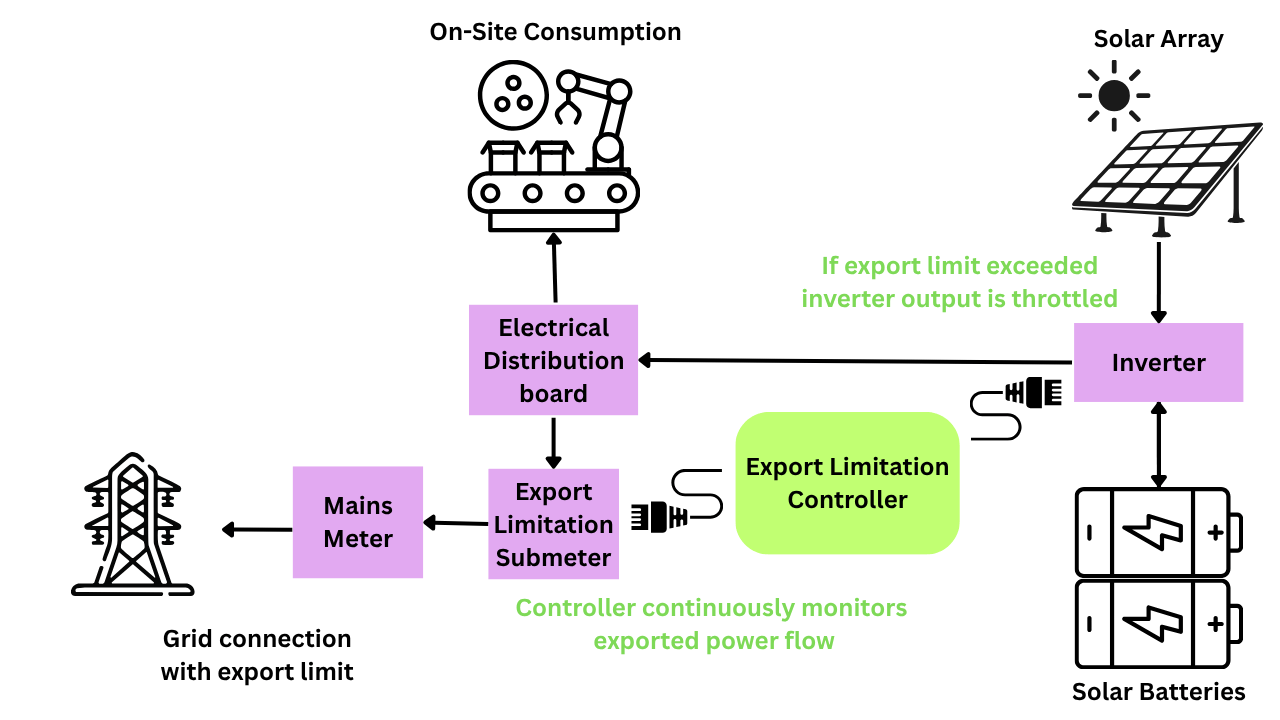
- Measurement: A sub-meter that continuously measures power flows between a commercial property and the grid.
- Controller: An approved controller device that uses measurement data to command inverters and/or battery systems to adjust output to maintain exports below a defined export limit.
- Failsafe: Defined failsafe behaviour to prevent the export limit being exceeded if any individual component of the system fails.
- Tamper-proof: Physical sealing and password protection for configurable settings of the system to prevent unauthorised adjustment.
- Formal approval: An on-site witness test conducted by an engineer from the DNO confirming the system is functioning correctly.
Why export limitation exists in the electricity network
Most domestic and commercial properties in Britain are connected to a regional low-voltage electricity distribution network.
These electricity distribution grids were designed based on a pre-renewables model where large-scale coal, gas and nuclear power stations fed power into the high-voltage national grid. This national backbone moves power across the country, feeding into regional distribution networks. On the distribution networks, the voltage is stepped down at substations to gradually lower-voltage networks that supply local homes and businesses.
The grid hasn’t been designed to support microgeneration, where generation occurs at a local level, reversing the overall flow of power.
When a business exports power through its connection to the grid, it increases the voltage locally and causes the electricity supply to neighbouring properties to be delivered at greater than 230V (nominal UK voltage).
An export limit requirement on commercial solar panels is used to ensure that exports from a single property do not cause the local supply to exceed the statutory upper voltage limit (253V), above which electronic equipment may be damaged.
💡Read our guide to voltage optimisation for businesses to understand how businesses can adapt to high mains voltage.
How an export limitation system works
This section explains how a G100 compliant export limitation system works to maintain grid exports below an agreed level.
Power measurement
Export limitation systems rely on a power measurement device installed at the business electricity connection with the local grid. It is typically installed next to the mains business electricity meter.
The power measurement device continuously monitors the power flow through the mains connection. The device typically measures both active power (in kW) and reactive power (in kVAr).
For more information on power measurement devices, read our guide to sub-metering for businesses.
Communicating to a controller
The measurements taken by the power measurement device are automatically communicated to a controller system.
Compliant controllers for export limitation include the following devices:
- Inverters with export limitation logic
- Dedicated controller hardware
- Energy Management Systems for larger installations
The Energy Networks Association website provides a comprehensive list of compliant and non-compliant Export Limitation devices.
Adjusting solar output
If the power measured through the connection with the grid approaches or exceeds the agreed limit, the controller will automatically make the following system adjustments:
- Charge an on-site commercial solar battery — To reduce the power being exported to the grid, the controller will instead use excess electrical energy to charge any available on-site batteries.
- Throttle solar inverters — The export limitation system throttles back the inverters so that solar generation is reduced.
G100 compliant export limitation systems must make system adjustments to reduce grid exports within five seconds of the export limit being exceeded.
Optimising business setup around export limitation
When an export limitation system throttles inverter output, any excess solar generation is lost.
This has a direct impact on the net business electricity prices paid, since the business’s earnings under the Smart Export Guarantee (SEG) scheme will be limited.
This section explains how a business can optimise its energy setup to prevent this waste.
Battery storage capacity
Adding battery storage capacity to a commercial solar system is the most effective way to avoid losses due to export limitations.
Where battery storage capacity is available, an export limitation system can charge the batteries rather than throttle the inverter and waste the excess generation.
The stored solar energy can later be sold back to a business energy supplier under the SEG scheme at night, when there is no solar energy generation.
💡Battery storage capacity can also help to reduce business energy costs by storing solar energy during off-peak periods and selectively using it as an alternative to grid power during peak periods. Find out more in our guide to peak shaving for businesses.
EV charging integrations
Businesses with electric vehicle fleets can use the strategic timing of charging to absorb excess generated solar power when the export limit is approached.
A carefully configured Energy Management System can automatically instruct EV chargers to increase their charging rate during periods of sunny weather, when solar generation is highest.
Solar system size planning
In general, the price per kWh a business can receive under the Smart Export Guarantee scheme is significantly lower than the import price it will pay in a business electricity bill.
Accordingly, maximising return on investment on a commercial solar system is best achieved by sizing the solar array to match the site’s actual electricity consumption.
In the most efficient systems, grid export is only needed on rare occasions, such as bank holidays, so losses from export limitation are minimal.
For more information, visit our full guide on return on investment for commercial solar systems.
Export limitations for businesses – FAQs
Our business energy experts answer the key questions about export limitations for businesses.
What does a G100 export limitation system cost for a business?
The total cost of a G100 export limitation system for a commercial solar installation varies considerably depending on system size and complexity.
As a rule of thumb, export limitation adds around 5% to overall commercial solar installation costs.
What is a G100 export limitation scheme?
A G100 export limitation scheme is another name for an Export Limitation Scheme.
See above where we explain what’s involved in an Export Limitation Scheme.
Can export limits be increased?
An export limit can only be changed with written agreement from the Distribution Network Operator.
Increasing an export limit typically requires contributing to upstream network reinforcement.
Network reinforcement is an expensive option and will typically only be viable for high-capacity solar systems that plan to sell their electricity through a solar PPA.
What is the difference between export limitation and curtailment?
Export limitation and curtailment are two methods used by grid operators to protect infrastructure from too much intermittent renewable power, however they work in different ways.
Export limitation imposes a hard export limit on a specific microgenerator. In contrast, curtailment provides greater control by instructing a particular generator to disconnect from the grid at particular times.
Curtailment is often used for large-scale UK wind farms, which can overwhelm the ability of the national grid to distribute power during windy conditions.
Find out more in our guide to wind curtailment.
Does export limitation vary depending on location?
Yes, the export limitation applied by grid operators varies by location because it depends on local grid characteristics.
Export limitation is the result of an engineering calculation based on the physical characteristics of the specific section of the distribution network serving a particular site.
This means that G99 applications for identical solar systems can be given different export limitation requirements, even if both are connected to the same regional electricity distribution network.
Can a system still generate full power if export is restricted?
Yes, an export limitation scheme does not limit how much solar power can be generated; it simply restricts the maximum power that can be exported to the grid.
This means that solar power generated on site can be used directly or stored for later use in solar batteries.
 Back to blog
- Share: