
Business energy audit
Discover how much your business can save on energy costs
Just enter your business postcode…
 Our use of cookies
 This website uses cookies to ensure you get the best experience on our website, to read more about the cookies we use, please read our cookies policy here.
Necessary cookies enable core functionality such as security, network management, and accessibility. You may disable these by changing your browser settings, but this may affect how the website functions.
Discover how much your business can save on energy costs
Just enter your business postcode…
Start saving now
A commercial energy audit is an assessment of how a business uses electricity and gas across its site, systems, and operations. Its purpose is to identify where energy is being used inefficiently and where consumption and costs can be reduced without disrupting day-to-day activities.
Rather than focusing on how much energy a business buys, an audit looks at how that energy is actually consumed. This includes equipment, operating patterns, and supporting systems such as heating, lighting, and IT equipment.
The outcome of a commercial energy audit is a clear set of opportunities to improve business energy efficiency. These may range from simple behavioural or setup changes through to more strategic upgrades. The depth of insight depends on the type of audit carried out.
Below are the main types of commercial energy audit, each suited to different business needs:

A self-guided review that helps businesses assess their own energy use using a structured checklist. It focuses on spotting common sources of energy waste, inefficient settings, and easy improvements that are often overlooked in day-to-day operations.
Best suited to small businesses or organisations looking for a low-effort starting point.

A detailed on-site assessment carried out by a business energy expert, using site data and technical analysis. This type of audit provides deeper insight and supports decisions around larger energy-saving investments.
Best suited to larger or energy-intensive businesses that want robust recommendations backed by evidence.

A focused audit that looks at one system or area only, such as heating, lighting, refrigeration, or manufacturing equipment. It is used where a business already knows where issues exist, but does not need a full site-wide audit.
Best suited to businesses with specific energy concerns or limited budgets.

An audit focused on commercial gas bills and business electricity bills rather than physical systems. It reviews tariffs, charges, usage patterns, and meter data to identify errors, inefficiencies, or opportunities to reduce costs.
Best suited to businesses looking to lower energy costs without needing to invest in operational or equipment changes.

An assessment of whether on-site generation, such as commercial solar panels or wind, could be suitable for a business. It considers site constraints, usage patterns, and potential impact on long-term energy costs.
Best suited to exploring green business energy options as part of their wider business energy procurement strategy.

A regulatory energy compliance audit assesses and documents how a business uses energy to meet legal reporting obligations such as ESOS and SECR. It creates a clear, auditable record of energy use across sites and systems, rather than focusing purely on cost savings.
Best suited to larger organisations and public sector bodies with mandatory reporting obligations.
Undertaking a business energy audit is most effective when approached as a structured review rather than a one-off task. The goal is to understand how energy is used across the business, identify inefficiencies, and decide what level of action is appropriate.
Below, we set out the practical steps involved in undertaking a business energy audit and the different ways businesses typically approach it.
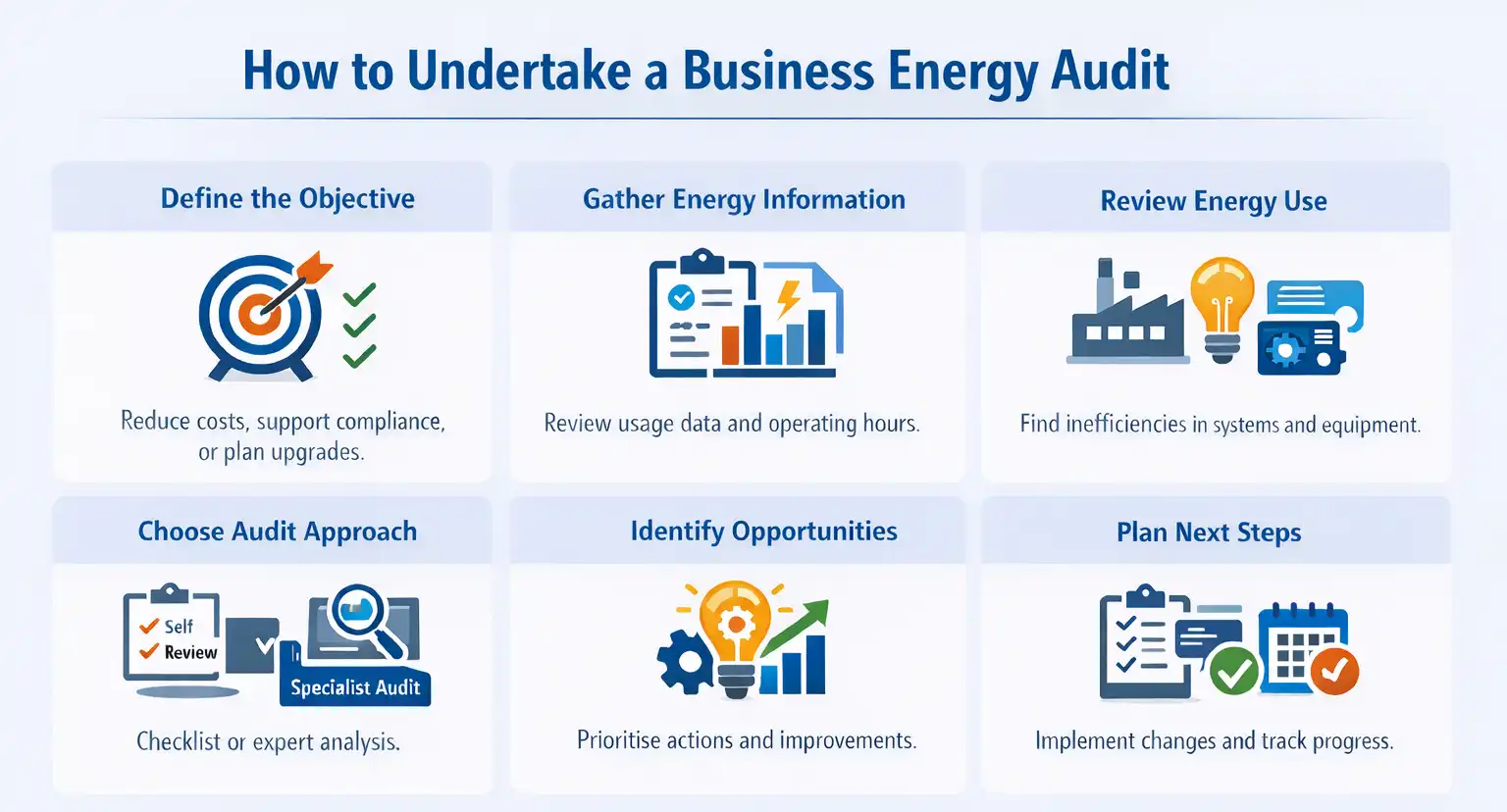
Before undertaking a business energy audit, it is important to set the scope and purpose of the review. This means being clear about what the business wants to achieve, whether that is reducing business electricity rates, supporting compliance, or informing future investment decisions.
At this stage, the focus is on context rather than analysis. You should understand how the site operates, including opening hours, occupancy levels, seasonal variation, and any known operational constraints. This helps ensure the audit reflects how the business actually functions.
You should also identify which sites, buildings, or areas are in scope. For multi-site businesses, deciding whether to audit everything at once or prioritise certain locations can make the process more effective.
Once the scope is set, the next step is to analyse how energy is actually being used across the business using available data. This often involves reviewing information from business energy monitoring systems, along with consumption data captured through sub meters and main site meters.
Looking at detailed usage data makes it easier to understand when energy is being consumed, which areas or systems are driving demand.
The way a business undertakes an energy audit depends on its size, energy usage, and objectives.
Some businesses begin with a self-review using a business energy audit checklist. This approach helps highlight obvious issues and quick wins, and provides a clearer view of whether a more detailed audit is needed.
Others choose to engage an energy audit specialist from the outset. This is more suitable for energy-intensive operations, complex sites, or where findings need to support investment decisions.
A phased approach is also common, starting with a checklist or high-level review and progressing to a more detailed audit once priorities are clear.
Once inefficiencies are identified, the next step is to decide which actions to pursue. Some improvements can be made quickly through operational changes, while others may require longer-term investment.
Not every recommendation needs to be implemented immediately. Documenting findings creates a clear roadmap for prioritising actions over time and aligning energy improvements with wider business plans.
A business energy audit should be viewed as a starting point. Its value lies in using the findings to eliminate unnecessary business energy consumption, manage risk, and improve energy use in a practical and measured way.
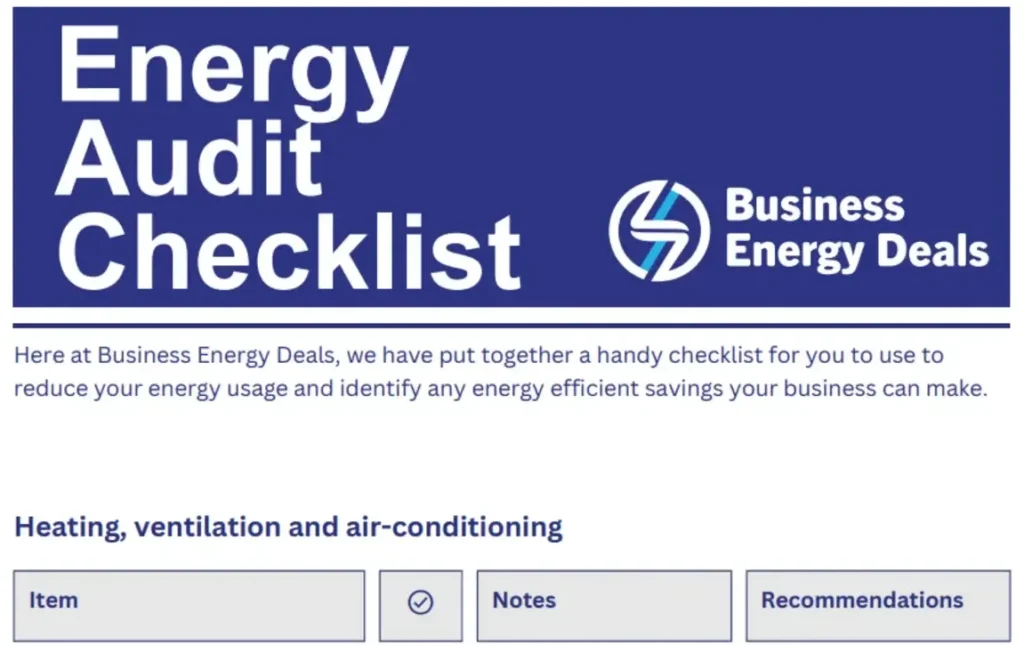
Many businesses can start a business energy audit without hiring a professional auditor by using the free checklist we’ve created.
Our checklist is designed to help businesses review how energy is used across their premises and identify common sources of waste and inefficiency. It is particularly well-suited to small commercial properties, such as offices, where there is no specialist machinery or complex equipment.
Click here for our: Free Business Energy Audit Checklist
Professional commercial energy audits are typically delivered by established business energy suppliers and specialist energy audit firms. These audits go beyond high-level reviews, providing site-specific insight, technical analysis, and formal reporting that can support cost reduction, compliance, and long-term planning.
Below are examples of well-known providers that offer professional commercial energy audit services in the UK.
E.ON business energy, provides commercial energy audits designed to help businesses understand how energy is used across their sites and where inefficiencies exist. Their service commonly begins with a review of historical consumption data, followed by an on-site assessment carried out by an experienced energy manager.

SSE business energy offers professional commercial energy audits delivered by a nationwide team of engineers and technical specialists. These audits are often used by larger or more complex organisations where energy use spans multiple systems, buildings, or processes.
The cost of a professional business energy audit varies depending on the size and complexity of the business being assessed. Rather than a fixed price, audit costs are typically influenced by the factors below.

Larger commercial buildings or businesses with multiple sites generally cost more to audit. This is because more areas, systems, and usage patterns need to be reviewed, increasing the time and resources required to complete the assessment.

Businesses that rely on specialist or energy-intensive equipment, such as manufacturing, refrigeration, or food processing, usually require a more detailed audit. These environments often need auditors with specific technical expertise, which can increase the overall cost.
The type of energy systems in place can also affect cost. Sites with integrated technologies such as solar panels or advanced controls may require a more complex assessment. However, businesses using energy management systems already have granular usage data available, which can streamline the audit process and help keep costs lower.
Below are the most common findings identified during business energy audits, grouped by whether they can be addressed quickly or require longer-term planning.
These findings are typically operational rather than technical. They do not require major investment but can have an immediate impact on energy use and costs.

Audits often reveal heating, lighting, or equipment running when buildings are unoccupied. This is common in offices, retail units, and mixed-use sites.
What businesses usually do next: Review timers, controls, and shutdown procedures to align energy use with actual operating hours.
Poorly configured heating or cooling systems frequently lead to overheated or overcooled spaces. This increases energy use and affects comfort.
What businesses usually do next: Adjust set points, zoning, and control settings to better reflect occupancy and use.

Older lighting systems or lights left on in low-use areas are a frequent finding, particularly in corridors, storage areas, and external spaces.
What businesses usually do next: Improve lighting controls and replace older, inefficient systems with LEDs.

Audits often show that energy waste is linked to habits rather than equipment, such as ad hoc use of heaters or inconsistent shutdown routines.
What businesses usually do next: Introduce clearer operating guidance and basic energy awareness measures.
These findings typically require planning, budget, or phased implementation. They are common in older buildings or energy-intensive sites.

Many audits uncover systems that no longer match how a space is used, often due to changes in layout, occupancy, or operating hours.
What businesses usually do next: Assess upgrade options or reconfiguration to improve efficiency and control.

Poor insulation, uncontrolled air leakage, or ageing windows can significantly increase heating and cooling demand.
What businesses usually do next: Prioritise upgrades that stop heat escaping and provide the best value.

A common finding is that businesses cannot easily see when or where energy is being used, making it difficult to manage or improve performance.
What businesses usually do next: Install a system of sub-meters to isolate the energy consumption of key processes of business functions.

In sectors such as manufacturing, food processing, or refrigeration, audits often identify older or inefficient equipment as a major driver of energy consumption.
What businesses usually do next: Optimise operating schedules and maintenance in the short term, then plan phased equipment upgrades where the savings justify the investment.
A business energy audit helps organisations understand how electricity and gas are used across their premises and where unnecessary consumption occurs. Acting on audit findings typically delivers benefits in three key areas.

A business energy audit highlights where electricity and gas are being used inefficiently. An audit allows businesses to identify and eliminate avoidable usage that is causing unnecessarily high commercial electricity and business gas prices.
While audits focus on reducing usage, many businesses also reduce costs by reviewing tariffs. Using business electricity comparison or business gas comparison services alongside an audit can help businesses switch business energy onto more competitive rates without operational changes.

For large business energy users and public sector organisations, energy audits play an important role in meeting compliance obligations.
While most businesses are not legally required to carry out a business energy audit, for large organisations, the Energy Savings Opportunity Scheme and Streamlined Energy and Carbon Reporting schemes require organisations to assess energy use, identify significant areas of consumption, and demonstrate that efficiency opportunities have been considered.
A business energy audit also helps reduce unnecessary emissions by cutting wasted energy at the source. Improving the efficiency of systems that rely on natural gas supply lowers the amount of gas consumed for heating and hot water, directly reducing emissions.
Electricity use also carries an indirect emissions impact. The national grid still relies heavily on gas power stations to generate electricity, meaning that reducing electricity demand lowers associated emissions across the wider energy system.