 Our use of cookies
Energy Management Systems: Features, types and costs for businesses
For many UK businesses, electricity costs are driven as much by when power is used as by how much, and that’s where Energy Management Systems (EMS) deliver their greatest value.
This guide explains how an EMS works to monitor, control and optimise energy consumption. Here are the key parts of our guide:
- How Energy Management Systems work
- Key functions of an Energy Management System
- Types of Energy Management Systems
- Key components of an Energy Management System
- Costs of commercial energy management systems
What is an Energy Management System?
An Energy Management System (EMS) is a combination of software and hardware that helps to monitor, control, and optimise how electricity is used across a commercial property or portfolio of sites.
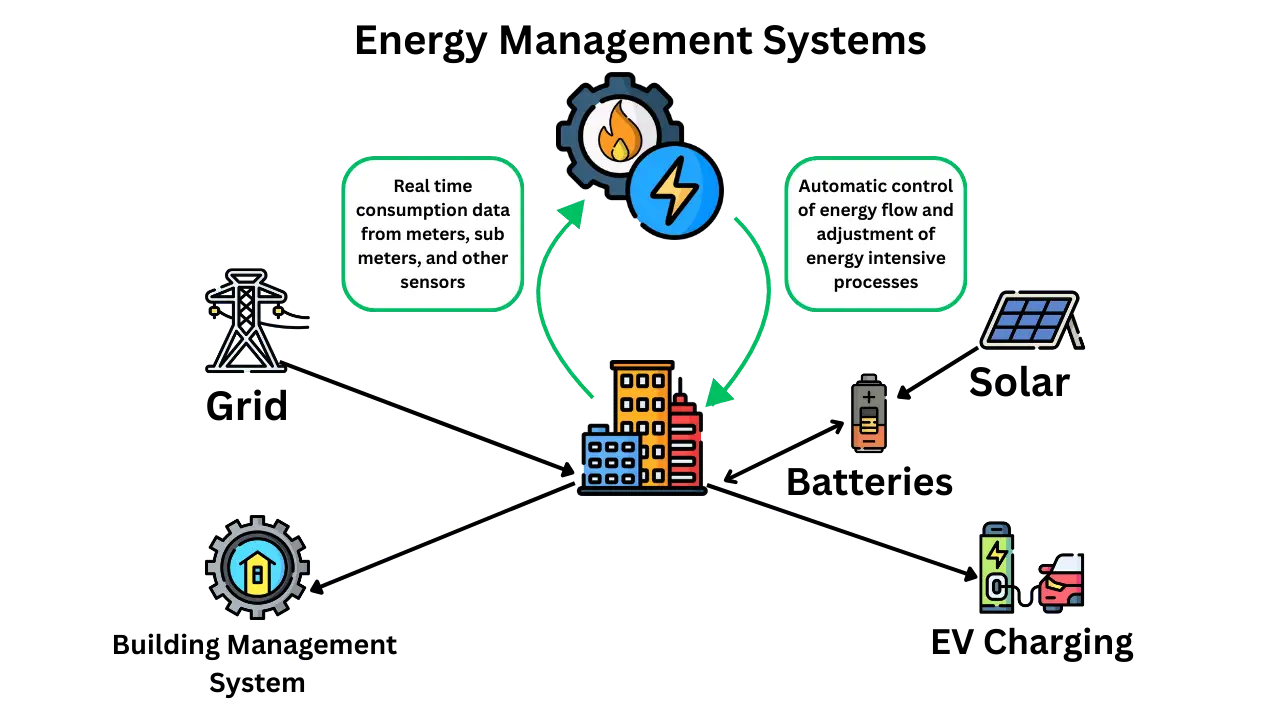
An EMS gives businesses visibility and control over their energy usage. It collects real-time data from meters, sensors, and equipment, analyses how and when energy is consumed, and then either provides recommendations or automatically adjusts systems to reduce energy consumption and cut costs.
How Energy Management Systems work
The following step-by-step process explains how an Energy Management System works to optimise electricity usage. This process runs on a continuous loop, allowing energy performance to improve over time.
1. Data collection
An EMS collects real-time data from on-site electricity meters, sub-meters, sensors, and connected building or industrial systems.
The measurement devices installed for an EMS are configured to provide the software with high-resolution data, allowing it to understand where, when and how energy is being used.
2. Data aggregation and transmission
Data from meters and sensors are gathered by on-site gateway devices, which aggregate readings from multiple sources and transmit them securely to an EMS platform.
Gateways translate industrial communication protocols and ensure reliable data flow, even in complex or multi-site environments. Gateway devices transmit aggregated real-time data off-site via a broadband connection.
3. Analysis and decision making
The EMS analyses collected data against historical usage patterns, electricity tariffs, and operational constraints, such as maximum import capacity.
Using predefined rules and optimisation algorithms, the system identifies inefficiencies, predicts peak demand, and determines the most cost-effective way to use electricity from the grid, on-site generation, and energy storage.
4. Automatic control and recommendations
Based on its analysis, the EMS can issue recommendations and automatically adjust connected systems, depending on how it is configured.
Using connected smart switches, power control units, or integrations with building management systems, an EMS can automatically adjust energy-intensive processes.
Cloud-based EMS software provides management dashboards, automatic reports, and alerts to help businesses improve their energy performance.
Key functions of an Energy Management System
Energy Management Systems offer a number of functions that enable businesses to optimise their electricity consumption, drive down costs, and minimise carbon emissions.
This section summarises the key capabilities of an Energy Management System.
Monitoring performance
All EMS systems include business energy monitoring software to measure and analyse power consumption at a property.
Energy monitoring provides real-time analytics and visualisation of energy performance, helping to identify inefficiencies and optimise business operations.
The monitoring functionality of an EMS can also provide alerts for abnormal behaviour, such as sudden spikes in consumption from failing equipment.
Time of use optimisation
An EMS can automatically control the use of electricity in a commercial building to take advantage of multi-rate business energy tariffs.
An EMS analyses past consumption data to plan energy usage and schedule energy-intensive operations, such as data backups or the use of heavy machinery, at optimal times.
The system can also strategically use commercial solar batteries or bi-directional EV charging to minimise the electricity drawn from the grid during expensive peak periods.
Peak shaving
Businesses with half-hourly meters pay excess demand charges when peak power demand exceeds the Maximum Import Capacity agreed with their local distribution network operator.
An Energy Management System helps your business avoid excess demand charges by shifting the timing of non-essential processes and utilising energy storage.
Find out more in our full guide to peak shaving for businesses.
Optimisation of generated power
Commercial properties with renewable energy generation have an intermittent source of power, with output dependent on weather conditions.
An EMS employs a smart algorithm to determine how to use this power most effectively.
Commercial operations will use generated power directly during peak periods to avoid the most expensive business electricity prices. During off-peak periods, however, generated power will be stored for future peak periods.
If an EMS detects that energy storage is fully utilised, the system exports excess generated electricity back to the grid under the Smart Export Guarantee scheme.
Device controls
An Energy Management System can provide remote and automatic control of energy-intensive devices or systems. Typical examples include air conditioning, heating, lighting, and industrial equipment.
The EMS optimises the energy usage of these systems by using feedback from IoT sensors, such as motion, lighting, or temperature sensors.
Energy forecasting and scenario planning
An Energy Management System can provide forecasts of energy demand and costs using historical consumption data and operational patterns, such as building occupancy.
This forward-looking insight helps improve decision-making when planning a business energy procurement strategy.
Demand flexibility incentives
An EMS is a valuable tool for taking advantage of the demand flexibility service.
The demand flexibility scheme provides financial rewards for reducing power demand when requested by the national grid.
An EMS allows businesses to control non-critical activities and utilise energy storage to minimise power consumption during demand flexibility events.
Types of Energy Management Systems
Energy Management Systems (EMS) vary widely in scope and complexity, with different types designed to address specific operational needs, from managing a single building’s energy use to coordinating energy strategies across multiple sites or facilities.
The table below shows the most common types of EMS offered to businesses in the UK:
| EMS System Type | Acronym | Purpose |
|---|---|---|
| Building Energy Management System | BEMS | Optimises energy use in buildings by controlling HVAC, lighting, and other systems. |
| Industrial Energy Management System | IEMS | Manages and reduces energy consumption in industrial processes and manufacturing facilities. |
| Home Energy Management System | HEMS | Manages residential energy use, integrating smart devices and renewable energy sources. |
| Renewable Energy Management System | REMS | Optimises the generation, storage, and use of renewable energy sources like solar and wind. |
| Enterprise Energy Management System | EEMS | Centralises energy management across multiple facilities or sites in an organisation. |
| Agricultural Energy Management System | AEMS | Manages energy use in agriculture, such as irrigation, greenhouse climate control, and machinery. |
| Campus Energy Management System | CEMS | Manages energy use across university or corporate campuses, integrating renewables and smart tech. |
In practice, many commercial EMS platforms combine features from several system types. For example, a Building Energy Management System may also manage on-site renewables and energy storage, while an Enterprise Energy Management System typically aggregates data from multiple building-level systems.
Key components of an Energy Management System
An Energy Management System relies on two-way communication between a variety of on-site hardware devices and cloud-based software. Here’s a summary of the different types of components that are typically used in an EMS:
Measurement hardware
The decision engine of an EMS relies on collecting real-time data from the following types of devices installed across a commercial property.
Electricity meters
An EMS can receive real-time consumption data from the following types of business electricity meters:
- Main meters – Half-hourly or smart meters installed by business energy suppliers to measure the consumption of an entire property.
- Sub-meters – Additional meters installed to measure the consumption of a specific electrical circuit or piece of equipment.
- Generation meters – Devices that measure the output from on-site commercial solar panels.
Electrical sensors
In addition to metering devices that measure power consumption, EMS systems can also receive data from devices that measure other aspects of an electrical supply.
- Voltage sensors – Devices that monitor incoming voltage to detect fluctuations or poor power quality.
- Voltage optimisation units – Devices that optimise the voltage of a grid connection and provide both input and output data for an EMS.
- Power quality analysers – Devices that measure harmonics, reactive power, and phase imbalance of an incoming power supply.
Environmental sensors
EMS systems can receive data from internal environmental sensors that help to explain why energy is being used. This can include:
- Temperature sensors
- Occupancy and motion sensors
- Light intensity sensors
Control devices
An EMS can be configured to automatically control the following types of devices that influence how electricity is used.
Energy flow hardware
This hardware manages how electricity flows between different sources and uses, including:
- Commercial solar batteries – Instructing a Battery Management System to charge or discharge.
- Renewable power control – Directing power flow from renewables between energy storage, on-site usage, and exporting to the grid.
Control systems
Control devices allow an EMS to adjust devices that consume power. Examples include:
- Smart plugs – Used to turn off individual appliances or office equipment.
- Lighting control systems – Used to reduce lighting in rooms with no occupancy.
- Building Management Systems – Used to control air conditioning and heating systems.
Communication hardware
An EMS relies on a Local Area Network to facilitate the connection between sensors, meters, control devices, and the central EMS platform, using the following communication hardware:
Gateway device
A gateway device is a piece of hardware that acts as a translator, aggregator, and traffic controller between on-site energy hardware and the EMS software platform. A gateway device can translate many different industrial communication protocols before securely sending the data to the EMS platform.
Network infrastructure
An EMS typically relies on connections to local area network infrastructure to transmit data, such as Wi-Fi access points or Ethernet switches. The data is sent to a cloud-based EMS software provider using a broadband connection.
EMS software platform
An EMS typically uses a centralised software platform to process data, provide insights, and facilitate control.
Modern EMS software platforms are usually cloud-based, analysing data at an off-site, centralised server location.
Identifying if your business needs an Energy Management System
For most micro business energy customers, the cost and time required to install an EMS may not significantly improve energy efficiency. Instead, we recommend reading our list of business energy efficiency tips for cheaper and more immediate solutions.
For larger organisations, the following key questions can help you determine whether your business could benefit from an EMS.
What is the size of your energy bill?
If energy costs represent a significant portion of your operating expenses, an EMS can likely help reduce them.
If energy costs are smaller, we recommend using our business electricity comparison service to provide a quicker solution for reducing your bills.
Do you operate energy-intensive equipment?
If your business uses energy-intensive equipment, such as air conditioning, refrigeration, machinery, or EV charging, you are more likely to benefit from the control that an EMS offers.
Do you have a three-phase power supply?
If your connection to the grid is a 400V three-phase power supply, typically used for energy-intensive properties, you are more likely to benefit from the optimisation recommendations of an EMS.
Learn more in our guide to single-phase versus three-phase power supplies.
Do you have multiple energy sources?
If you use renewable energy, energy storage, or backup generators, an EMS can help coordinate these sources effectively.
Are you required to report on energy usage or emissions?
An EMS simplifies tracking and reporting for sustainability programmes or regulations, which is beneficial for businesses that need to comply with Streamlined Energy and Carbon Reporting (SECR) or the Energy Savings Opportunity Scheme (ESOS).
Implementing an Energy Management System
Implementing an EMS is a significant investment, involving the purchase of hardware, labour, and software licences.
The time and cost required for implementation depend on the size and complexity of your power consumption.
To help you understand what is involved, we have summarised the five key steps required to implement an EMS.
Step 1: Energy audit
In the UK, there are several different types of EMS platforms to choose from, each designed for different use cases.
The best way to select an EMS platform is to understand the energy-intensive processes and equipment used by your organisation.
We recommend conducting an energy audit to gain this understanding. Visit our business energy audit page for a free checklist to guide you through the process.
Step 2: Vendor selection
Vendor selection is a critical step in implementing an Energy Management System, as platforms vary significantly in capability, scalability, and compatibility.
Businesses should assess whether an EMS provider can integrate with existing meters, building management systems, and on-site generation or storage.
Choosing a vendor with proven experience in similar commercial environments helps ensure the system can be deployed effectively.
Step 3: Hardware installation
An effective EMS typically requires the installation of control devices, sensors, and sub-meters at your site.
An EMS provider will typically advise what equipment is required, where it should be installed, how devices will communicate, and which loads, generation assets, or batteries will be controllable.
A qualified electrician, appointed by your EMS provider or separately, will be required to install additional devices at your site. Find out more in our guide to sub-metering for businesses.
Step 4: Connect to EMS platform
Sensors, meters, and control devices are connected to an on-site gateway device, which aggregates data from across the site and translates it into a format the Energy Management System can process.
The gateway communicates securely with the EMS platform over the local area network, using a wired or wireless connection.
Step 5: EMS configuration
Configure the EMS to meet the requirements of your commercial property, including:
- Automation rules: Schedule equipment that the EMS controls, such as lighting, heating, and air conditioning.
- Import capacity: Set the maximum import capacity for each power connection (MPANs).
- Multi-rate tariff: Define peak and off-peak timings as agreed with your business energy suppliers.
- Configure alerts: Establish consumption thresholds for automatic alerts.
A final commissioning and testing step ensures that all meters, sensors, gateways, and control devices are installed correctly, data is accurate, and automation rules operate safely and as intended under real operating conditions.
Costs of commercial energy management systems
A contract for deploying an EMS typically includes both upfront costs, covering the work and equipment required during installation, and ongoing subscription costs.
This section explains how EMS costs work and the key factors that impact pricing.
Upfront EMS costs
There are four key aspects of work and cost typically required during the installation of an Energy Management System:
- System design – A plan from the EMS vendor that includes hardware architecture and gateway configuration.
- Hardware costs – Providing sub-metering equipment, environmental sensors, control devices, and gateway devices.
- Installation – Sending a qualified electrician to install the required hardware.
- Commissioning – Testing and validation of the EMS to ensure data accuracy.
The upfront costs quoted for an EMS installation vary widely, depending on the number of properties and the complexity of their electrical systems.
Recurring EMS costs
Most EMS platforms available to UK businesses use a software subscription model, typically charged:
- Per site
- Per meter or data point
- Per controlled asset (e.g. battery, EV charger)
The monthly recurring subscription covers cloud hosting, data processing, and software updates.
Additional recurring add-ons include ongoing performance reviews and access to a support desk.
Return on investment
Although an EMS can require a significant upfront investment, it is designed to deliver a measurable return by targeting the most expensive aspects of a business electricity bill.
By reducing peak demand charges, optimising energy use against time-of-use tariffs, and improving the utilisation of on-site generation, an EMS typically generates ongoing savings that outweigh its cost over time.
For energy-intensive or half-hourly metered businesses, these savings are often recurring, meaning the system continues to deliver value long after the initial investment has been recovered.
 Back to blog
- Share: