 Our use of cookies
What is an MPAN? A guide to supply numbers for businesses
Whether you are switching energy suppliers or checking your business electricity bill, understanding your MPAN is essential. An accurate MPAN is vital for ensuring that your business pays for the electricity your company actually uses.
This guide explains what an MPAN number is, where to find it, how to read it, and why it is important for managing your business energy contract and comparing business electricity prices.
What is an MPAN?
An MPAN (Meter Point Administration Number) is a unique reference that identifies the electricity supply at a specific property.
The MPAN represents the electricity connection for your premises on the grid and allows business energy suppliers to accurately manage your supply details, billing, and switching information.
You might also hear it called a Supply Number or S-Number on your electricity bill. Unlike your meter serial number, which relates to a physical device, the MPAN refers to the actual electricity supply point registered to your address.
If you are switching business energy suppliers, your MPAN is one of the key details needed to complete the transfer of your supply smoothly and without delay.
What is an MPAN number used for?
Your MPAN number plays a key role in managing your electricity supply. It is used across several essential processes in the energy industry, including:
- Tariffs and billing: Each electricity tariff is linked to a specific MPAN to prevent billing errors or duplicate charges.
- Supplier switching: The MPAN ensures the correct supply point is transferred when you move to a new energy supplier.
- Meter identification: It links a physical electricity meter to a specific electricity connection, which is especially important for properties with multiple occupiers.
- Smart meter installations: Installers use the MPAN to confirm the right supply is connected when fitting a smart business energy meter.
- Energy data tracking: The MPAN ties your supply to usage data, helping businesses monitor business energy consumption.
Getting the MPAN right on your contract helps prevent billing mistakes or delays when switching suppliers.
Where to find your MPAN number
If you need to locate your MPAN, there are a few easy ways to find it, even if you do not have access to your bill or know who your supplier is.
On your electricity bill
The most reliable place to find your MPAN number is on your business electricity bill. It is usually displayed in a box labelled ‘Supply Number’, often near your account or meter details. It is a 22-digit number split across two lines. A bill will also confirm the supply address related to the MPAN.
On your electricity meter
In some cases, you will find your MPAN number on meter labels. This is more common in older installations or where engineers have used on-site labelling.
From your energy supplier or DNO
If you cannot find your MPAN on your bill or meter, contact your current energy supplier. They can confirm it using your account details or address.
You can also contact your local Distribution Network Operator (DNO), the company that manages the electricity grid in your area. Each DNO keeps a full record of all MPANs on their network. If you are unsure who your DNO is, use the Energy Networks Association’s lookup tool to find the right contact.
How to read your MPAN number
An MPAN is displayed as two lines of numbers on your electricity bill. Each part provides different information about your supply.
The diagram below shows what information is contained within each part of the MPAN.
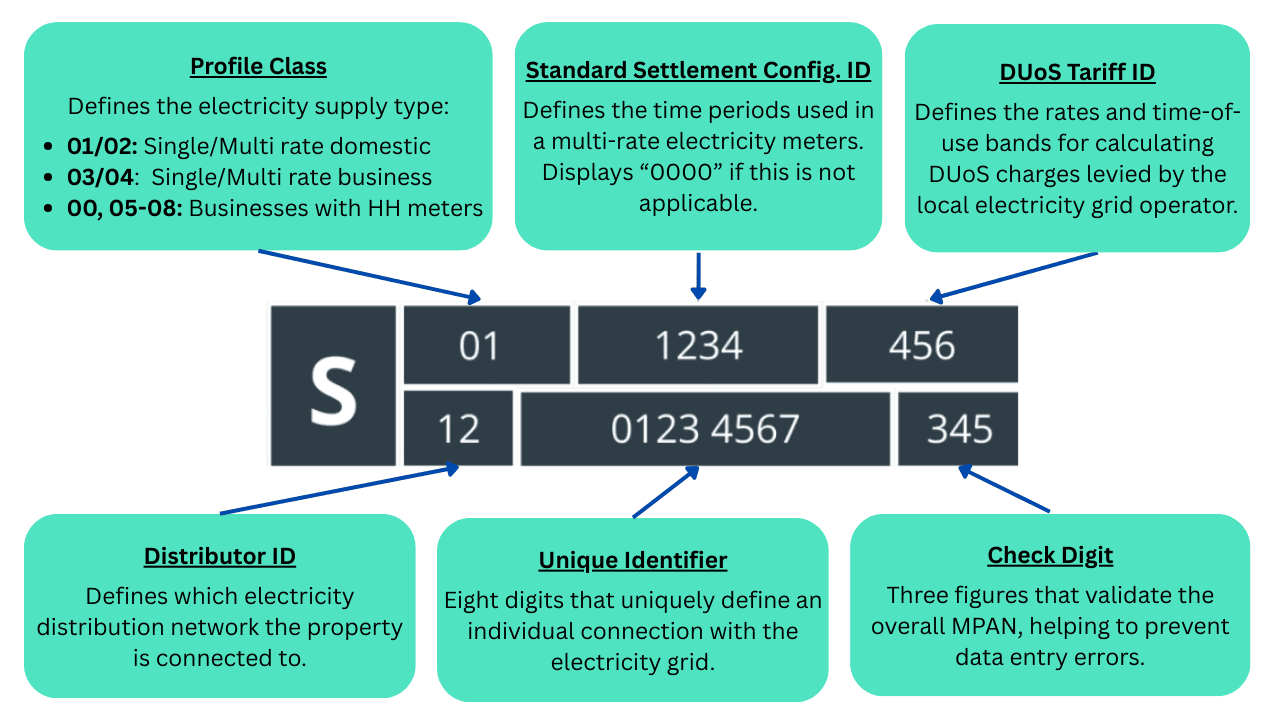
MPAN top-line
The nine-digit top line of an MPAN contains information about the characteristics of your electricity connection. It consists of the following three elements:
MPAN profile class
The first two digits of an MPAN are called the profile class. This indicates the type of property or supply being served.
The table below shows the different profile classes used across electricity connections in Great Britain.
| Profile class | Type of supply | Description |
|---|---|---|
| 00 | Half-hourly supply | Used for highly energy-intensive commercial properties, typically with a half-hourly electricity meter. |
| 01 | Domestic single-rate | Standard household supply charged at one rate. |
| 02 | Domestic multi-rate | Homes with tariffs such as Economy 7. |
| 03 | Business single-rate | Commercial properties charged at a flat rate per kWh. |
| 04 | Multi-rate business supply | Businesses where electricity costs vary by time of use, often linked to a multi-rate business electricity meter. |
| 05–08 | Larger commercial supply | Energy-intensive sites with a Maximum Import Capacity over 100 kVA and a half-hourly electricity meter. |
Standard settlement configuration ID
The next four digits of the MPAN are called the Standard Settlement Configuration ID (SSC) and identify how an electricity meter is configured to record electricity consumption.
It is primarily relevant for older Economy 7 and Economy 10 meter types, defining the periods during which the meter records “peak” and “off-peak” electricity consumption.
These digits often display “0000” for newer smart meters configured to record and transmit separate meter readings every half hour.
DUoS tariff ID
The next three digits are called the DUoS tariff ID and categorise the type of electricity connection within the local distribution network.
These figures define how DUoS charges for using the local electricity network are calculated. DUoS charges are paid by your energy supplier and are typically incorporated into domestic and business electricity standing charges.
MPAN bottom line
The bottom line of your MPAN is a 13-digit number unique to your electricity supply point.
Suppliers, network operators, and billing systems use this reference to ensure the correct supply is registered to your account.
The table below shows the three components of the MPAN bottom line:
| Element | Description |
|---|---|
| Distributor ID | The first two digits identify your Distribution Network Operator, or Independent Distribution Network Operator. |
| Unique identifier | The next eight digits uniquely identify your supply point. |
| Check digit | The final three digits validate the MPAN and help prevent entry errors. |
Changes to the MPAN top line
In September 2025, the top-line section of the MPAN used across the retail electricity market was updated to display different information.
The change was made in preparation for the Market-wide Half-Hourly Settlement reform, which is overhauling how energy suppliers purchase electricity.
The following changes were made:
- The 3-digit Meter Time Switch Code (MTC) was replaced with the 4-digit Standard Settlement Configuration ID (SSC).
- The Line Loss Factor Class (LLFC) was renamed the DUoS tariff ID.
What does the MPAN change mean for my business?
The change to the MPAN number has no impact on your electricity connection, contracts, or the tariff your business pays.
The only effect most businesses may notice is the change to how the MPAN appears on their electricity bill.
Neither business nor domestic customers need to take any action regarding the change to the MPAN at their properties.
Why energy suppliers need your MPAN
When using a business electricity comparison service or speaking to a new supplier, you will likely be asked for your MPAN. This is because it identifies the exact electricity supply point connected to your property.
Providing your MPAN allows suppliers to:
- Retrieve the correct technical and usage data for pricing.
- Confirm that the right supply point is being transferred.
- Prevent delays or an erroneous transfer during the switch process.
- Ensure your new contract starts on the correct supply point.
By sharing your MPAN upfront, suppliers can provide accurate quotes and complete the switching process quickly.
Business energy brokers also use your MPAN to retrieve tailored prices from trusted business energy suppliers, helping you find the best deal available.
MPAN numbers and data privacy
Your MPAN is not classed as personal or confidential information, but it is linked to a specific supply address. For that reason, it should always be handled with care to protect your account and prevent misuse.
To protect your account:
- Avoid publishing your MPAN publicly, such as on invoices or online documents.
- Never share it outside of secure channels when arranging new contracts.
- Only provide it to licensed suppliers or brokers registered with the Energy Ombudsman.
All MPAN information is stored within secure national databases such as ECOES, which can only be accessed by licensed energy providers under strict controls.
MPAN supply number – FAQs
Still have questions about your MPAN number? Our experts answer the most common questions about MPAN numbers.
Can I switch suppliers without my MPAN?
It is best to locate your MPAN before switching. Most suppliers and comparison services can find it using your business address and postcode, but having it ready helps prevent errors and ensures the switch is processed quickly.
Is the MPAN the same as the meter serial number?
No. The MPAN identifies the electricity supply point, while the meter serial number refers to the physical meter at your premises.
Think of the MPAN as your property’s address within the national electricity network, and the meter serial number as the label on the actual device recording your usage. If you arrange a new business electricity meter installation, your meter serial number will change, but your MPAN will remain the same.
Can I have more than one MPAN at my business address?
Yes, this is quite common. If your site has multiple meters or separate electricity grid connections, each one will have its own unique MPAN.
For example, a business with a large commercial building or energy-intensive equipment may have individual MPANs for separate connections to the mains supply.
If you are unsure how many MPANs are registered to your property, your electricity supplier or energy broker can check this for you.
What’s the difference between MPAN and MPRN?
An MPAN refers to your electricity supply, while an MPRN (Meter Point Reference Number) relates to your gas supply.
Both are unique identifiers used by suppliers to manage your connection, billing, and switching process. You will typically find your MPAN on your electricity bill and your MPRN on your business gas bill. If you use both fuels at your premises, you will have at least one MPAN and one MPRN.
 Back to blog
- Share: