 Our use of cookies
How voltage optimisation works for businesses
Voltage optimisation can be a quick and effective way to reduce your business’s energy bills and carbon emissions by up to 12%, while also extending the lifespan of your electronic equipment.
However, it’s not the right fit for every business. Voltage optimisation works best for commercial properties with voltage-sensitive equipment and where the grid connection consistently delivers over 235 volts.
This guide will help you determine whether your business can benefit from voltage optimisation and calculate your potential savings. Here’s what we cover:
- How voltage optimisation works
- How voltage optimisation affects different types of electrical loads
- Types of voltage optimisation units for businesses
- Voltage optimisation costs
- Voltage optimisation savings and payback period
What is voltage optimisation?
Voltage optimisation is a technology designed to reduce your incoming mains voltage to the optimal level needed by your electrical equipment.
In Britain, the grid typically supplies around 240 volts, whereas most appliances are designed to operate most efficiently at around 220 to 230 volts. This excess voltage leads to wasted energy, unnecessary heat generation, and increased wear on your equipment.
A voltage optimisation system automatically regulates and lowers the voltage supplied to your building to the most efficient level. This helps reduce electricity use, cut your business energy bills, and extend the lifespan of your electrical equipment.
How voltage optimisation works
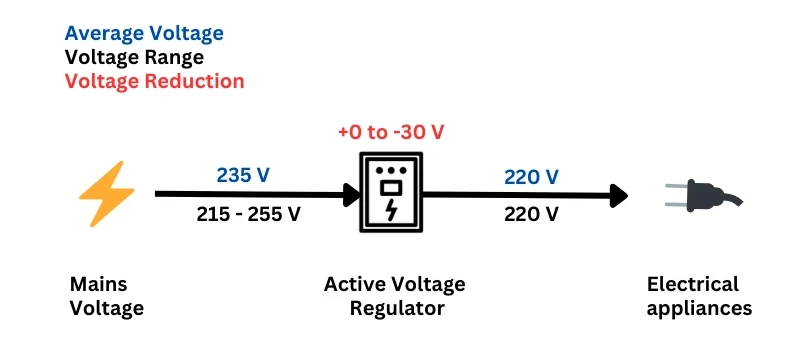
This section explains how a voltage optimisation unit regulates and reduces the voltage of a business’s electricity supply to the optimal level.
1. Incoming mains voltage
In Britain, the supply voltage of the national grid is 230V with a tolerance of +10% / -6%, meaning voltages can vary from 216V to 253V.
The voltage level at a property depends on the local electricity network infrastructure. Sites located close to an electrical substation often receive a higher average voltage, sometimes as high as to 240V.
Supply voltages are also affected by demand from nearby properties, which means the incoming voltage to a property can fluctuate throughout the day.
The voltage levels mentioned above apply to single-phase supplies, but fluctuating or higher-than-optimal voltages are also common on 400V three-phase power connections.
2. Voltage optimisation unit
A voltage optimisation (VO) unit is a metal-enclosed cabinet installed between the incoming mains supply and the mains distribution board. Its function is to adjust and regulate the incoming voltage from the grid so that it matches the optimal operating level for your equipment.
When electricity enters a site at a higher voltage than necessary, the VO unit automatically reduces it to the optimal level using transformers or electronic controls. This ensures that all connected systems receive a stable and efficient power supply.
Some VO systems also monitor voltage in real time and respond to fluctuations, keeping the output voltage constant even as the grid supply varies.
3. Output voltage
The output from a voltage optimisation unit connects directly to your building’s main electrical distribution board (also known as the switchboard). All circuits and equipment supplied from that board then receive power at the optimised voltage level.
For larger commercial properties, the output of the VO unit may be connected to specific sub-boards or key circuits to provide more targeted voltage optimisation.
How voltage optimisation affects different types of electrical loads
The impact of voltage optimisation depends on the types of electrical equipment (referred to as loads) in use at your business.
Some electrical loads are highly sensitive to voltage and can achieve noticeable energy savings, while others already regulate voltage internally, meaning optimisation makes little or no difference.
This section explains the three most common types of electrical load used in commercial properties and how each responds to voltage optimisation:
Resistive loads
Resistive loads are the simplest type of electrical equipment and the most impacted by voltage reduction.
In resistive equipment, power consumption is proportional to the square of the voltage, so small reductions in voltage produce a significant reduction in energy consumption.
Here are some typical examples of resistive loads used in British commercial properties:
| Device Type | Examples |
|---|---|
| Incandescent Lighting | Halogen lamps, traditional filament bulbs |
| Electric Heaters | Space heaters, panel heaters |
| Immersion Heaters | Equipment used to heat water |
| Kitchen equipment | Electrical ovens, grills and toasters |
Inductive loads
Inductive loads are pieces of electrical equipment that deliver a fixed mechanical output regardless of small changes in voltage.
When the voltage is reduced to the optimal level, the motor operates more efficiently, drawing less current and generating less heat. This reduces both energy consumption and equipment wear.
Here are some typical examples of inductive loads used in British commercial properties:
| Device Type | Examples |
|---|---|
| Induction Motors | HVAC fans, pumps, lifts, compressors |
| Refrigeration Equipment | Commercial fridges, freezers, cold rooms |
| Fluorescent Lighting | T8/T12 tubes with magnetic ballasts |
| Laundery Equipment | Washing machines and tumble dryers |
Electronic loads
Electronic loads are pieces of equipment that can regulate their own supply voltage. They draw only the power they need, regardless of incoming voltage.
Voltage optimisation has little or no impact on the energy consumption of electronic loads.
Here are some typical examples of electronic loads used in British commercial properties:
| Device Type | Examples |
|---|---|
| LED Lighting | Modern LED panels or bulbs |
| IT equipment | Office PCs, network equipment, servers |
| Audio-Visual Equipment | Televisions, projectors, sound systems |
| EV charging | When EV chargers that use onboard electronics to manage power delivery |
Types of voltage optimisation units for businesses
Voltage optimisation systems are available in several configurations, each designed to suit different site conditions and levels of voltage variation. The main types (fixed, dynamic, and solid-state) all perform the same basic function of reducing incoming voltage, but they differ in how precisely they control it.
The table below summarises the key characteristics of each type, including how they work, their advantages and limitations, and the kinds of commercial sites they are best suited to.
| Type | How it works | Advantages | Disadvantages | Best for |
|---|---|---|---|---|
| Fixed Voltage Optimisation | Reduces incoming voltage by a fixed percentage (typically 4–6%), lowering the average supply to around 220V. | Simple, low-cost, reliable, and easy to install. | Does not adapt to voltage fluctuations, so may under-supply during low-voltage periods. | Sites with consistently high mains voltage and equipment not highly sensitive to small voltage changes. |
| Dynamic Voltage Optimisation | Monitors and adjusts output voltage in real time to maintain a set target level (e.g. 225V). | Provides stable, efficient voltage even under varying grid conditions and delivers consistent savings. | Higher upfront cost; more complex to install and commission. | Sites with variable supply voltages or sensitive electronic equipment. |
| Solid-State Voltage Optimisation | Uses advanced electronic controls for precision regulation and can also provide reactive power optimisation. | Offers the highest accuracy and efficiency. | Most expensive option; requires more space and may need a temperature-controlled environment. | Large or complex sites with three-phase supplies or critical voltage-sensitive loads. |
Voltage optimisation costs
A voltage optimisation system requires a significant upfront capital investment, which should pay for itself over time through long-term reductions in energy consumption.
The cost of a system typically depends on the capacity of the specific business electricity connection and the type of system used. Here are indicative prices for single VO unit installations:
| System Type | Typical Cost Range (Installed) |
|---|---|
| Fixed VO Unit | £3,000 – £10,000 |
| Dynamic VO Unit | £7,000 – £25,000 |
| Solid-State VO Unit | £20,000 – £50,000+ |
The prices above include hardware and installation, based on indicative supplier pricing from UK VO manufacturers and commercial installation case studies.
Voltage optimisation maintenance costs
Voltage optimisation systems require minimal maintenance and should continue to operate for between 15 and 25 years before replacement becomes necessary.
Most businesses enter into a support contract with their VO provider, typically costing a few hundred pounds per year, to carry out basic annual checks.
Voltage optimisation savings and payback period
Installing a voltage optimisation system can save businesses between 7% and 12% on the unit charges in their business electricity prices.
We recommend reading the section below on how to assess the suitability of voltage optimisation to understand whether your business is likely to benefit from it.
A well-matched voltage optimisation system can pay for itself in under three years through reduced energy costs and will continue to deliver savings for two decades or more.
The calculator below allows you to estimate the annual savings and payback period for installing a voltage optimisation unit for your business.
The savings available from voltage optimisation increase in proportion to:
- Annual power consumption in kWh
- The average unit cost paid to your business energy supplier.
💡At Business Energy Deals, we specialise in helping companies reduce their energy costs. Use our business electricity comparison service today to find out how much you can save.
How voltage optimisation differs from other energy saving methods
Voltage optimisation is one of several technologies and approaches available to improve business energy efficiency. This section compares voltage optimisation to other energy-saving methods.
Voltage optimisation vs power factor correction
A power factor correction unit is another device that can be installed at the point of a grid connection.
Instead of reducing the supplied voltage, a power factor correction unit reduces the flow of reactive current supplied to inductive loads.
Instead of reducing active power consumption measured in kWh, power factor correction reduces reactive power consumption and charges.
Voltage optimisation vs equipment replacement
Modern devices used in commercial properties are typically significantly more energy efficient than older equivalents.
For example, replacing fluorescent lighting with a modern LED equivalent will typically deliver savings of 50-80%.
Voltage optimisation reduces the supplied voltage to equipment, whereas replacing equipment with newer, more efficient models allows the equipment to do the same work while consuming less power, regardless of the supplied voltage.
Voltage optimisation vs variable speed drives
Variable speed drives (VSDs) are devices fitted to electrical motors that regulate their speed and power consumption. They allow motors to slow down and consume less power when full speed is not required, significantly reducing energy consumption.
This differs from voltage optimisation, which reduces the voltage supplied to devices rather than the amount of work those devices are performing.
How to assess the suitability of voltage optimisation
Voltage optimisation is typically only beneficial for your business if your site consistently receives mains voltage above 235V and uses energy-intensive equipment that is sensitive to voltage fluctuations.
This section explains how to determine whether these conditions apply to your business.
Assess electrical equipment for voltage optimisation
A voltage optimisation unit will only be beneficial at a property using voltage-sensitive equipment.
Some equipment is highly sensitive to voltage and can achieve noticeable energy savings, while other equipment already regulates voltage internally, meaning optimisation makes little or no difference.
The table below shows the potential energy savings from voltage optimisation for different types of equipment:
| Device Type | Examples | Load Type | Energy Savings Potential |
|---|---|---|---|
| Incandescent Lighting | Halogen lamps, traditional filament bulbs | Resistive | High |
| Electric Heaters | Space heaters, panel heaters | Resistive | High |
| Induction Motors | HVAC fans, pumps, lifts, compressors | Inductive | Medium to High |
| Refrigeration Equipment | Commercial fridges, freezers, cold rooms | Inductive | Medium |
| Fluorescent Lighting | T8/T12 tubes with magnetic ballasts | Inductive | Medium |
| LED Lighting | Modern LED panels or bulbs | Electronic | Low |
| Computers & Servers | Office PCs, network equipment, data centres | Electronic | Low |
| Audio-Visual Equipment | Televisions, projectors, sound systems | Electronic | Low |
For more information on assessing the relative energy use of electrical equipment, visit our guide to business energy consumption.
Overall power demand
Investing in voltage optimisation equipment is typically not worthwhile for micro business electricity customers with low power demand, as the potential savings are likely to be minimal.
Instead, we recommend considering voltage optimisation solutions for properties with a Maximum Import Capacity exceeding 100 kVA and a half-hourly energy meter.
Power quality assessment
Before investing in voltage optimisation equipment, it is essential to assess the voltage levels supplied to your property.
Some properties may already receive a stable 220V supply, making voltage optimisation unnecessary.
The voltage supplied to an individual property depends on the local infrastructure of your distribution network operator and the power demand from other nearby properties.
A professional power quality assessment involves connecting a voltage data logger to your mains supply to continuously measure voltage variability over a representative period of one or two weeks.
If the recorded voltage is consistently:
- Above 235V: Voltage optimisation is likely to deliver significant savings.
- Within 220–235V: Voltage optimisation may offer only limited benefits.
Advantages and disadvantages of voltage optimisation
Here’s a quick overview of the main benefits and considerations of voltage optimisation for commercial sites.
Reduced energy consumption
Common electrical equipment, such as lighting and heating, consumes significantly less energy when supplied with electricity at the optimal voltage level.
Using a voltage optimisation system can reduce the energy consumed at a commercial property, as recorded by a business electricity meter, by up to 12%.
Business electricity bills are calculated based on these meter readings, so a VO unit can lead to substantial reductions in energy costs.
Extended equipment lifespan
When voltage is consistently supplied above the optimal level, it accelerates wear and failure in motors, lighting, transformers, and air conditioning systems.
Voltage optimisation helps equipment last longer, reducing maintenance and replacement costs.
Efficiency and sustainability goals
Installing a voltage optimisation system can support a business’s sustainability goals by reducing the carbon emissions associated with power consumption.
The British electricity grid still relies heavily on gas power stations, which produce CO₂ emissions in proportion to the power they generate. Voltage optimisation reduces the number of kilowatt hours (kWh) consumed, thereby minimising the carbon emissions associated with electricity generation.
The reduction in carbon emissions is particularly beneficial for large businesses participating in the following schemes:
- Energy Savings Opportunity Scheme (ESOS) – Voltage optimisation helps reduce the energy intensity ratio of commercial activities.
- Streamlined Energy & Carbon Reporting (SECR) – Voltage optimisation systems reduce kWh energy consumption and the associated carbon emissions.
Installation complexity and space requirements
Voltage optimisation systems must be installed by a qualified electrical engineer. The installation process usually involves temporarily shutting off power to the property, which may cause a brief disruption to operations.
Additionally, VO units can occupy a substantial amount of space within a plant room or switchgear area.
Voltage optimisation FAQs
Our business energy experts answer common questions about voltage optimisation.
Does voltage optimisation reduce kWh or just lower voltage?
Voltage optimisation reduces both. Lowering the supplied voltage to your equipment is the mechanism, but the result is a genuine reduction in kilowatt-hour (kWh) consumption as recorded by your electricity meter.
This is because most electrical equipment consumes less power when voltage is supplied at the optimum level.
The exception is electrical equipment that already has internal power regulation, which will consume broadly the same number of kWh regardless of the voltage supplied.
How can some equipment use more current when the voltage is reduced?
Inductive loads, such as motors and compressors that are designed for a fixed mechanical output, can draw more current if the supplied voltage drops below their design rating.
Increased current can generate heat in motor windings and shorten equipment lifespan.
A correctly installed voltage optimisation system will be configured to reduce voltage to 220 V without falling below the design rating of the equipment.
How common is overvoltage in commercial buildings?
Overvoltage is widespread in the UK. Industry surveys and voltage audits carried out by voltage optimisation providers suggest that the majority of UK commercial properties receive an average supply voltage above 230 V, and a significant proportion consistently receive above 235 V.
Overvoltage tends to be more pronounced during periods of low local demand, such as nights and weekends, when less power is being drawn from the local grid.
 Back to blog
- Share: