
Business gas prices
Compare October 2026 Business Gas Prices and Save up to 45% Today
Just enter your business postcode…
 Our use of cookies
 This website uses cookies to ensure you get the best experience on our website, to read more about the cookies we use, please read our cookies policy here.
Necessary cookies enable core functionality such as security, network management, and accessibility. You may disable these by changing your browser settings, but this may affect how the website functions.
Compare October 2026 Business Gas Prices and Save up to 45% Today
Just enter your business postcode…
Start saving now
Wholesale gas prices have risen sharply in 2026 due to a restriction in global natural gas supplies caused by the conflict in Iran.
Fixed gas prices available on the market are currently highly volatile.
Use our business gas comparison service to find the current fixed rates available on the market to protect your business today against market uncertainty.
Below, you’ll find the latest average one-year fixed gas rates for October 2026.
| Size | Annual Consumption kWh | 1 Year fixed gas rate p/kWh |
|---|---|---|
| Small | 10,000 to 50,000 | 11.3 |
| Medium | 50,000 to 100,000 | 10.8 |
| Large | 100,000 + | 10.6 |
The chart below shows how fixed business gas prices have changed over the past 24 months.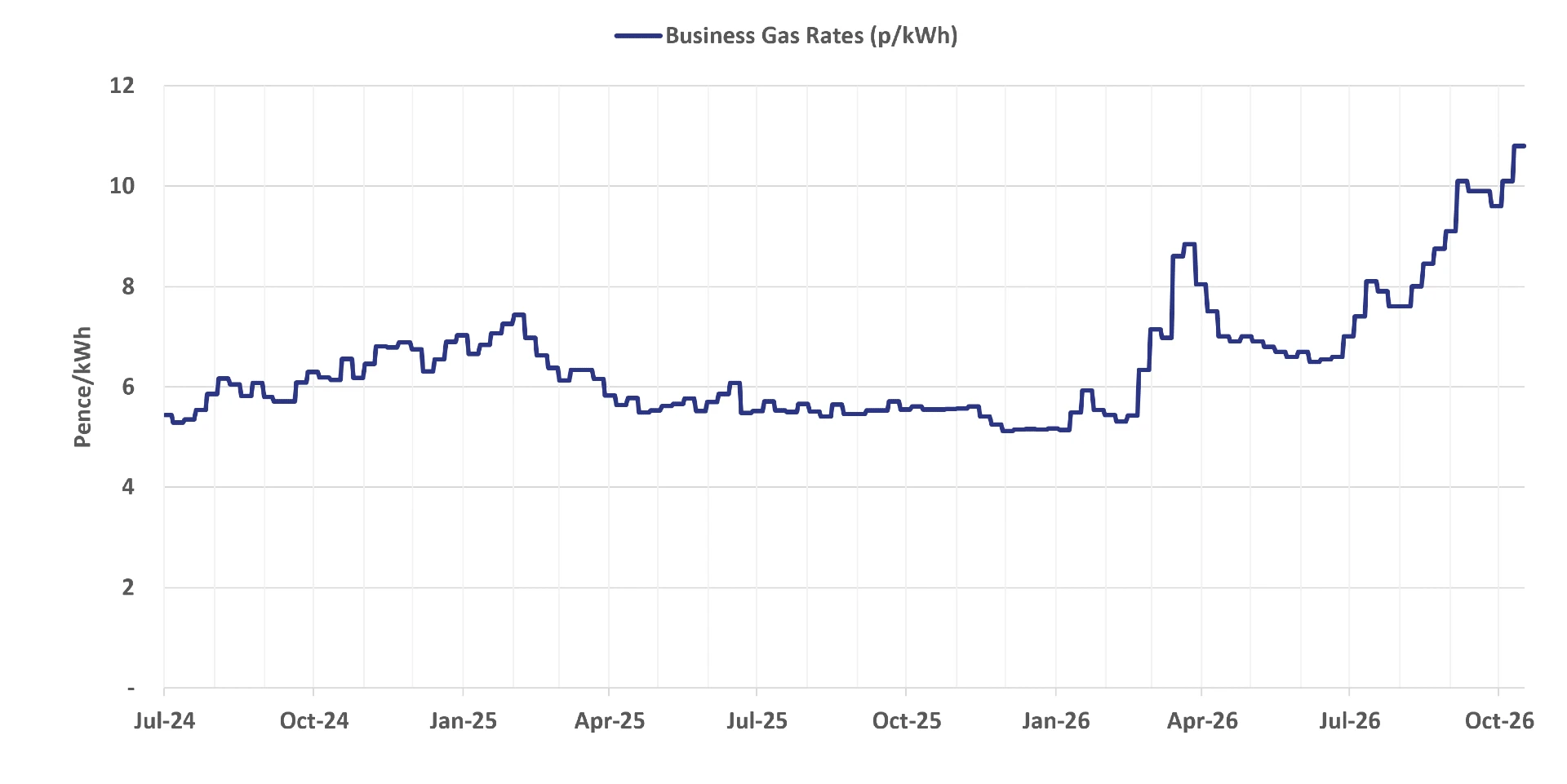
Sources: Our current business gas prices data has been compiled using:
The table below shows the average business gas rates per kWh paid by companies with one-year fixed gas contracts. The data shows average rates in 2026, and compares them to prices from the previous three years.
| Size | Annual Consumption kWh | 2023 average rates p/kWh | 2024 average rates p/kWh | 2025 average rates p/kWh | 2026 average rates p/kWh |
|---|---|---|---|---|---|
| Small | 10,000 - 50,000 | 8.91 | 6.42 | 6.36 | 7.91 |
| Medium | 50,000 - 100,000 | 8.51 | 5.92 | 5.86 | 7.41 |
| Large | 100,000 + | 8.36 | 5.72 | 5.66 | 7.21 |
Source info: Our average business gas price data has been compiled using:
Securing the best commercial gas rates doesn’t have to be complicated. Here are three effective strategies to maximise your savings:

Lock in fixed prices when market conditions are favourable to avoid future price increases.

Bundle your gas and electricity with one supplier to simplify your energy costs.

Save more by selecting a longer-term contract tailored to your business needs.
Get the cheapest business gas prices with our hassle-free service
Just enter your business postcode…
Start saving now
Several factors influence the cost of a business gas supply, often causing fluctuations from month to month or year to year. Understanding these can help you make better decisions when arranging your gas tariffs.

Business gas suppliers purchase natural gas from producers and European and LNG importers. The most important determinant of gas quotes is the prices that suppliers can secure when purchasing gas to supply your business.

Business gas quotes are typically fixed for between one and three years. Suppliers usually offer a discount for longer contracts to reward loyalty; however, this also depends on the market’s expectations of future gas prices.

Regional gas distribution networks and independent gas transporters charge distribution fees that vary based on the location of your commercial property.

Gas suppliers incorporate a profit margin into their business gas quotes. When a supplier is seeking to grow their business, they may offer more competitive quotes at a lower profit margin to attract new customers.

Some business gas suppliers offer green commitments, such as sourcing a percentage of your gas from biogas or purchasing green gas certificates. Green commitments typically raise the price of business gas quotes.

The capacity of your business gas connection, recorded within your MPRN, determines the fixed charges for maintaining the connection to the local gas grid.

Supply shortages, increased global demand, or geopolitical events can impact the cost of gas. The UK relies on imported gas through the Langeled pipeline, making it vulnerable to these global market changes.

Business gas prices often rise during colder months as demand increases for heating. Conversely, prices may fall during warmer months when demand is lower.
Although business gas rates are billed per kWh, what really matters to your business is the total amount you’ll pay each month. You can estimate this easily using three figures from your latest bill.
You’ll need:
Multiply your usage by the unit rate to find your total energy cost, then add the standing charge for the number of days in the month.
A small business using 2,000 kWh of gas in a 30-day month with a 7.2p unit rate and a 35p daily standing charge would pay:
Choosing the right business gas tariff depends on whether your business values price cost certainty, flexibility, or lower emissions. Most suppliers offer three main tariff types: fixed, variable, and green.

A fixed-rate business gas tariff locks in your unit price for the full contract term, typically one to three years. It provides predictable bills and shields your business from market price spikes, making it ideal if you prioritise cost stability and accurate budgeting.

Variable tariffs track movements in the wholesale gas market. When prices fall, you can benefit from cheaper rates, but when the market rises, your costs increase. This option suits businesses that are comfortable with some risk in exchange for potential savings.

Green gas tariffs supply energy sourced from renewable biogas or offset traditional gas through carbon credits. These contracts help businesses lower their carbon footprint and align with wider green business energy goals.
Flexible energy contracts allow businesses to purchase gas in portions over time rather than locking into a single rate at contract start. You can buy gas from the market at different points, which means you can take advantage of price dips. This option works best for larger businesses with the time and resources to actively manage their energy purchasing.

Pass-through tariffs separate the wholesale gas energy cost from the non-commodity charges, such as network and distribution costs, which are billed at their actual rate rather than bundled into a fixed unit price. This gives businesses greater transparency over what they are paying for.
Below, we answer the most commonly asked questions about business gas prices.
The cost of business gas per kWh depends on several factors, including your supplier, location, tariff type, contract length, and the current state of the wholesale gas market.
Prices fluctuate in line with wholesale market conditions, which means the rate your business pays can vary significantly depending on when you sign a contract. As a general guide, small businesses typically pay between 7p and 12p per kWh, though rates outside this range are possible during periods of market volatility.
For tailored rates that match your business’s needs, use our business energy comparison service to request bespoke quotes today.
Business gas rates are the charges companies pay to use natural gas from the gas mains network.
These rates are outlined in your gas tariff and used to calculate your monthly business gas bill.
Here’s a summary of the different types of business gas rates:
While your gas tariff will detail the main charges, such as the unit price, standing charges, the Climate Change Levy, and VAT, there are additional costs you should be aware of when reviewing your overall gas costs.
For example, you might encounter one-off connection or installation fees if you’re setting up a new gas supply. Some contracts include meter operator fees for installing or maintaining your gas meter, especially if it’s an older advanced business gas meter.
You may also face administrative or service fees for account management and charges for early contract termination or changes to your agreement. In variable tariffs, look out for market adjustment fees that reflect fluctuations in wholesale costs or regulatory changes.
Awareness of these extra costs can help you compare offers more accurately and choose the best deal for your business.
A good business gas rate aligns with current market conditions and offers competitive pricing compared to other suppliers. It takes into account:
In Britain, there are over 30 business gas suppliers competing to offer the best prices. At Business Energy Deals, we specialise in connecting small businesses with the best business gas rates.
Business gas prices are not uniform. Two businesses on the same street can be paying very different rates, and understanding why can help you secure a better deal.
The main factors that influence what your business pays: