Our use of cookies

Heat networks for businesses: District heating, regulations and commercial benefits
Heat networks are shared heating systems, where several homes or businesses are heated by hot water carried through insulated pipes from a central heat source.
This guide explains how heat networks work for businesses. Here’s what we cover:
- District heating and communal heating
- How do heat networks work?
- Heat network billing for businesses and tenants
- Benefits and drawbacks of heat networks
- Heat network operator and supplier responsibilities
What is a heat network?
A heat network is a shared heating system that supplies heat from a central source to several buildings or properties, through a network of insulated pipes carrying hot water.
Heat is generated at a central energy centre, using sources such as gas boilers, combined heat and power (CHP) plants, large heat pumps, energy-from-waste plants, or waste heat from industrial sites, rather than a boiler in each property.
There are estimated to be over 14,000 operational heat network sites in Great Britain, and since 27 January 2026, they have been regulated by Ofgem, giving customers protections similar to those for gas and electricity.
District and communal heat networks
Heat networks fall into two main types, depending on whether they serve a single building, or several across a wider area.
Communal heat networks
Communal heating supplies several units within a single building from a shared heat source, usually in an on-site plant room. It is by far the most common type, making up around 85% of UK heat networks.
It is typical of apartment blocks, student accommodation, office building heating and mixed-use developments.
The landlord or management company usually owns the system, running it directly or through a specialist operator, and recharges occupiers through the service charge or a supply agreement.
Most communal systems run on gas boilers, though newer developments increasingly use heat pumps.
District heat networks
District heating supplies several separate buildings across a wider area, such as a town centre, campus or business park, from one or more large energy centres.
These networks are usually run by specialist operators, local authorities or energy companies, and are often built alongside major developments.
Their scale allows them to use heat sources that would not be viable for a single building such as energy-from-waste plants.
Well-known examples include:
- Sheffield: The city centre network, supplied with heat from an energy-from-waste plant.
- Southampton: A scheme known for using geothermal heat.
- Pimlico, London: One of the UK’s oldest district networks, dating from the 1950s.
- Bunhill, London: A network using waste heat from the London Underground.
How do heat networks work?
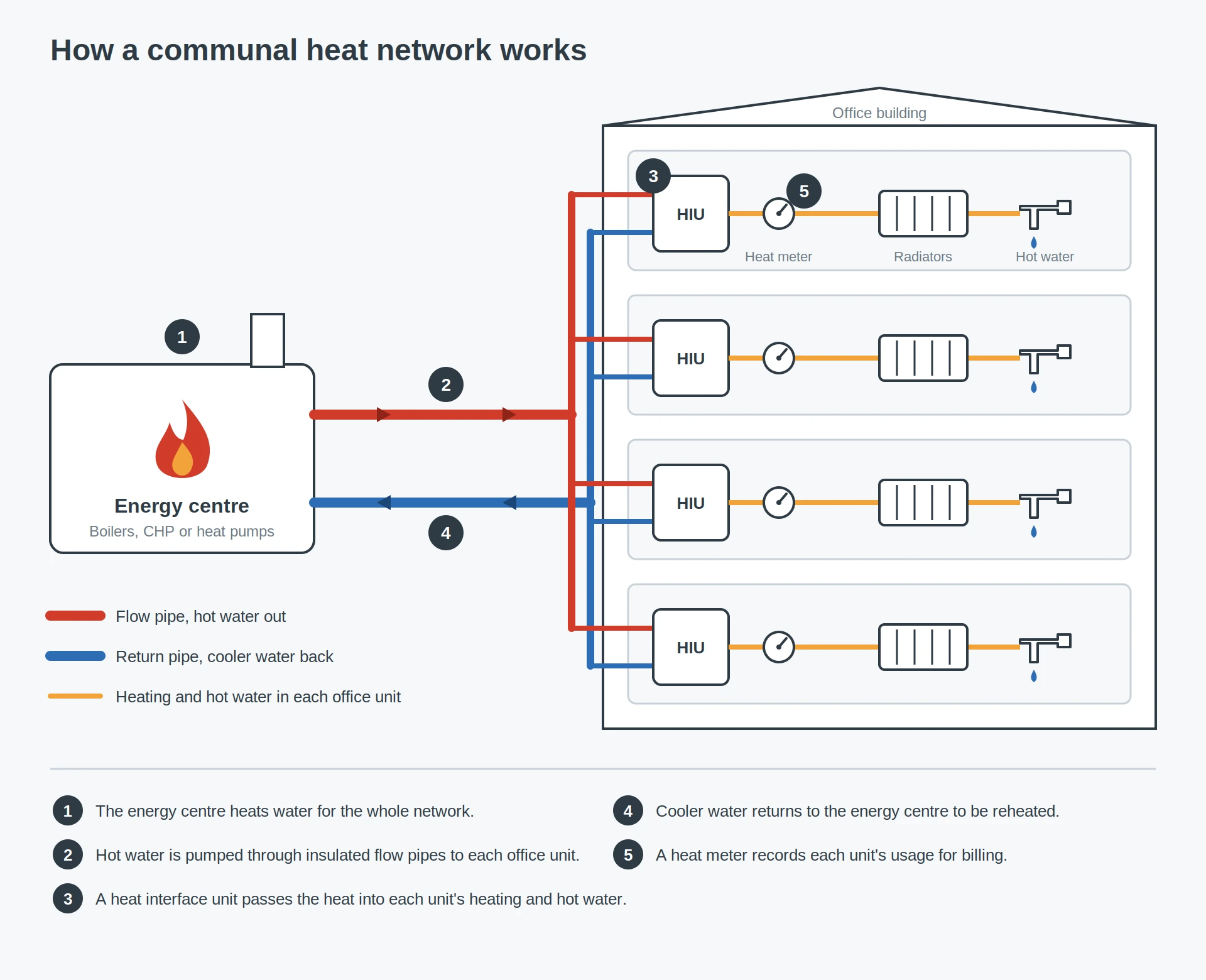
A heat network works as a closed loop, circulating hot water from a central energy centre to the properties connected to it, and back again.
1. Heat is generated at an energy centre
The process starts at a central plant, which heats water for the whole network. This can use gas boilers, a combined heat and power (CHP) plant, large heat pumps, or a source of waste heat, often in combination.
2. Hot water is pumped through insulated pipes
The heated water is pumped through insulated flow pipes, running underground or through the building, to each connected property. The insulation keeps heat losses to a minimum as the water travels across the network.
3. Heat is transferred at each property
Each property has a heat interface unit (HIU), which uses a heat exchanger to pass heat from the network’s water into the property’s own heating system and hot water supply. The two systems never mix, and no fuel is used on site.
4. Cooled water returns to be reheated
Once the heat has been transferred, the cooler water travels back to the energy centre through return pipes, where it is heated again, completing the closed, continuous loop.
5. Heat usage is measured
Heat usage is recorded by heat meters, which calculate the heat consumed in kWh from the volume of water passing through and the temperature difference between the flow and return.
Meters are installed at two levels:
Bulk meters
Bulk meters are installed where a district network enters a building, recording the building’s total heat consumption. The operator bills the building owner on this basis, and the owner recovers the cost from occupiers.
Final customer meters
Final customer meters are installed at each tenancy, whether a unit, floor or section of a building, so each business is billed for its own consumption. Where a bulk meter is also present, these function as sub-meters.
Unmetered properties
Some older buildings have no final customer meters, usually because fitting them has been assessed as not technically feasible or cost-effective.
In these cases, the building’s heat cost is shared between tenancies, either by floor area, or using heat cost allocators, small devices fitted to radiators that estimate each tenancy’s share of the heat.
Heat network billing for businesses and tenants
How a business is billed for heat depends on how its usage is measured, which determines both how its share of the cost is worked out, and who bills it.
How is the cost of heating each unit worked out?
The method used to measure each business’s heat usage determines how its share of the cost is calculated.
Individual heat meters
Where a tenancy has its own heat meter, the business is charged for its metered usage in kWh, plus a standing charge covering the network’s fixed running costs, similar to any business gas bill:
Heat lost in shared pipework, or used in common areas, does not appear on any tenant’s meter, so it is usually recovered through the standing charge or service charge.
Heat cost allocators
Allocator readings are not measured in kWh, but used to compare each tenancy’s share of the building’s heat. The total cost is usually split into a fixed part, shared by floor area to cover heat lost from shared pipework, and a variable part, shared by readings:
As the costs are shared out proportionally, the total always matches the building’s bill.
Unmetered properties
The building’s total heat cost are split by a fixed method, usually floor area:
This means a business with low heating needs can end up paying for heat used by its neighbours.
Who issues the heat network bills?
Heat networks can involve a network operator, a landlord and its tenants. In every case, the tenant ultimately pays for the heat it uses, but the bill can reach it through different routes, depending on how the network is set up:
- Landlord to tenant billing (service charge recharging): Where the landlord owns and runs the heating system itself, it recharges each tenant for heat, usually through the service charge. This is common in communal systems in multi-let buildings.
- Operator to tenant billing (direct supply): Where the tenant has its own supply agreement with the network operator, the operator bills it directly, in the same way as a gas or electricity supplier. This is more common on larger district networks with individual meters.
- Operator to landlord to tenant billing (bulk supply): Where the operator supplies the building’s heat to the landlord in bulk, the landlord then bills each tenant for its share, either separately or through the service charge.
Heat network energy sources
Heat networks can use a wide range of energy sources, often in combination, which affect both the price of heat and its carbon emissions. The most common include:
- Gas boilers: The most common source in Great Britain, particularly in communal networks, offering reliable heat. These use a mains gas connection to deliver natural gas.
- Combined heat and power (CHP): Plants that generate electricity and capture the heat produced in the process, making more efficient use of fuel, though most still run on gas, so their costs also track gas prices.
- Heat pumps: Large air, ground or water-source heat pumps that extract heat from the surrounding environment, using electricity. They are increasingly used in new networks as a low-carbon alternative to gas.
- Energy from waste: Plants that burn non-recyclable waste to generate heat, often supplying large district networks.
- Waste heat: Heat captured from industrial processes or infrastructure, such as factories, data centres or underground railways, which would otherwise be lost.
- Biomass: Boilers burning sustainably sourced wood chips or pellets, used in some networks as a lower-carbon alternative to gas.
- Geothermal: Heat drawn from deep underground, a very low-carbon source, though only viable in certain locations, so it is used in a small number of UK networks.
Many networks combine sources, such as heat pumps for most of the year, backed up by gas boilers at times of peak demand.
Is a heat network worth it for my business?
Most businesses moving into premises with an existing communal heat network do not have a choice, as the network relies on every occupier to share its fixed running costs, and leases usually require tenants to use it.
Only landlords connecting a building to a new district network face a genuine choice.
For tenants, here are the key points to consider before renting or buying a property that uses a heat network:
What does a heat network mean for a business moving in?
Being on a heat network changes how a business pays for and manages its heating:
- No choice of heat supplier: Heat comes from the network’s operator only, so it cannot be switched like gas or electricity, though the business’s electricity can still be switched by comparing business electricity prices.
- Costs set by the network: Heat is billed by the operator or through the service charge, and can cost more or less than an individual boiler or heat pump, depending on the network.
- Shared reliability: Outages or maintenance issues at the energy centre affect every connected property at once.
What should a business check before signing a lease?
Since the heating comes with the property, it is worth reviewing the following before signing:
- The cost of heat: Prices vary widely, with larger, newer networks often competitive with a gas boiler, and older or smaller ones costing more.
- How heat is billed: Usually through the service charge in multi-let buildings, or a separate supply agreement on larger networks, based on individual meters in newer buildings, or a fixed split, often by floor area, in some older ones.
- How prices can change: Prices are typically reviewed annually, and linked to fuel costs or inflation.
- The heat source: The cost of gas-fired networks track business gas prices, while heat pump or waste heat networks are less exposed, and lower the business’s reported emissions.
- Reliability: Older systems are more prone to outages, so it is worth asking about past interruptions and how complaints are handled.
Commercial benefits of heat networks
Heat networks offer several commercial benefits, but also come with trade-offs worth understanding.
Benefits of heat networks
The main benefits for businesses and building owners are:
- No on-site plant: No boiler to maintain and frees up space.
- Lower Scope 2 emissions: Low-carbon energy networks reduce reported emissions from purchased heat, supporting ESG and Streamlined Energy and Carbon Reporting
- Potential cost savings: Economies of scale can deliver heat more cheaply than individual boilers.
- Regulatory resilience: For owners, low-carbon networks help buildings meet tightening energy efficiency standards.
Drawbacks of heat networks
The main trade-offs are:
- No choice of supplier: Each network has a single supplier, so unlike a normal business energy supplier, there is no option to switch to find a cheaper tariff.
- Variable prices: Older, gas-fired or small networks can cost more than an individual boiler or heat pump.
- Shared reliability: A fault at the energy centre affects every connected property at once.
- Long-term commitment: Owners’ heat supply agreements often run for 15 to 25 years or more.
Heat network operators and supplier responsibilities
Since 27 January 2026, heat networks in Great Britain have been regulated by Ofgem, with rules for the organisations that run them, and protections for the customers they supply.
Roles in regulated heat networks
Ofgem’s regulation is built around two regulated roles, the operator and the supplier, which can be held by different organisations or the same one, alongside the customers they serve:
- Heat network operator: Controls the physical system, the energy centre and pipework. This may be the landlord, a local authority, or a specialist energy company appointed to run the network.
- Heat supplier: Provides heat to customers, and is responsible for their contracts and bills. This is whoever bills the customer, whether the operator directly, or a landlord recharging its tenants.
- Customer: The business or household that uses and pays for the heat, protected by Ofgem’s rules whichever organisation supplies it.
Who needs to register a heat network with Ofgem?
Operators and suppliers of most heat networks must register with Ofgem, including landlords that are likely to act as either, for example by running a communal heating system, or recharging tenants for heat.
Existing networks have been automatically authorised, under what is known as deemed authorisation, but must be registered by 26 January 2027, with details of their organisation, ownership, financial resilience and consumer protection arrangements.
Each network must be registered individually, including where district and communal networks are connected.
Heat supplier responsibilities
The supplier is ordinarily the customer’s single point of contact, even where an operator or contractor is involved. Its main responsibilities include:
- Treating customers fairly: Following Ofgem’s standards of conduct in all dealings with customers.
- Clear supply contracts: Providing heat supply contracts that set out the terms of supply.
- Fair pricing: Charging fair prices, under Ofgem’s fair pricing and cost allocation rules.
- Accurate billing: Remaining responsible for bills, even where a third party produces them, with domestic and micro-business customers also protected from back-billing.
- Handling complaints: Resolving complaints, with unresolved cases able to go to the Energy Ombudsman.
Heat network operator responsibilities
The operator is responsible for the network itself, and must also follow Ofgem’s standards of conduct.
This includes running and maintaining the energy centre and pipework, so that heat is supplied reliably and efficiently, with technical standards for operators also being developed by the government.
Heat network regulation enforcement
Ofgem monitors suppliers and operators, and where there is evidence of customer detriment and an unwillingness to address non-compliance, it will take enforcement action.
This can include consumer redress orders, under which an operator or supplier may be required to pay compensation, explain the breach, or vary or terminate the consumer’s contract.
These rules sit alongside existing obligations under the Heat Network (Metering and Billing) Regulations 2014.
Considerations before connecting to a heat network
Connecting to a heat network means linking a building’s heating system to a nearby district network, via a new pipe connection and a substation or heat interface units, so it no longer needs its own boilers.
The opportunity usually arises when a network is built or extended nearby, when a building’s boilers are due for replacement, or during a major refurbishment. New developments may also be required to connect as a planning condition.
For landlords and building owners, it is a long-term decision. The main points to consider are:
- Feasibility: Whether a network with spare capacity runs nearby, and whether the building’s heating system and space can accommodate the connection.
- Costs: The connection charge and building works, and how the ongoing unit rate and standing charge compared with running a boiler or heat pump.
- Contract terms: How long the agreement runs, often 15 to 25 years or more, and how prices can change over time.
- Heat source: Whether the network runs on gas or low-carbon sources, which affects future prices and emissions.
- Regulatory obligations: Landlords that recharge tenants for heat are likely to count as heat suppliers, and must register with Ofgem and follow its rules.
- Heat network zoning: In England, certain buildings in designated zones may in future be required to connect.
Heat networks for businesses FAQs
Our business energy experts answer commonly asked questions regarding heat networks:
Do commercial heat network customers have the same protections as domestic customers?
Homes and micro-businesses receive more protections than larger businesses, as with gas and electricity supplies.
All businesses are covered by Ofgem’s core rules, such as the Standards of Conduct and fair pricing, but protections such as back-billing limits only apply to domestic and micro-business customers.
What happens if a heat network supplier fails?
The heat supply should continue. Ofgem appoints another authorised company to take over the network, similar to the Supplier of Last Resort process for gas and electricity. A special administration regime acts as a final backstop.
Can businesses leave a heat network once connected?
Tenants usually cannot, as their lease typically requires them to use the building’s network. Building owners can leave, but this depends on the terms of their heat supply agreement, which may run for 15 to 25 years or more. Leaving also means paying the capital costs of installing a new system.
What is a self-supply heat network, and is it regulated?
A self-supply heat network is one where an organisation only supplies heat to itself, such as a business or university heating its own buildings on a single site. These networks are regulated by Ofgem, but with fewer obligations, unless they also supply third parties.
Can a heat network serve residential, commercial and industrial buildings?
Yes, a single network can supply homes, businesses and industrial sites, as is common in mixed-use developments and larger district networks. Each type of customer receives the protections relevant to it.
 Back to blog
- Share: