 Our use of cookies
Combined heat and power (CHP) for businesses: How cogeneration systems work
Businesses in Britain pay electricity and gas rates that are significantly higher than those in most other European countries. Installing an on-site combined heat and power (CHP) unit offers businesses with high heating and electricity demand a way to bring these costs under control.
By generating electricity and useful heat simultaneously from a single fuel source, CHP systems can convert up to 90% of their fuel into productive energy, delivering significant cost savings.
This guide explains how CHP systems work and the opportunity they present for businesses. Here’s what we cover:
- How combined heat and power systems work
- Types of combined heat and power systems
- Why businesses use combined heat and power systems
- How combined heat and power compares to conventional energy supply
- Combined heat and power system costs and other considerations
What is combined heat and power (CHP)?
Combined heat and power (also known as cogeneration) is a technology that generates electricity and useful heat simultaneously from a single fuel source.
Unlike a conventional energy supply, where electricity is generated at a remote power station, and an on-site boiler produces heat, a CHP unit does both jobs at once, using a single gas-fired engine or turbine located at or near the site.
On-site CHP units are widespread across commercial, industrial and public sector sites in Britain. According to Government statistics, there are over 2,000 large-scale CHP units operating in the UK, with combined output accounting for 7% of total electricity generation.
How combined heat and power systems work
The diagram and steps below explain how a typical reciprocating engine CHP unit generates electricity and hot water for a commercial building.
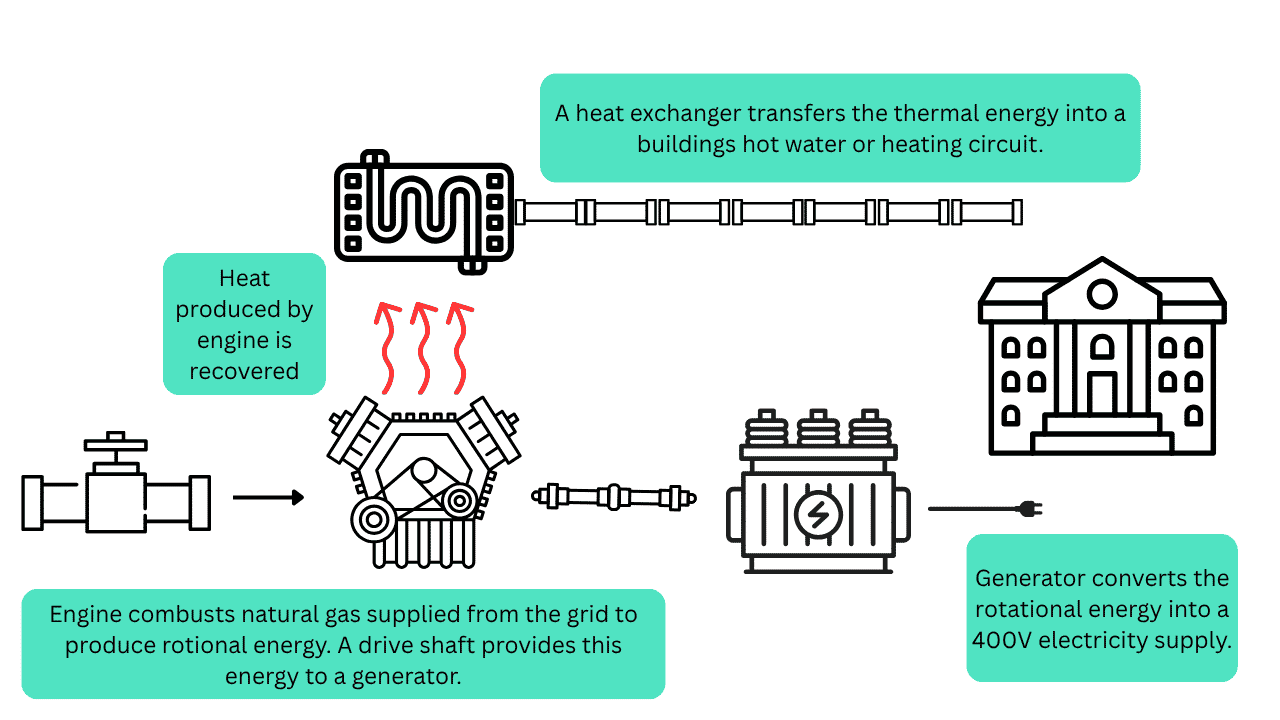
Fuel intake and combustion
At the heart of a CHP unit is a modified internal combustion engine that operates much like a car engine, except that it runs on natural gas rather than petrol.
Most CHPs have a business gas connection to the local gas distribution network, providing a continuous fuel supply.
Inside the engine, natural gas is mixed with air and ignited, producing mechanical movement in a rotating drive shaft.
Electricity generation
The drive shaft is used to power a generator unit, which produces a 400 V three phase electricity supply by spinning a magnet inside a copper coil.
The electricity produced is then fed into the commercial property’s mains distribution board, where it powers devices on site.
Where there is excess electricity, this can be stored using a commercial solar battery, or exported back to the grid under the smart export guarantee scheme.
Heat recovery
When in operation, internal combustion engines produce large quantities of heat, which is usually released into the environment via a radiator system.
The engine inside a CHP is designed to efficiently capture this heat from three distinct sources:
- Engine jacket cooling water — The engine block is surrounded by a jacket of cooling water, which transfers the waste heat produced by the combustion of natural gas.
- Lubricating oil cooler — Internal combustion engines use an oil system to remain lubricated. As oil is pumped around the engine, it absorbs heat, which is recovered by a secondary heat exchanger.
- Exhaust gas heat exchanger — Engines produce exhaust gases at temperatures typically exceeding 400°C. A heat exchanger is used to capture the thermal energy in this gas before it is vented into the atmosphere.
Heated water output
The three distinct heat recovery systems all feed thermal energy into the site’s heating and hot water system.
This works as a direct alternative to a boiler system, which separately uses natural gas to heat water.
A buffer vessel can be used to temporarily store excess heat produced by the CHP to help match heat generation against demand.
Key components of a combined heat and power system
The table below explains the key components and their function in a typical reciprocating CHP system:
| Component | What It Does |
|---|---|
| Gas supply & metering | Delivers natural gas (or biogas/biomethane) to the unit at the correct pressure and flow rate. A dedicated business gas meter measures fuel consumption for billing and performance monitoring. |
| Gas pressure regulator | Reduces and stabilises the incoming gas pressure to the level required by the engine. |
| Intercooler | Cools the compressed air coming from the turbocharger before it enters the cylinders. |
| Fuel-air mixing system | Precisely blends the correct ratio of gas and air before delivery to the cylinders. |
| Cylinders & pistons | The core of the engine. Fuel-air mixture is ignited inside the cylinders, and the expanding gases drive the pistons back and forth. |
| Spark plugs | Ignite the fuel-air mixture at precisely the right moment in each cylinder's cycle. |
| Crankshaft | Converts the linear back-and-forth motion of the pistons into rotational mechanical energy, which is then transmitted to the generator via a driveshaft. |
| Generator | Converts the mechanical rotation of the crankshaft into electrical power. Produces AC electricity, typically at 400V for smaller units. Larger units may generate at higher voltages. |
| Voltage transformer | Steps the generator output voltage up or down to match the site's electrical distribution system or grid connection requirements. |
| Switchgear & protection relays | Protection relays automatically disconnect the unit if a fault is detected. |
| Engine jacket cooling circuit | Circulates water around the engine block to prevent overheating. |
| Jacket water heat exchanger | Transfers heat from the engine cooling circuit into the building's hot water or heating system. |
| Lubricating oil system | Circulates oil around the engine's moving parts to reduce friction and carry away heat. |
| Oil cooler heat exchanger | Recovers heat from the lubricating oil circuit and transfers it into the building's heating system. |
| Exhaust manifold | Collects the hot exhaust gases from all cylinders and channels them towards the exhaust heat recovery system. |
| Exhaust gas heat exchanger | Recovers thermal energy from the exhaust gases produced by the engine. |
| Heat interface & buffer vessel | Connects the CHP's heat output to the site's wider heating and hot water circuit. A buffer vessel (thermal store) absorbs mismatches between heat production and demand. |
| Remote monitoring system | Transmits operational data to the manufacturer, maintenance contractor, or site energy manager. Enables remote diagnostics, performance tracking, and early fault detection without a site visit. |
Types of combined heat and power systems
This section explains the most common types of CHP systems used at commercial properties in Britain.
💡The sizes of CHP units below are presented in electrical power output. As a guide, a typical 20 kW CHP unit would typically generate 120,000 kWh of electricity annually.
Reciprocating Engine CHP
The most common type of CHP system. The engines run on a natural gas, biogas or biomethane supply to generate electricity and heat.
- Sizes: 5 kW to several MW of electrical output
- Electrical efficiency: 35 – 45%
- Overall efficiency: 80 – 90%
Typical use cases include hotels, leisure centres, hospitals and universities.
Gas Turbine CHP
Instead of a reciprocating piston engine, a gas turbine CHP unit uses a jet-engine-style turbine to generate mechanical power.
Compressed air is mixed with fuel and ignited in a combustion chamber, and the resulting hot gases spin a turbine at very high speed, driving a generator.
- Sizes: Typically 5 MW upwards
- Electrical efficiency: 25 – 35%
- Overall efficiency: 70 – 85%
Typical use cases are large industrial facilities such as paper mills and chemical manufacturing plants.
Steam turbine CHP
A Steam Turbine CHP is a system that burns municipal waste or biomass fuel to produce high-pressure steam.
The steam passes through a turbine to generate electricity, and heat is recovered from the exhaust gases for heating systems.
- Sizes: Typically upwards of 0.5 MW
- Electrical efficiency: 15 – 30%
- Overall efficiency: 80 – 85%
The system has the key advantage of running on cheap fuels such as general non-recyclable waste from local commercial waste collection services.
Micro-CHP
Micro-CHP units are small-scale systems designed for individual buildings or small sites. They operate on the same principles as reciprocating engine CHP, but on a much smaller scale, typically using a Stirling engine rather than an internal combustion engine.
A Stirling engine also uses natural gas as a fuel, but generates power from the expansion of gas as it is alternately heated and cooled. There is no internal combustion, making it very quiet and low-maintenance.
- Available sizes: 1 kW up to around 50 kW electrical output
- Electrical efficiency: 6 – 15%
- Overall efficiency: Up to 90%+
Typical use cases include small hotels, care homes and office buildings that have a high and consistent heat demand.
Why businesses use combined heat and power systems
A business CHP system can produce a cheaper supply of electricity and heating than a separate boiler system combined with a business electricity connection to the grid.
This section explains the key financial benefits of investing in a CHP system.
Gas is much cheaper than electricity in Britain
In Britain, business electricity prices per kWh are typically three to four times higher than business gas prices per kWh.
This means that even though the engines used in a CHP system are only around 30% efficient, they can produce a cost per kWh of electricity that is competitive when compared directly with the tariffs offered by a business energy supplier.
Avoided networking costs and environmental levies
The cost of a unit of electricity (kWh) delivered by the national grid includes a wide range of network costs and environmental levies that are additional to the wholesale electricity market cost associated with generating that power.
These costs are entirely avoided by generating electricity on-site as an alternative to grid power. The biggest costs that are avoided are:
- Supplier obligation levy — The funding mechanism for the Contracts for Difference scheme.
- Renewable Obligation costs — A requirement for licensed electricity suppliers to purchase ROCs to match against the consumption of customers.
- EII support levy — The funding mechanism for the Network Charging Compensation Scheme.
- BSUoS charges — Fees used to fund the grid management activities of NESO, the national grid operator.
- TNUoS charges — Fees used to fund the operation and expansion of the national grid.
- DUoS charges — Fees used to fund the activities and investments of Distribution Network Operators.
Climate Change Levy exemption
The Climate Change Levy is a government tax charged per kWh of electricity and gas consumed, and collected through commercial gas and business electricity bills.
The Climate Change Levy is currently 0.827 pence per kWh for both electricity and gas supplied by licensed commercial electricity and business gas suppliers.
CHP systems registered with the Combined Heat and Power Quality Assurance (CHPQA) programme can qualify for a complete exemption from this tax, subject to meeting specific efficiency and quality requirements set out by the UK government.
Revenue generation
CHP systems typically run on a heat-led basis, with the engines adjusting their overall output to match on-site heat demand.
This means that a CHP system will often produce more electricity than can be immediately used on site.
Businesses with a CHP system can export any electricity that cannot be consumed on site back to the grid under the SEG scheme.
Under the scheme, a business energy supplier will purchase each kWh of exported electricity, generating a separate new stream of revenue.
Reducing connection-based standing charges
Installing a CHP system dramatically reduces a business’s reliance on importing power through a grid connection.
Energy-intensive businesses require a high-capacity connection with the grid. These connections typically incur a high business electricity standing charge and monthly maximum demand charges.
Businesses that install a CHP system can typically negotiate a reduction in their grid connection capacity to save on these charges.
How combined heat and power compares to conventional energy supply
For most businesses in Britain, a conventional energy supply means:
- Electricity purchased from the grid, generated centrally at power stations and transmitted across the national grid to the site.
- Heat generated on-site by burning gas in a boiler.
This section compares the key attributes of these approaches with those of a CHP system.
Efficiency comparison
A conventional large-scale generator (nuclear power stations, gas power stations, etc.) produces electricity only. These generators produce vast quantities of heat which is simply released into the environment, and consequently operate at approximately 30% efficiency.
An on-site gas boiler is more efficient at delivering heat, typically converting gas into heat at 85% efficiency.
A CHP unit converts 80–90% of the fuel it burns into useful energy. For every unit of gas burned in a CHP unit, a business typically gets 2.5 times more useful energy than it would from the combination of grid electricity and a separate boiler producing the same outputs.
The stark efficiency benefit results in lower energy costs for businesses, but requires a significant upfront investment in the installation of a CHP unit.
Carbon emissions comparison
Because a CHP system produces two forms of output at once, it also produces significantly less carbon dioxide per unit of energy compared with a separate electricity supply and gas boiler system.
This is of particular benefit to large businesses in the UK that are required by SECR to publicly report the carbon emissions associated with their energy usage.
However, due to the government’s Clean Power 2030 plan, the carbon emissions associated with grid electricity are falling each year. This means that the emissions benefits of a CHP system may become less favourable than importing electricity from the grid and using a separate high-efficiency boiler.
💡Find out the current carbon intensity of the grid using our National Grid Live dashboard.
Resilience comparison
A conventional grid electricity supply exposes businesses to operational disruption during grid outages.
A CHP unit provides a degree of independence from the grid, allowing it to serve as a backup power source during a grid outage.
What influences combined heat and power system performance
The efficiency of a CHP unit in simultaneously generating both an electrical supply and heat can justify a strong return on investment, but only in the right circumstances.
CHP units are designed to operate at near full load 24/7, producing heat and electricity in a fixed ratio determined by their design, for example, producing 1.5 units of heat for each unit of electricity.
These constraints mean that the value of a CHP is maximised for businesses with:
Consistent heat demand requirements
Ideally, a business with a CHP unit will have a consistent baseload requirement for heat. For example, a hotel with a 24-hour hot water demand is a much better candidate for a CHP unit than an office building with no heating demand outside of working hours.
Heat-to-power ratio match
The sizing and operation of a CHP unit is typically determined to match the heating requirements of the building it is supplying. This is because excess heat cannot be exported and must be dumped.
The amount of electricity the unit will generate is a function of its design and required heat output. The ideal host for a CHP will be able to use most of the electricity generated by the CHP on site.
Excess electricity can typically be exported to the grid; however, export rates are much lower than avoided import rates from the grid. This means the ideal host will rarely generate excess electricity.
Combined heat and power system costs and other considerations
This section explains the key costs and other considerations for a business evaluating a CHP installation.
Capital costs
Investing in a CHP system requires significant upfront capital. Micro-CHP systems for a small commercial property start at around £10,000, while a large industrial system will cost millions.
The costs of installing a CHP include the unit itself as well as the significant labour costs required from specialists to carry out the installation.
Once installed, a CHP unit typically has an operational life of 15–20 years.
Grid connection application
New CHP installations at properties connected to the grid require approval from the local Distribution Network Operator.
In assessing the application, the DNO will evaluate whether there is sufficient capacity on the local grid to accept power generated by the CHP unit.
Where local network capacity is an issue, a DNO may apply:
- Export limitation — A requirement to install a device that limits power exports onto the grid to below a specified threshold.
- Network reinforcement — A requirement to pay for local network reinforcement before approval is granted.
Planning permission
Unlike commercial solar panel installations and other green microgenerators, a CHP unit installation is not automatically a permitted development.
The planning requirements depend on:
- Location and unit size
- Height of the exhaust flue
- Noise levels of the chosen unit
- Local air quality restrictions
Units above 1 MW of thermal input typically also require an environmental permit from the Environment Agency (or national equivalent), which sets limits on emissions of specific greenhouse gases and particulates.
Ongoing operating costs
Once operational, a CHP unit will consume large quantities of natural gas. Fuel costs are typically the largest ongoing cost.
We recommend using our business gas comparison service to find the most competitive tariffs available to your business, to minimise the gas supply costs for the CHP unit.
Additionally, CHP units require routine maintenance inspections and servicing from a qualified provider.
Combined heat and power FAQs
Our business energy experts answer other common questions about CHP units.
Does a CHP system work for all businesses?
No. CHP works best for businesses with a great, consistent demand for both heat and electricity throughout the day and, ideally, across the year.
Businesses with low or highly seasonal heat demand, or those operating only during daytime hours with little overnight energy use, are generally less well suited. The higher upfront capital cost also means that micro business electricity customers may struggle to achieve an acceptable payback period.
Smaller businesses can instead make savings on their energy costs using our business electricity comparison service.
Does CHP replace grid electricity completely?
In most cases, no. The majority of CHP installations are designed to run alongside the grid rather than replace it entirely.
A CHP unit is typically sized to meet a site’s consistent underlying demand for heat and power. Then the grid then provides top-up electricity during peak demand periods that exceed the unit’s output.
Is CHP only for large production industries?
No. While CHP is widely used in large industrial settings such as refineries, chemical plants, and food manufacturers, it is by no means limited to these sectors.
Commercial buildings of many kinds operate CHP systems successfully, including hotels, hospitals, care homes, leisure centres, universities, and office buildings.
System sizes range from small micro-CHP units of just 1–2 kW (comparable in size to a domestic boiler) right up to multi-megawatt industrial installations. This wide range means the technology can be scaled to suit organisations of very different sizes and energy demands.
What level of daily operating hours is needed for CHP to be effective?
As a general rule, most industry professionals consider a minimum of 4,500 to 5,000 running hours per year (equivalent to 12 to 14 hours of operation per day) as the threshold below which it becomes difficult to build a compelling financial case for CHP.
Below this level, the capital cost is spread across too few hours of productive operation to achieve a reasonable payback period.
Can CHP still be viable if heat demand varies throughout the day?
Yes. Varying heat demand throughout the day is very common and does not necessarily rule out CHP as a viable option. The key is managing the mismatch between heat production and heat demand effectively, which is primarily achieved by installing a thermal buffer vessel.
A buffer vessel acts as a heat store. It absorbs surplus heat when the CHP unit is producing more than the site currently needs, and releases it when demand exceeds the unit’s output. This allows the CHP to keep running at full load even during temporary dips in demand, rather than shutting down or dumping heat unproductively.
Can CHP systems be scaled over time as a business grows?
Yes. CHP systems can be scaled to accommodate business growth, and this is something worth planning for at the design stage, even if additional capacity is not needed immediately.
The most common approach is a modular installation, where two or more smaller CHP units are installed side by side rather than a single larger unit.
 Back to blog
- Share: