 Our use of cookies
Supplier of Last Resort for business energy customers
When a business energy supplier fails, the immediate concern is always the same: will the gas and electricity stay on? The answer is yes. The Supplier of Last Resort mechanism ensures no business is left without electricity or gas when a supplier collapses.
This guide covers everything businesses need to know, from how the process is triggered through to what happens to contracts, rates, credit balances and accounts.
What is a Supplier of Last Resort?
A Supplier of Last Resort (SoLR) is a safety mechanism operated by the energy regulator Ofgem, designed to protect customers if their energy supplier fails. Because gas and electricity are considered essential services, the regulator has powers to step in when a supplier becomes unable to continue operating to ensure that customers are never left without supply.
When a supplier fails, Ofgem can revoke its licence and direct another licensed energy supplier to take over responsibility for the failed supplier’s customer base. This appointed SoLR takes on those customers automatically, so supply continues without interruption regardless of what happens to the original supplier.
When the Supplier of Last Resort process is triggered
The SoLR process is triggered when a licensed energy supplier reaches financial failure.
Ofgem has the power to revoke a supplier’s licence with 24 hours’ notice in specific circumstances, including where the supplier is unable to pay its debts, has a receiver appointed over its assets, has an administration order made against it, or becomes subject to a High Court winding-up order.
Before entering formal insolvency proceedings, suppliers and their creditors are required to give at least 14 days’ notice to both Ofgem and the Secretary of State. This window gives the regulator time to assess the situation and decide on the most appropriate course of action.
Ofgem’s preferred outcome in any supplier failure is a trade sale, where the failing business is sold as a going concern to another supplier. This is considered the least disruptive route for customers and the wider market.
Where a trade sale is not feasible, the regulator will assess whether it is practical to appoint a SoLR or whether the circumstances call for an energy supply company administration order instead.
What happens if your business energy supplier goes bust
The most important thing to know about what happens when a business energy supplier goes bust is that gas and electricity will continue to flow to business premises without any gap in service, regardless of what happens to the failed supplier. Customers do not need to take any immediate action.
Once Ofgem revokes the failed supplier’s licence, a new supplier is appointed as the Supplier of Last Resort and automatically becomes responsible for all affected customers. This appointment takes effect on the same date as the licence revocation, so there is no period during which customers are without a supplier.
Within a reasonable period of appointment, the SoLR is required to contact affected customers directly. That communication will confirm:
- The original supplier is no longer operating. And identifies themselves as the new supplier; and
- Sets out the deemed electricity and gas rates that apply
Customers should keep an eye out for this correspondence and, where possible, take a meter reading around the time of the switch.
It is worth noting that any credit balance held with the failed supplier is not automatically protected or transferred. Recovering that balance will depend on the insolvency process and what, if anything, the appointed SoLR has agreed to offer in this regard.
From there, the formal transfer process begins. Customers will be moved onto the SoLR’s systems and will begin being charged the deemed rates set out in the letter above.
Once the transfer completes, impacted businesses have the option to agree a new contract with the SoLR directly or move to another supplier of their choice.
The Supplier of Last Resort process
When a business energy supplier fails, the Supplier of Last Resort process moves quickly and follows a defined sequence of steps. Understanding each stage helps business customers know where they stand and what to expect.
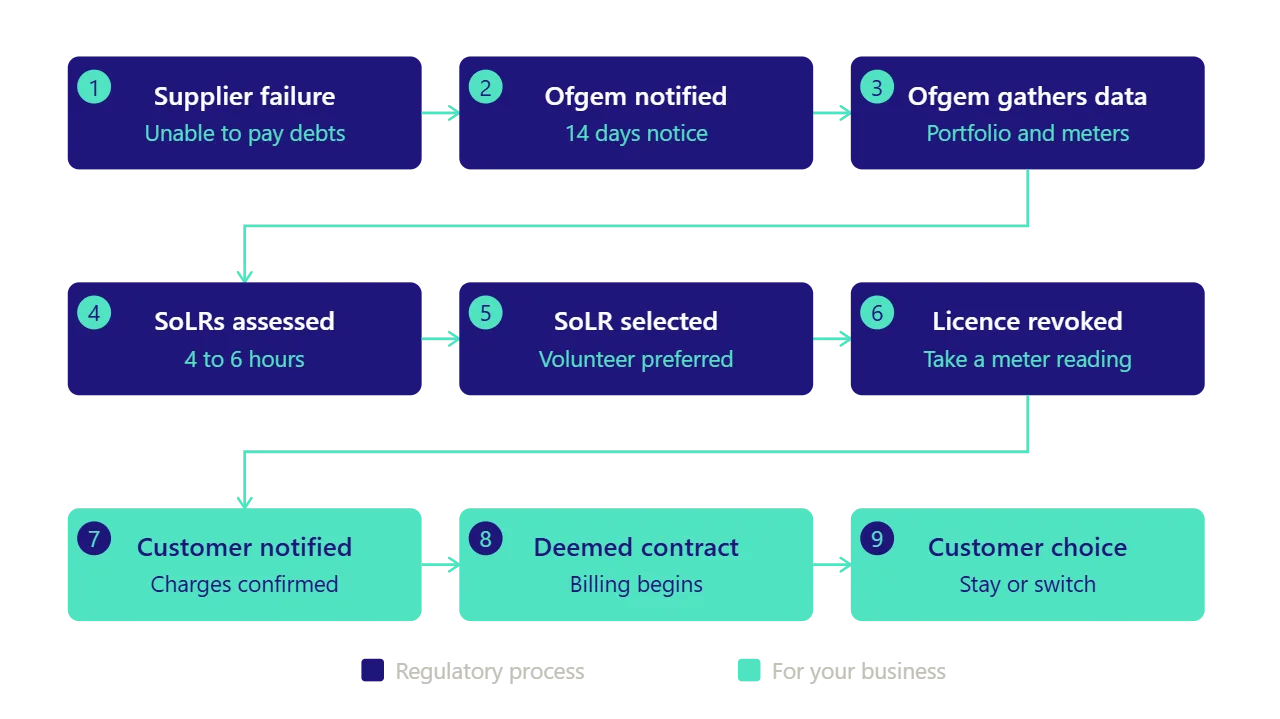
Step 1: Supplier failure is confirmed
The process begins when a supplier becomes unable to pay its debts, enters administration, has a receiver appointed, or faces a winding-up order. At this point, the conditions for licence revocation are met.
Step 2: Notification to Ofgem
Before entering formal insolvency proceedings, suppliers or their creditors are required to give at least 14 days’ notice to both Ofgem and the Secretary of State. This creates the window for the regulator to act.
Step 3: Ofgem gathers information
Ofgem collects portfolio data from the failing supplier and relevant industry parties, covering the number and types of customers, MPANs and MPRNs, consumption volumes, and credit balances, providing potential SoLRs with what they need to assess their capacity to take on impacted customers.
Step 4: Potential SoLRs are contacted
Licensed suppliers who have indicated a willingness to act as a SoLR are approached. They are typically given between four and six hours to respond with detailed information about their ability to take on the additional customer base without disrupting their existing supply obligations.
Step 5: SoLR is selected and directed
Ofgem selects the most suitable supplier based on criteria covering energy sourcing capability, credit cover, customer service arrangements, and proposed deemed business electricity prices and commercial gas rates.
Preference is given to suppliers who volunteer for the role. Ofgem can direct a supplier to act as SoLR without its consent if no suitable volunteer comes forward.
Step 6: Licence revocation and SoLR appointment
The failed supplier’s licence is revoked with 24 hours’ notice, and the SoLR appointment takes effect on the same date, so there is no gap or interruption to supply.
We recommend taking readings of any impacted commercial gas and business electricity meters and keeping them dated, as it creates a clean record of business energy consumption at the point of the switch and protects against any billing disputes later.
Step 7: Customer notification
The SoLR is required to contact all affected customers within a reasonable period of appointment, confirming the change of supplier, setting out the deemed contract charges that will apply, and confirming that customers are free to switch at any time without an exit fee.
While waiting for this correspondence, any direct debit set up with the failed supplier can be cancelled at this stage if preferred. The new supplier will make contact to explain how they will take on the account, including any direct debit arrangements.
Step 8: Transfer to deemed contract
Customers are automatically placed on the SoLR’s deemed contract from the date of appointment. The SoLR takes on responsibility for billing and begins the process of transferring customers onto its own systems.
Once the transfer process has completed, the terms of any fixed contract with the original supplier will no longer apply.
Step 9: Customer choice
Once on the deemed contract, customers can either agree to a new fixed or variable rate contract directly with the SoLR or move to a supplier of their choice. No termination fee applies during this period.
Businesses that take no action will remain on the deemed contract for as long as it runs, with the deemed rate applying throughout.
As deemed contracts can be more expensive than a negotiated market rate, reviewing options as soon as possible after the SoLR appointment is the most effective way to keep energy costs down.
How long does the SoLR process take?
The SoLR appointment typically takes effect within days of a failure being confirmed. The full transfer of billing and account data onto the SoLR’s systems can take several weeks, so there may be a delay before the first bill arrives.
From day one, businesses are free to switch to a new supplier at any point with no exit fee. The formal SoLR arrangement lasts a maximum of six months, after which Ofgem’s direction expires, and any customer still on a deemed contract reverts to the SoLR’s standard deemed contract terms and rates.
What happens to your rates and contract after a SoLR transfer?
From the date of the SoLR appointment, affected businesses are automatically placed on what is known as a deemed energy contract.
This is not a contract that has been agreed or signed in the usual sense. It is a default arrangement that gives the SoLR the right to charge for the gas and electricity supplied while the customer decides what to do next. There is no fixed term, no exit fee, and no obligation to stay.
The deemed contract remains in place until one of three things happens:
- The business agrees a new contract directly with the SoLR
- The business arranges to switch business energy supplier
- The six month SoLR direction period expires.
After the six month period has expired, the customer reverts to the SoLR’s standard deemed contract rates.
Are SoLR deemed rates higher than normal?
Most businesses are on fixed-rate contracts before a supplier failure, meaning they have locked in a competitive rate in the open market. A SoLR appointment ends that arrangement immediately. From the date of appointment, affected businesses move onto a deemed contract rate they have not chosen or negotiated, and for most, that will mean a significant jump in what they pay.
Deemed contracts are not competitive tariffs. They exist to ensure supply continues, not to offer value.
The practical reality is that the majority of businesses affected by a SoLR appointment will find themselves paying more than they were on their previous contract.
Taking the time to compare business electricity prices or compare business gas prices as early as possible is the most effective way to limit exposure to the deemed rates.
What happens to your account, balances and outstanding debt
The SoLR takes over responsibility for supply, but it does not automatically inherit everything associated with the failed supplier’s accounts.
Once a supplier fails, an insolvency practitioner is appointed to manage the financial wind-down of the business. This is a licensed professional, appointed by the failed supplier’s creditors or the court, whose role is to take control of the company’s assets, settle outstanding liabilities, and distribute what remains to creditors.
Details of who has been appointed will typically be published by Ofgem at the point of the failure, and can also be found through Companies House or the Insolvency Service register. Several aspects of an existing account will sit with the insolvency practitioner rather than the SoLR, and it is important to understand which is which.
Credit balances
Any credit balance held with the failed supplier is not automatically transferred to the SoLR. Those funds sit within the insolvency process and are usually handled by the insolvency practitioner.
Ofgem does consider how potential SoLRs propose to handle credit balances as part of the selection process, with a preference given to those who agree to honour them by applying a credit to the customer’s account.
If a credit balance is not honoured by the SoLR, it becomes an unsecured claim against the failed supplier through the insolvency proceedings. Businesses should note the balance on their account and keep copies of any recent statements as supporting evidence.
Outstanding debt and direct debits
Any outstanding invoices owed to the failed supplier at the point of failure do not disappear. These transfer to whoever is managing the assets of the failed supplier through the insolvency process, and businesses remain liable to pay them.
Direct debits set up with the failed supplier can be cancelled at this stage if preferred. The new supplier will make contact to explain how they will take on the account, including how they will receive payments for any outstanding bills.
Old bills, account access and complaints
One of the most common practical difficulties following a supplier failure is losing access to the online account and business electricity bills or business gas bill history. Supplier portals are often taken offline quickly once insolvency proceedings begin.
If access to historical bills is needed, the options are to contact the insolvency practitioner directly, request data from the SoLR (which will have access to some meter and consumption data via network operators), or use dated meter readings taken at the time of the switch as a cross-reference.
Keeping a record of the final energy meter reading at the point of the SoLR appointment is the single most useful step a business can take to protect itself against billing disputes.
Complaints relating to the failed supplier should be directed to the insolvency practitioner rather than the SoLR or Ofgem.
Any complaints about the SoLR’s handling of the transfer follow the SoLR’s standard complaints process in the first instance, with the Energy Ombudsman available as an escalation route if the complaint is unresolved after eight weeks.
What is the difference between Supplier of Last Resort and Special Administration Regime?
Where the SoLR process transfers customers to a new supplier, the Special Administration Regime takes a different approach. Rather than moving customers elsewhere, the failed company continues to operate under a court-appointed administrator whose objective is to keep the supply running while finding a buyer or arranging an orderly customer transfer. The Secretary of State has the power to provide financial support during this period.
SAR is only used where the SoLR route is not feasible, most commonly where a supplier is too large for any single licensed supplier to absorb.
Bulb Energy is the most prominent example; it collapsed in November 2021 with 1.5 million customers and was placed into SAR with administrators from Teneo appointed by the High Court. After 13 months, customers were transferred to Octopus Energy in December 2022.
From a business customer’s perspective, the key distinction is straightforward. Under SAR, the existing supplier relationship continues under new management. Under SoLR, a new supplier relationship begins from the date of appointment.
Who to contact if your transfer to the SoLR is delayed or incorrect
The SoLR is the first point of contact for any issues with the automatic transfer. As the appointed supplier, it has a regulatory obligation to handle customer queries, issue accurate bills, and manage the transfer process promptly.
If there are problems with meter readings, billing errors, or delays in being formally moved onto the SoLR’s systems, these should be raised with the SoLR directly in the first instance.
If the SoLR fails to resolve the issue satisfactorily, the matter can be escalated to Ofgem, which retains oversight of the SoLR’s conduct throughout the direction period and has enforcement powers where a supplier is not meeting its obligations.
For complaints that remain unresolved after eight weeks, the Energy Ombudsman provides an independent escalation route. For any issues relating specifically to the failed supplier’s account, such as final bills or credit balance claims, the insolvency practitioner is the appropriate contact.
Supplier of Last Resort for businesses – FAQs
Below, our experts answer the most commonly asked questions about the supplier of last resort.
Can I refuse the Supplier of Last Resort assigned to my business?
No. Ofgem has the power to direct a supplier to take on the failed supplier’s customers, and businesses cannot opt out of the appointment. The SoLR becomes the supplier from the date the direction takes effect. However, there is no obligation to stay. Businesses can switch to any supplier of their choice at any point during the SoLR period with no exit fee.
Can I request a different supplier instead of the one Ofgem appoints?
No. The SoLR is selected by Ofgem based on a set of criteria covering operational capacity, customer service arrangements, and proposed deemed contract rates. Individual businesses have no input into that selection.
The right to switch freely and without penalty means that if the appointed SoLR is not suitable, moving to a preferred supplier is straightforward.
Will my energy supply continue if my supplier collapses suddenly overnight?
Yes. The SoLR process is designed to handle exactly this scenario. Ofgem can move quickly, and the SoLR appointment takes effect on the same date as the licence revocation, meaning there is no gap in supply regardless of how sudden the failure is.
Can a Supplier of Last Resort change my tariff without agreement?
Yes. The previously agreed fixed rate ends when the supplier fails, and the SoLR applies a deemed contract rate automatically from the date of appointment. Businesses can negotiate a new contract directly with the SoLR or switch to another supplier at any time.
Will I be backdated onto the new supplier’s rates after the transfer?
The deemed contract applies from the date of the SoLR appointment, not from the date billing is actually set up. Businesses will be charged for all consumption from the appointment date onwards, even if there is a delay before the first bill arrives. This is why taking a meter reading at the point of the switch is important.
What happens if my business has multiple meters or sites?
All meters and supply points registered with the failed supplier transfer to the SoLR under the same direction. The transfer process applies to each meter point individually, which can mean more complexity and a longer lead time before all sites are fully migrated onto the SoLR’s systems.
Businesses with multiple sites should take meter readings across all locations at the point of the switch.
What happens if the new supplier cannot access previous usage data?
The SoLR receives some consumption and meter data from network operators and industry systems, but may not have access to the full billing history held by the failed supplier. Where data is incomplete, the SoLR is required to bill on a reasonable basis using the available consumption information.
Meter readings taken by the business at the point of the switch serve as an important independent record and can help resolve any disputes over opening figures.
 Back to blog
- Share: