 Our use of cookies
Peak shaving for businesses: Strategies to minimise energy costs
To control costs, energy-intensive businesses must consider not only how much electricity they use but also when they use it.
If these businesses have significant power demand in the late afternoon, when the electricity grid experiences peak demand, they pay higher unit charges. Peak shaving offers a solution to avoid exposure to these expensive periods.
Here is what we cover in this guide to peak shaving for businesses:
- What is peak shaving in business energy management?
- The ways peak shaving reduces business energy costs
- How peak shaving works
- Peak shaving strategies used by businesses
What is peak shaving in business energy management?
Peak shaving is an energy management strategy used by businesses to reduce electricity consumption during periods of peak grid demand and highest electricity prices.
Peak shaving allows energy-intensive businesses to adjust the timing of their power consumption to align with the financial incentives in their energy contracts and minimise costs.
The ways peak shaving reduces business energy costs
This section explains the four common ways in which strategic peak shaving can reduce business electricity prices.
Peak DUoS periods
DUoS charges are network costs levied by Distribution Network Operators (DNOs) for the use of the local electricity grid. In pass-through tariffs, commonly used for energy-intensive properties, business energy suppliers will pass these costs through as a separate line item on the business electricity bill.
DUoS unit charges per kWh depend on the time of use and are divided into three cost bands:
- Red – The most expensive period when the local grid is typically under peak strain, usually during weekday late afternoons and evenings.
- Amber – Mid-range times, either side of the peak, where DUoS unit fees are moderately priced.
- Green – Periods of lowest demand on the local grid where electricity is cheapest.
💡 These unit fees vary by region and connection type, but typically green fees are near zero, whereas red fees are often between 3p and 5p per kWh, depending on the DNO region.
Capacity charges
Capacity charges are a separate category of DUoS charges levied by DNOs, to guarantee the Maximum Import Capacity of a business electricity connection.
These charges relate to the maximum half-hourly demand of a business. Peak shaving can reduce this measured maximum demand to:
- Avoid excess capacity penalties – Incurred when a site exceeds its agreed capacity.
- Reduce capacity charges – By agreeing on a lower Maximum Import Capacity with the DNO.
For more information, visit our guide to maximum demand and capacity charges.
Wholesale electricity costs
Businesses on flexible energy contracts can choose to have exposure to variable wholesale electricity market prices.
Businesses can use peak shaving to shift consumption to periods when wholesale power is cheapest.
A notable example of this is a data centre that powers down entirely during periods of peak wholesale prices.
Flexibility services
Businesses can earn additional revenue by reducing demand on request during periods of peak grid stress.
Flexibility services available to British businesses include:
- Demand flexibility service
- Capacity Market Regional
- DNO flexibility services
Find a new energy supplier that can help your business participate in these flexibility services by using our business electricity comparison tool today.
How peak shaving works
Energy-intensive commercial properties are fitted with half-hourly electricity meters that automatically record and transmit power consumption every thirty minutes.
Business electricity charges are based on precise power consumption for every thirty-minute period of the day.
The structure of the charges and schemes above means that the unit cost per kWh of electricity consumed is more expensive in some periods than others.
Peak shaving is the process of strategically shifting the timing of consumption to avoid the most expensive periods.
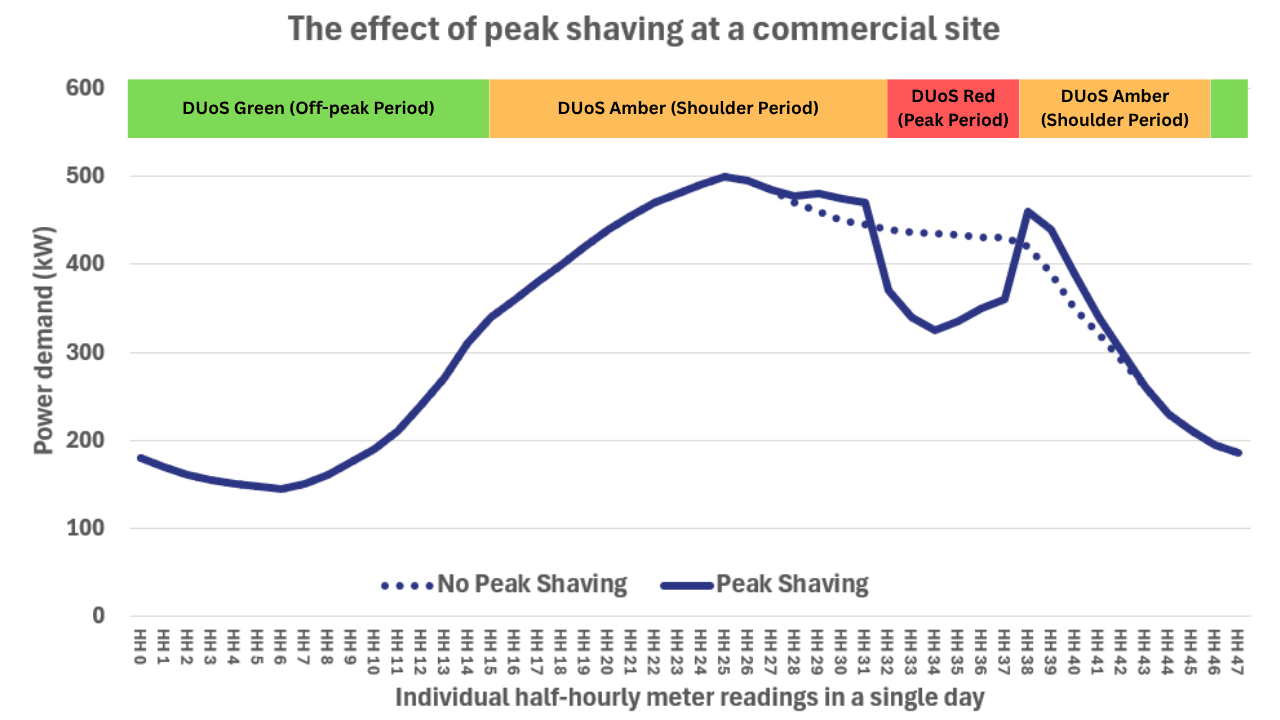
The graph below shows the business energy consumption of a commercial property throughout a single day with and without peak shaving. We used the example of a business using peak shaving to avoid the red period of DUoS charges.
Peak shaving strategies used by businesses
This section covers the three most common peak shaving strategies used by energy-intensive businesses in Britain.
The effectiveness of these strategies is typically measured and optimised using business energy monitoring software.
Load shifting
Load shifting is the tactic of rescheduling the operation of energy-intensive equipment away from peak hours. Common examples include:
- Running production processes earlier or later.
- Charging electrical equipment or vehicles overnight.
- Pre-heating or pre-cooling buildings, then letting temperatures drift during peak times.
- Pre-cooling refrigeration units so compressors reduce load during peak times.
Battery storage
Businesses with energy storage capacity, such as commercial solar batteries, can strategically store electricity in off-peak periods and discharge it during peak periods.
Battery storage peak shaving works best for energy-intensive businesses with limited flexibility for load shifting.
Batteries can be programmed to automatically follow this strategy using an Energy Management System.
Battery storage is the dominant peak shaving strategy as it achieves savings without interfering with business operations.
On-site generation
Industrial businesses often install independent dispatchable electricity generation capacity on-site to reduce reliance on the grid during peak periods.
Common examples include Combined Heat and Power (CHP) units and waste incinerators.
These generators are not connected to the local grid but use a private wire to supply electricity directly to industrial sites; they can serve as an alternative to grid power during peak periods.
Peak shaving for businesses – FAQs
Our business energy experts answer the commonly asked questions about peak shaving.
What’s the difference between peak shaving and load shifting?
Peak shaving is an umbrella term for any activity that strategically reduces electricity consumption from the grid during peak periods.
Load shifting is one example of these activities, as it changes the timing of specific business processes to reduce peak power demand.
Other common examples include using battery storage or on-site power generation.
When are peak electricity periods in the UK?
In the UK, the “red periods”, which have the highest peak unit costs, generally occur between 16:00 and 19:30, Monday to Friday.
However, the precise banding for these peak periods varies between regional Distribution Network Operators (DNOs).
We recommend searching for the “schedule of charges” for your specific DNO to clarify the precise peak hours in your area.
How does peak shaving support grid stability?
The electrical system in Britain must be kept in a constant state of balance, where the supply of electricity exactly matches demand.
The grid operator NESO is responsible for working with grid operators and generators to maintain this balance.
Peak shaving makes NESO’s job easier, as participating businesses tend to reduce their demand during the peak evening periods of household consumption.
This means the grid becomes less reliant on expensive and polluting backup options, such as turning on older gas power stations.
 Back to blog
- Share: