 Our use of cookies
Electricity interconnectors: How the British grid imports electricity
Great Britain has some of the highest electricity generation costs in Europe. Undersea electricity interconnectors offer a solution by allowing the national grid to import cheaper French nuclear energy and Norwegian hydroelectricity.
In 2024, the UK imported a record 43.7 TWh of electricity from neighbouring countries through international interconnectors, meeting 14% of overall demand for power.
In this guide to electricity interconnectors, we cover:
- What are electricity interconnectors?
- How electricity interconnectors work
- How electricity flows between countries through interconnectors
- Electricity interconnectors map and where they connect
- How many electricity interconnectors does the UK have?
What are electricity interconnectors?
Electricity interconnectors are high-voltage cables that link one country’s electricity grid to another, letting power flow between them in either direction.
Since Great Britain is an island, its electricity interconnectors are high-capacity undersea cables connecting the British grid to neighbouring countries, including France, the Netherlands, Belgium, Norway, Denmark, the Republic of Ireland and Northern Ireland.
Driven by market forces, interconnectors send electricity from the cheaper market to the more expensive one, helping to stabilise prices in both grids.
How electricity interconnectors work
Most of the electricity interconnectors connecting Great Britain to other electricity markets are owned as joint ventures between National Grid Plc and the equivalent grid operator in the country being connected to.
Grid owners don’t direct power flows on the interconnector themselves. Instead, they sell the interconnector capacity to traders, who direct the flow of electricity by purchasing power from one wholesale market and selling it on another.
Here’s the process of how electricity interconnectors are used:
Sale of interconnector capacity
Interconnector operators sell the right to use it to wholesale market traders.
Interconnector capacity sales are made through auctions run by the Joint Allocation Office, a specialist European auction house for transmission capacity rights. The sales of capacity define:
- Capacity direction
- Time and date window
- Capacity in MW
In a similar way to the British wholesale electricity market, all winning bids are allocated at the single highest accepted marginal price.
The winning bidders hold the right to use the interconnector to deliver power in the defined direction, up to their capacity allowance.
Capacity holders trade on wholesale markets
Traders that hold interconnector capacity will analyse the wholesale electricity markets on either side of the interconnector to determine whether they can profitably use the purchased capacity.
When traders can buy power cheaply, move it through the interconnector and sell it at a higher price, they’ll arrange this through separate transactions in each wholesale market.
Nomination of the flow of electricity
In the hours before the held capacity window, the trader confirms to the interconnector operator how much of their held capacity they intend to use, if any.
Following market signals, traders holding capacity from high price to low price markets will take up their allocation.
When prices in the connected markets are closely aligned, after accounting for transmission losses, the price difference is not sufficient to justify flow. At these times, the interconnector sits idle.
💡You can see the current net imports through interconnectors using our National Grid live dashboard.
Real-time balancing
The section above explained how private traders use international interconnectors to profit from price differences in the wholesale markets. But NESO, the British national grid operator, also uses interconnectors to keep supply and demand balanced on the grid.
Once all traders have nominated their power flows through the interconnector, NESO can pay the interconnector operator through the Balancing Mechanism to reduce or increase flows, giving it precise control over power availability on the grid.
Interconnectors can ramp power flows up or down within minutes, making them a useful tool for last-minute adjustments to the availability of power on the grid.
To use the interconnectors for balancing, NESO must agree with the operator of the connecting grid to accept the adjustment, to avoid passing a balancing problem from one grid to another.
How electricity flows between countries through interconnectors
This section explains how electricity physically flows from one grid network to another via an undersea electricity interconnector.
High-Voltage Direct Current
Britain’s electricity interconnectors are typically designed as two high-capacity cables, each carrying the opposite voltage, creating a single circuit that can transmit power long distances.
The cables are typically made with a copper core approximately 3 cm in diameter (about the size of a £2 coin), protected by a 5 cm insulation layer.
Unlike the majority of the British national grid, which uses Alternating Current (AC) electricity, undersea interconnectors typically use High Voltage Direct Current (HVDC) through the cables.
Direct Current is used because it transmits power more efficiently, avoiding the energy losses caused by the constantly changing current in an AC connection. Total end to end losses on British interconnectors are approximately 3 to 5%.
Converter stations
The undersea interconnectors connect to an onshore converter station, which changes the DC power supply in the undersea cable into an AC supply at the voltage and frequency needed by the local grid.
For example, the ElecLink connector with France uses the following series of substations and converter stations to deliver power:
- GB Grid substation: The GB transmission network delivers and receives 400 kV power at 50 Hz via a substation in Sellindge, 14 km inland from Folkestone.
- Folkestone converter station: Converts the power supply from 400 kV AC to ± 320 kV DC.
- Undersea cable: The 51 km undersea cable carries ± 320 kV DC power through the Channel Tunnel.
- Peuplingues converter station: Converts the power supply from ± 320 kV DC to 400 kV AC.
- French grid substation: The French transmission network receives and delivers the 400 kV AC power supply via a substation near Calais.
How many electricity interconnectors does the UK have?
There are currently 11 operational electricity interconnectors, with one further interconnector under construction.
Of the operational interconnectors, 10 are undersea, with one land-based connection across the border between Northern Ireland and Ireland.
The table below shows the names, connections and capacities of all operational international interconnectors, based on UK government data.
| Interconnector Name | Connecting Country | Capacity (MW) | Year Commissioned |
|---|---|---|---|
| IFA | France | 2,000 | 1986 |
| North-South (land only) | Republic of Ireland | 540 | 1995 |
| Moyle | within the UK | 500 | 2001 |
| BritNed | Netherlands | 1,000 | 2011 |
| East-West | Republic of Ireland | 500 | 2012 |
| Nemo Link | Belgium | 1,000 | 2019 |
| IFA 2 | France | 1,000 | 2021 |
| North Sea Link (NSL) | Norway | 1,400 | 2021 |
| ElecLink | France | 1,000 | 2022 |
| Viking | Denmark | 1,400 | 2023 |
| Greenlink | Republic of Ireland | 500 | 2025 |
Electricity interconnectors map and where they connect
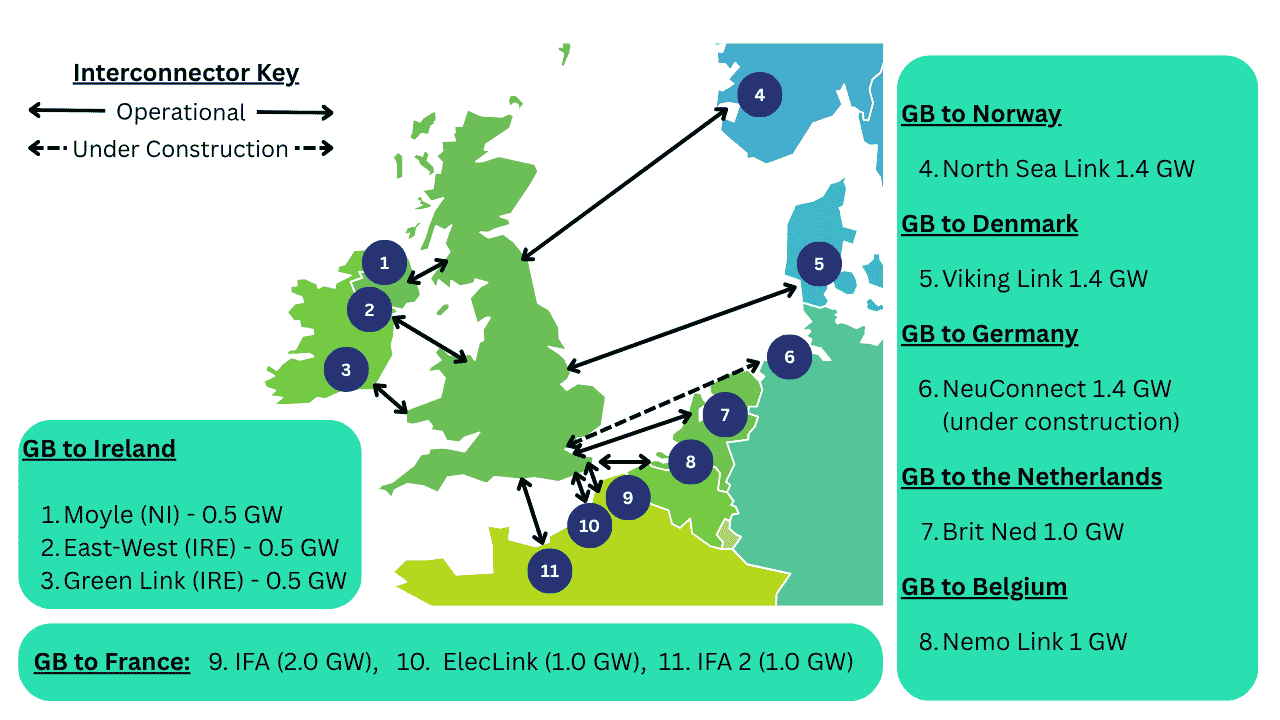
The map below shows the connections made by the undersea electricity interconnectors to Great Britain, including those operational and those under construction.
How interconnectors affect electricity prices
Electricity interconnectors allow the British wholesale electricity market to trade electricity with European markets. Buying and selling electricity with other markets reduces wholesale price volatility.
To show this effect, we’ve set out the impact on the market in two scenarios: when British electricity prices are at their lowest, and when they’re at their highest.
Windy days when prices are low
Electricity generation in Great Britain is dominated by UK wind farms.
On windy days, power generation from these wind farms floods the wholesale market and causes prices to drop to near-zero.
Interconnectors allow the market to adjust by selling this cheap power to other markets that have less wind capacity.
This has the effect of raising wholesale prices on windy days and helps to ensure the power generated by renewables can be fully utilised.
Still and dark evenings when prices are high
During evenings when there is limited wind, neither the UK’s wind nor solar farms contribute to power generation. This means the market must rely on gas fired power stations to meet additional demand.
Since these power stations rely on expensive business gas prices to pay for fuel, this dramatically increases the wholesale price of electricity on the market.
In these conditions, interconnectors run at full import capacity, letting the market rely less on the most expensive power stations and helping dampen prices.
The net impact of interconnectors
Interconnectors lower prices when the price of electricity in Britain is higher than in neighbouring markets, and raise prices when prices in Britain are lower.
In recent years, the domestic wholesale price of electricity has been consistently higher than continental European prices. The latest year of government data shows that the UK imported 43.7 TWh while exporting only 10.3 TWh of electricity through interconnectors.
A recent publication from National Grid estimated that the net consumer benefit of interconnectors since 2023 has been £1.65 billion through reduced domestic and business electricity prices.
💡At Business Energy Deals, we specialise in helping SMEs compare the prices of the best business energy suppliers. Find out how much you can save using our business electricity comparison service.
Why electricity interconnectors are important for network security
To avoid supply interruptions, the British grid operator must ensure there’s always enough power to meet demand.
This role has become increasingly difficult due to the Clean Power 2030 plan, which has increased the contribution of intermittent renewables.
During periods of high demand and low renewables, the grid operator must rely on paying older gas power plants or battery storage facilities to meet demand.
Interconnectors effectively offer another back-up power source, allowing the grid to import reliable baseload power produced by the large fleet of French nuclear power stations. This improves the overall stability and security of supply on the grid.
The future of electricity interconnectors in the UK
The UK’s fleet of electricity interconnectors is set to grow substantially over the next decade. Here’s a summary of the pipeline:
Under construction interconnectors
As shown on the map above, there is one undersea electricity interconnector currently under construction.
The NeuConnect project will link the British mainland to Germany with a 1.4 GW electricity link, connecting the Isle of Grain to Wilhelmshaven. Commercial operations are expected to commence in 2028.
Interconnectors approved by Ofgem
As part of the Strategic Spatial Energy Plan, Ofgem is working alongside the Department for Energy Security and Net Zero (DESNZ) and NESO to provide more direction on where future interconnector capacity should be built.
Currently, the interconnector projects that have received approval are:
- Tarchon Energy Interconnector: A 610 km subsea cable between East Anglia and Niederlangen, Germany, delivering 1.4 GW of electricity capacity.
- Mares Connect: A 190 km subsea cable between Bodelwyddan in North Wales and the Republic of Ireland, delivering 0.75 GW of additional electricity capacity.
- LirIC: A 142 km subsea electricity interconnector between Kilroot in Northern Ireland and Hunterston in Ayrshire, Scotland, delivering 0.7 GW of additional electricity capacity.
Offshore hybrid assets
Offshore hybrid assets are a new type of interconnector. Rather than a point-to-point connection between two grids, they are a multi-purpose subsea infrastructure that simultaneously connects offshore wind farms to two countries’ grids.
This hybrid approach offers more connection capacity for less cable and reduces the likelihood of wind curtailment, where the grid they supply cannot absorb the power generated during windy conditions.
Two offshore hybrid assets have been approved by Ofgem:
- LionLink: Connecting Dutch offshore wind farms to the GB grid with an onshore landing point in Suffolk, and providing up to 1.8 GW of clean electricity to each country.
- Nautilus: Connecting Belgian offshore wind farms to the GB grid, coming ashore at the Isle of Grain in Kent, and providing up to 1.4 GW of offshore wind to each country through subsea electricity cables.
Source: Ofgem – Next generation of future interconnectors
 Back to blog
- Share: