 Our use of cookies
Dogger Bank Wind Farm: A guide to the UK’s largest renewable energy project
The UK’s energy system once relied heavily on gas fields in the North Sea, but production has been in steady decline for the past two decades. Today, the same waters are witnessing a resurgence, not through fossil fuel extraction, but as a key source of renewable energy.
Dogger Bank, a vast sandbank in the middle of the North Sea, is the site of the world’s largest offshore wind farm development. Spanning seven projects, it will feature some of the largest wind turbines ever constructed.
If completed as planned, the wind farms on Dogger Bank will generate enough electricity to power 16 million homes, meeting around 17% of the UK’s annual demand.
Here are the key parts of our guide to the Dogger Bank wind farm developments:
- What is Dogger Bank?
- Dogger Bank wind farm development status
- Map of the Dogger Bank wind farms
- Dogger Bank wind farm development timeline
What is Dogger Bank?
Dogger Bank is a submerged sandbank in the North Sea, with a depth of between 15 and 30 metres. It begins approximately 100 kilometres off the east coast of England.
The sandbank area is vast. Covering 17,600 square kilometres, it spans the exclusive economic zones of the UK, the Netherlands, Germany, and Denmark.
At the end of the last Ice Age, around 8,000 years ago, when sea levels were lower, Dogger Bank was a landmass known as Doggerland, which connected Britain to mainland Europe.
Dogger Bank is a rich marine ecosystem, home to sand eels, cod, and flatfish, which in turn attract seabirds, seals, and porpoises. It is recognised as a Special Area of Conservation by all four countries it spans.
The shallowness of Dogger Bank, combined with the windy conditions in the North Sea, makes it an ideal location for fixed-bottom offshore wind farms.
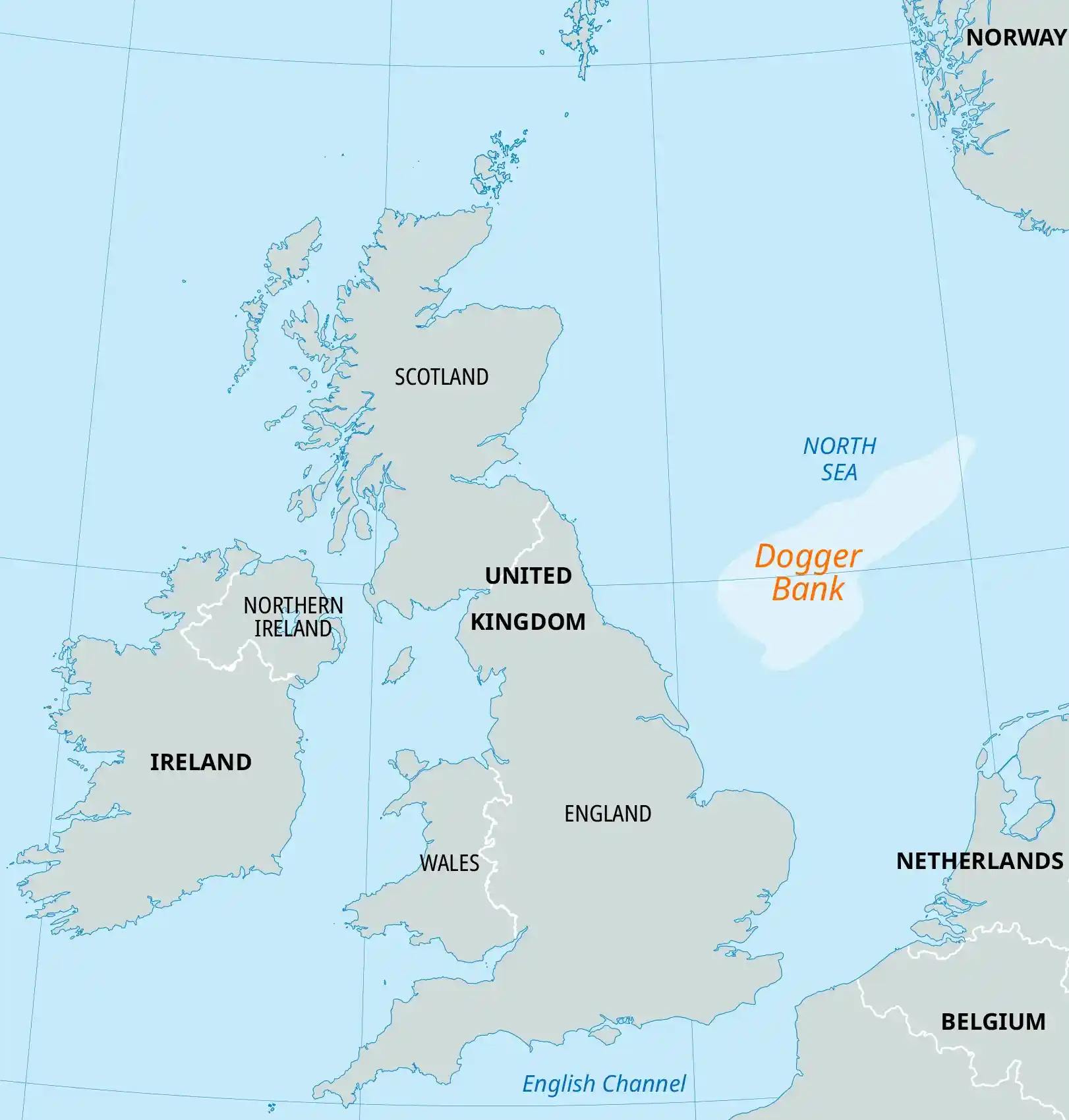
Credit: Britannica – Dogger Bank
Dogger Bank wind farm development status
By the early 2010s, offshore wind technology had matured enough to support projects hundreds of kilometres from shore, making development on Dogger Bank feasible. Today, seven wind farms on Dogger Bank are either under construction or in advanced planning. The table below shows their status.
| Project | Developers | Capacity | Status - (Summer 2026) | Expected commissioning |
|---|---|---|---|---|
| Dogger Bank A | SSE Renewables, Equinor, Vårgrønn | 1.2 GW | All wind turbine generators and inter-array cables have been installed. It is in the process of being commissioned. | Expected in 2026 |
| Dogger Bank B | SSE Renewables, Equinor, Vårgrønn | 1.2 GW | All monopile pieces have been installed. Inter-array cables have been laid and buried. Wind turbines are in the process of installation. | Expected in 2027 |
| Dogger Bank C | SSE Renewables, Equinor, Vårgrønn | 1.2 GW | Monopile pieces have been installed. No wind turbines installed yet. | Expected in 2027/2028 |
| Dogger Bank D | SSE Renewables, Equinor | 1.5 GW | Nationally Significant Infrastructure Project (NSIP) application expected to be made in 2027 | TBC |
| Sofia Offshore Wind Farm | RWE | 1.4 GW | Expected to be operational by the end of 2026. Installation of the 100 turbines was completed in June 2026. | Expected in 2026 |
| Dogger Bank South – East Array | RWE, Masdar | 1.5 GW | UK government approved planning permission in May 2026. Design work ongoing with the final investment decision targeted for 2027. | TBC |
| Dogger Bank South – West Array | RWE, Masdar | 1.5 GW | UK government approved planning permission in May 2026. Design work ongoing with the final investment decision targeted for 2027. | TBC |
Taken together, these developments, if completed as planned, will form the single largest source of electricity generation for the UK.
Map of the Dogger Bank wind farms
The Dogger Bank wind farms are situated between 100 and 200 kilometres off the north-east coast of England, in the central North Sea.
The map shows the location of each Dogger Bank wind farm.
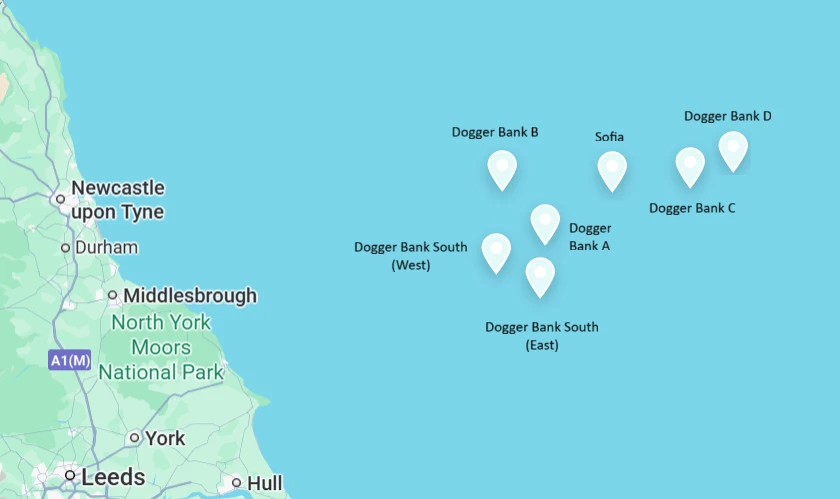
Source: Adapted from The Crown Estate Asset Map
The planned Dogger Bank South arrays are the closest to shore, while Dogger Bank A-C and Sofia, which are all under construction, are clustered further out in the North Sea.
The proposed Dogger Bank D will be the furthest offshore, close to the maritime border with the Netherlands and Germany.
Dogger Bank A and B are being developed with a high-voltage cable coming ashore at Ulrome, north of Bridlington. The cables for Dogger Bank C and Sofia will make landfall further north at Redcar, Teesside.
The two separate connections to the National Grid are being built to prevent bottlenecks that the combined power of the wind farms could cause. They also provide redundancy for the system.
Dogger Bank wind farm development timeline
This section summarises the investment and construction timeline for all major wind farm projects under development or in planning on Dogger Bank.
Pre-2019: Planning for development
The Crown Estate owns the economic rights to the seabed more than 12 kilometres offshore, which includes the entirety of the UK’s section of Dogger Bank.
Between 2008 and 2010, the Crown Estate awarded offshore wind leases for various sections of Dogger Bank, giving the holders exclusive rights to develop offshore wind in those areas. During the 2010s, the leaseholders carried out the necessary environmental and technical studies for the proposed wind farms.
In 2015, both the Sofia project and the Dogger Bank A-C developments received Development Consent Orders from the UK government. This is the form of planning permission required for nationally significant infrastructure projects.
September 2019: Contracts for Differences awarded
The Contracts for Difference scheme is the UK government’s principal subsidy for large-scale renewable energy generation.
In Allocation Round 3, in September 2019, the Sofia Wind Farm and Dogger Bank A-C secured contracts guaranteeing the price of the power they will generate for the first 15 years of operation.
The CfD contracts give developers certainty over the price of each megawatt hour (MWh) of power generated, enabling them to secure the multi-billion-pound investments required to begin construction.
2020/21: Investment secured
In 2020 and 2021, the Sofia project and the Dogger Bank A-C developments reached “financial close”, securing the financing required through signed contracts with lenders and investors.
Dogger Bank A-C investment
Here are the public details of the financial close for Dogger Bank A-C:
- Financing committed: c. £9 billion
- Financial close dates: A & B: November 2020; C: December 2021
- Equity partners: Equinor 40%, SSE 40%, Vårgrønn 20%
- Lenders: Consortium of 29 banks and three export credit agencies
SSE is a business energy supplier, providing energy to around 200,000 British businesses. Its equity stake allows it to use power from Dogger Bank to deliver its green business energy tariffs.
Sofia offshore wind farm investment
Here are the public details of financial close for the Sofia offshore wind farm:
- Financing committed: c. £3 billion
- Financial close date: March 2021
- Ownership and financing: Wholly owned and financed by RWE
2021 onwards: Construction
Construction commenced for each project following financial close. The developers have announced the following notable milestones:
- July 2022 – Work to commence laying turbine foundations at Dogger Bank A
- July 2023 – Offshore HVDC substation platform installed for Dogger Bank A
- October 2023 – First wind turbine installed at Dogger Bank A; power generation begins
- April 2024 – Offshore HVDC substation platform installed for Dogger Bank B
- May 2024 – Work to commence laying turbine foundations at Dogger Bank B
- May 2024 – Work to commence laying turbine foundations at Sofia
- March 2025 – First turbine installed at the Sofia Offshore Wind Farm
- May 2025 – Offshore HVDC substation platform installed for Dogger Bank C
- June 2026 – Installation of all turbines completed at Sofia Offshore Wind Farm
Technology used at the Dogger Bank wind farms
Building a wind farm on the scale of Dogger Bank, hundreds of kilometres offshore, is pushing the boundaries of current wind farm technology.
Dogger Bank has become a proving ground for technical innovation. Below, we summarise some of the key technological developments being implemented at the Dogger Bank wind farms.
Wind turbines
The wind turbines being constructed at Dogger Bank are enormous, among the largest and most powerful offshore wind turbines in the world. A single rotation of one of these turbines can generate enough electricity to power the average British home for two days.
Each blade is approximately 110 metres in length. The tip height of a turbine is 260 metres, comparable to The Shard, Western Europe’s tallest building.
Each wind farm array on Dogger Bank will feature rows of turbines arranged in line with the prevailing North Sea winds, with around one kilometre between each turbine.
The most advanced project, Dogger Bank A, is being constructed with 95 turbines, covering an area of 515 square kilometres.
High-voltage direct current transmission
Dogger Bank A will be the first offshore wind farm in the UK to use high-voltage direct current (HVDC) transmission.
Power generated by the turbines must travel more than 100 kilometres to connect to the National Grid on the British mainland.
To reduce transmission losses over this distance, Dogger Bank A is building an offshore converter platform, which converts the alternating current (AC) from the turbines into direct current (DC) that is transmitted via undersea cables.
AC power switches direction 50 times per second, creating resistive losses in high-voltage cables. In contrast, DC flows more efficiently in a single direction.
Once onshore, the power received from the undersea cables will be converted back to AC, as this is the form used by the national grid and distribution network operators to transmit electricity across the British mainland.
Digital and control systems
The wind farms being constructed on Dogger Bank are designed to operate fully remotely.
Unlike gas platforms in the North Sea, which house a permanent team of staff, the wind farms will be operated from an onshore control centre.
They will use a Supervisory Control and Data Acquisition (SCADA) system, with sensors installed on the turbines to detect issues and enable proactive maintenance.
What is the strategic importance of Dogger Bank wind farms
The UK government has supported the development of the Dogger Bank wind farms through its CfD scheme.
Here, we explore the environmental, security, and economic reasons why the government is backing the development of wind farms on Dogger Bank.
Renewable and low carbon power generation
The wind farms planned on Dogger Bank will form the world’s largest offshore wind cluster.
The electricity generated by these wind farms produces no direct greenhouse gas emissions and relies solely on the power of the wind, a renewable source of energy.
Power from Dogger Bank will make a significant contribution to Britain’s overall electricity demand and will reduce reliance on polluting gas fired power stations.
The UK government’s Clean Power 2030 plan targets 50 GW of offshore wind capacity by 2030, up from 31 GW in 2025. The projects under construction or in planning at Dogger Bank could provide 10 GW of this additional capacity.
Energy security
Another key element of the UK government’s energy strategy is achieving greater energy security.
At present, the UK grid relies heavily on natural gas imports via the Langeled pipeline and maritime LNG imports, which are then used to generate electricity at gas-fired power stations.
A key feature of the UK wind farms is that they do not depend on imported energy sources.
The turbines being installed on Dogger Bank are engineered to produce power for at least 25 years, relying solely on the abundant wind resources of the North Sea.
Economic impact
The initial construction of Dogger Bank A-C represents £9 billion of investment in the UK’s energy industry. It has created thousands of jobs in construction, operations, and maintenance across Hull, Teesside, Newcastle, and Grimsby.
The UK has by far the largest offshore wind capacity in Europe. The developments on Dogger Bank continue the UK’s leading role in delivering large-scale offshore wind farms.
Impact on electricity costs
The Dogger Bank A-C and Sofia developments received their Contracts for Difference agreements in 2019, when wholesale electricity prices were lower than they are today.
The strike price agreed for these projects is below current market prices, meaning the power produced from them should help reduce average domestic and business electricity prices.
Environmental considerations for the Dogger Bank wind farms
Dogger Bank is designated a Special Area of Conservation under UK law, protecting its sandbank habitat.
The decision to approve the construction of wind farms on the sandbank has been controversial. Some environmental groups argue that allowing development undermines the purpose of Dogger Bank’s protected status.
Here are the key environmental concerns and criticisms surrounding the construction of wind farms on Dogger Bank.
Seabed disturbance
The construction of each wind turbine requires a foundation to support the turbine tower.
The wind farms on Dogger Bank use monopile foundations, in which a giant steel tube, up to 10 metres in diameter and 50–90 metres long, is driven into the seabed to a depth of around 30 metres. The turbine tower is then attached on top of the monopile.
Installing the monopile foundations requires loud hammering that can create underwater noise of up to 220 dB. High-intensity underwater noise is known to affect the behaviour of marine life and fish, which tend to avoid the area during construction.
To mitigate this impact, pile-driving begins with lower-energy strikes that gradually increase, giving marine life a chance to leave the area. In addition, a ring of perforated hoses is placed around the pile, releasing a curtain of compressed air bubbles. This acts as a shield, absorbing sound waves to reduce noise intensity.
Impact on birdlife
The Dogger Bank habitat is an important feeding ground for a variety of seabirds, including kittiwakes, gannets, and skuas.
Environmental groups are concerned that the construction of wind turbines could either displace these species from the area or lead to collisions with the blades.
During the planning process for each wind farm, the flight paths of bird species were modelled and the layouts of the arrays were adjusted to minimise the impact on birdlife.
Impact from electromagnetic fields
The development of the wind farms on Dogger Bank involves laying high-voltage cables on the seabed, both between turbines and for export to the mainland.
Transmitting power through these cables produces an electromagnetic field. There are concerns about the impact this may have on sharks and rays inhabiting the sandbank, as they use electric and magnetic cues for navigation and hunting.
To mitigate these risks, the developers at Dogger Bank use shielded cables, buried 1–3 metres beneath the seabed, to reduce potential exposure of wildlife to electromagnetic fields.
 Back to blog
- Share: