 Our use of cookies
Distribution Network Operators (DNOs): Responsibilities, Infrastructure and Maps
The electricity grid in Britain is not a single continuous network. Instead, the country is divided into 14 regional distribution grids, each managed separately by Distribution Network Operators (DNOs), which provide electricity to properties within their respective areas.
In this guide, we explain the role of Distribution Network Operators in the British electricity grid. Here is what we cover:
- What is a Distribution Network Operator?
- Infrastructure used by a DNO to distribute electricity
- What Distribution Network Operators are responsible for
- How do I find my Distribution Network Operator?
- Distribution Network Operators by region
What is a Distribution Network Operator?
A Distribution Network Operator is a company that owns, operates and maintains the low-voltage electrical infrastructure in a particular region.
Regional electricity distribution networks receive power at 132 kV from the high-voltage national grid, distribute it across the region at 33 kV, and then reduce the voltage at a local level to provide a mains electricity supply to individual homes and businesses.
A Distribution Network Operator is a licensed role regulated by the energy regulator Ofgem, which defines each DNO’s geographical distribution area and requires them to develop and maintain the electricity network within that area.
Infrastructure used by a DNO to distribute electricity
A Distribution Network Operator receives high-voltage electricity from the national grid and uses the following sequence of infrastructure to deliver a power supply to local properties:
- Grid substations: Facilities located at the connection point with the high-voltage transmission grid. They use high-capacity transformers to step the 132 kV supply down to 33 kV.
- Overhead cables: The backbone of the distribution network, distributing power to key areas of demand using 33 kV cables.
- Substations: Local facilities that step the voltage down from 33 kV to either 400V for a three-phase commercial connection or 230 V for small businesses and domestic properties.
- Underground cables: Cables that distribute lower-voltage electricity in urban areas, connecting individual properties.
The DNO uses protection equipment throughout the network to control power flows and manage faults.
What Distribution Network Operators are responsible for
The licence issued by Ofgem assigns the following four key areas of responsibility to each regional DNO:
Efficient and reliable network operation
DNOs are responsible for ensuring the local grid is well maintained, enabling electricity to be delivered efficiently and reliably within the local area.
Ofgem uses a series of incentives and penalties related to operational performance, customer service and environmental factors.
DNOs are responsible for managing and resolving power cuts that occur on their networks and have the following targets:
- Unplanned power cuts (non severe weather) – Restore supply within 18 hours
- Unplanned power cuts (severe weather) – Restore supply within 24 hours
When these targets are missed, Ofgem requires the DNO to automatically compensate affected businesses and households.
Network reinforcement and expansion
Each DNO must continually develop its network, anticipating future demand and generation, to ensure the network can accommodate the following types of connection requests:
- New users: Providing new domestic or business electricity connections to properties within their region.
- Renewables: Facilitating connections for small-scale renewable generation, such as wind farms and commercial solar panels.
To introduce competition into the networks market, Ofgem allows licensed Independent Distribution Network Operators to make connections to new developments extending existing DNO networks.
Providing access to suppliers
DNOs must facilitate licensed energy suppliers using their network to deliver electricity to domestic and business consumers.
Distribution Network Operators cannot themselves provide an electricity supply directly to customers in their area. Instead, electricity is supplied by licensed energy suppliers operating in the retail energy market.
DNOs are responsible for managing Meter Point Administration Numbers (MPANs) allocated to electricity connections in their region. Suppliers use this system to identify and track the electricity consumption of individual properties.
Comply with pricing controls
DNOs earn Distribution Use of System (DUoS) charges from energy suppliers that use their networks.
As DNOs are natural monopolies, DUoS charges are carefully regulated by Ofgem, which limits what DNOs can recover from customers.
Energy suppliers pass on DUoS charges in the tariffs they offer to their customers. These charges do not normally appear separately on electricity bills but are instead included within:
- Unit domestic or business electricity prices per kWh
- Domestic or business electricity standing charges
Distribution charges vary by DNO, which is why we ask for your postcode when using our business electricity comparison service.
How do I find my Distribution Network Operator?
Here are the three easiest ways to identify the Distribution Network Operator that manages your connection to the electricity grid:
- Refer to the Distribution ID on your MPAN (as indexed in the table below).
- Find your region in the table below and follow the link to your DNO.
- Use the Energy Networks Association’s ‘find my network operator’ tool.
| MPAN Prefix | Region | Distribution Network Operator |
|---|---|---|
| 10 | East England | UK Power Networks |
| 11 | East Midlands | National Grid |
| 12 | London | UK Power Networks |
| 13 | North Wales, Merseyside and Cheshire | SP Energy Networks |
| 14 | West Midlands | National Grid |
| 15 | North East England | Northern Powergrid |
| 16 | North West England | Electricity North West |
| 17 | North Scotland | Scottish and Southern Energy |
| 18 | Central and Southern Scotland | SP Energy Networks |
| 19 | South East England | UK Power Networks |
| 20 | Southern England | Scottish and Southern Energy |
| 21 | South Wales | National Grid |
| 22 | South West England | National Grid |
| 23 | Yorkshire | Northern Powergrid |
Distribution Network Operators by region
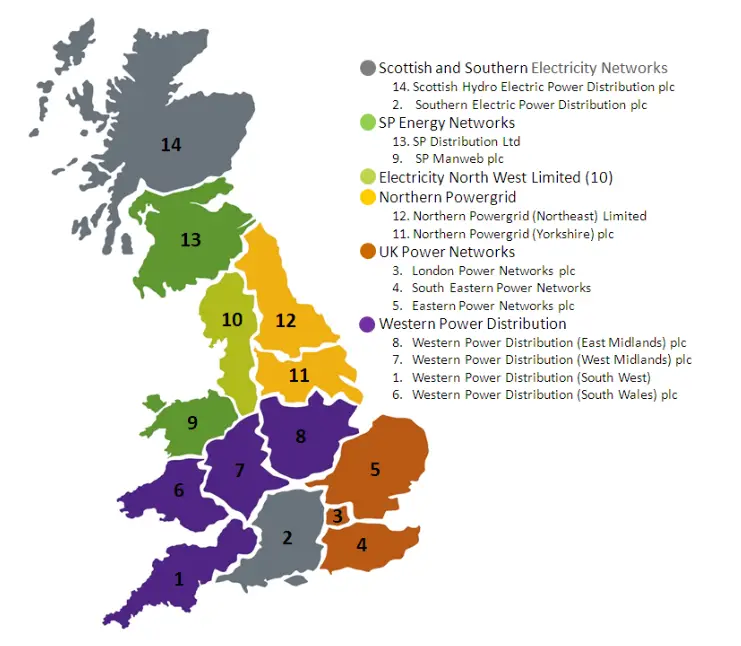
Distribution Network Operators in Britain are defined by their geographical areas. Each operator is responsible for distributing electricity to homes and businesses within its region.
The following map shows the 14 electricity distribution network regions:
Boundaries between DNOs
Licences issued by Ofgem establish formal, legally defined boundaries between DNO regions. Transferring a site between DNOs is typically not possible.
For new developments located near a boundary, only the DNO responsible for the connection point can make a connection offer.
Although the networks are divided at regional boundaries, adjacent DNOs typically interconnect via network interface points, which help to support network resilience and security of supply.
Who are the electricity Distribution Network Operators?
The following six companies own the 14 electricity distribution networks in Britain:
- SP Energy Networks – Part of the Scottish Power group, which is also a business energy supplier and owns a range of renewable electricity generation assets, including UK wind farms.
- National Grid Electricity Distribution – A subsidiary of National Grid plc, which also owns and operates the high-voltage electricity transmission network connecting the regional electricity distribution networks.
- Northern Powergrid – Owned by Berkshire Hathaway, Northern Powergrid exclusively manages electricity distribution networks and is focused on delivering a reliable power supply while investing in network innovation.
- Electricity North West – A privately owned electricity distribution company that focuses on providing a dependable power supply while investing in network resilience and environmental sustainability.
- Scottish and Southern Electricity Networks – A subsidiary of SSE plc, which also operates as a business electricity and business gas supplier, and is a major investor in UK renewables, including hydroelectric and wind power.
- UK Power Networks – Owned by the Cheung Kong Group (CK Group), UK Power Networks operates electricity distribution networks and focuses on reliable power delivery and infrastructure maintenance.
 Back to blog
- Share: