 Our use of cookies
Low Carbon Contracts Company (LCCC): Roles in the CfD and RAB schemes
The Low Carbon Contracts Company (LCCC) sits at the financial centre of the UK’s transition to a carbon-neutral energy system.
The LCCC enters into long-term contracts with private investors in low-carbon technologies, providing guaranteed price certainty over multiple decades. This certainty underpins billions of pounds of investment in renewable energy, nuclear power, hydrogen production and carbon capture infrastructure.
This article explains who the LCCC is, why it was created and how its settlement and levy processes operate in practice.
Who are the Low Carbon Contracts Company?
The Low Carbon Contracts Company (LCCC) is a government-owned company established to administer the UK’s low-carbon energy support mechanisms.
It oversees the settlement, payment and levy collection processes for the following schemes:
- Contracts for Difference
- Low Carbon Hydrogen Agreement
- Carbon Capture Revenue Support Contracts
- Nuclear RAB model
The LCCC provides the financial infrastructure that gives private investors in low-carbon technologies the confidence to develop assets in the UK.
Why was the Low Carbon Contracts Company created?
The Low Carbon Contracts Company was established in 2013 as part of the UK’s Electricity Market Reform programme to operate the newly created Contracts for Difference (CfD) scheme.
Under the reform, Contracts for Difference replaced the Renewable Obligation scheme as the principal support mechanism to encourage the decarbonisation of the national grid.
The financial settlement of the Contracts for Difference scheme is complex and involves:
- Continuous cash flow management
- Forecast modelling
- Levy collection
- Credit cover monitoring
- Reconciliation processes
The LCCC was created to act as a single, creditworthy counterparty to CfD agreements. Its operational independence from the energy regulator and government departments strengthens its governance and enhances confidence in the scheme.
What are the Low Carbon Contracts Company’s responsibilities?
The LCCC has responsibilities across four separate low-carbon subsidy schemes. This section explains its role in each.
Contracts for Difference
The Contracts for Difference scheme is the LCCC’s core and original function. It is the principal government support mechanism for large-scale renewable electricity generation, providing a guaranteed strike price per MWh of electricity generated by participating projects.
The LCCC acts as the counterparty, entering into contracts with all eligible participants in the scheme. It is responsible for making and collecting CfD difference payments, which effectively stabilise the electricity price received by participants.
The LCCC funds payments to scheme participants by charging domestic and business energy suppliers the Supplier Obligation levy.
In the sections below, we fully explain the LCCC’s role in managing the CfD scheme and collecting the Supplier Obligation levy.
Low Carbon Hydrogen Agreement
The Low Carbon Hydrogen Agreement (LCHA) is a revenue support scheme for the low-carbon production of hydrogen, specifically:
- Electrolytic hydrogen — Produced using excess electricity from UK wind farms to split water via electrolysis.
- CCUS-enabled hydrogen — Produced from reformed natural gas with associated carbon capture and storage.
The Low Carbon Hydrogen Agreement operates in a similar manner to the CfD scheme. It provides revenue stabilisation by paying a difference payment where the achieved market price for hydrogen falls below the agreed strike price.
The LCCC’s role includes:
- Signing the contract with the hydrogen producer
- Calculating price gap (difference) payments
- Collecting levy funding
- Enforcing contractual compliance
- Monitoring carbon intensity eligibility
In its 2025 annual report, the LCCC stated that it had signed its first 10 Low Carbon Hydrogen Agreements.
The Hydrogen Production Business Model is currently funded through general taxation.
Carbon Capture Revenue Support Contracts
Carbon Capture Revenue Support Contracts are subsidy mechanisms designed to encourage the roll-out of Carbon Capture, Usage and Storage (CCUS) technology in the UK.
The scheme provides revenue support for the following categories of CCUS projects:
- Industrial facilities, such as chemical and cement plants, that capture the carbon dioxide they produce.
- Gas power stations that capture carbon dioxide produced from the combustion of natural gas.
- Carbon dioxide transport and storage infrastructure operators that transport and permanently store captured carbon dioxide.
In 2025, the LCCC entered into its first two Carbon Capture Revenue Support Contracts with a cement facility in North Wales and an energy-from-waste facility in the North East of England.
Nuclear RAB model
The Nuclear Regulated Asset Base (RAB) model is a funding mechanism currently being used to support the construction of Sizewell C nuclear power station.
The scheme provides investors with a guaranteed return on their investment in the nuclear power plant.
The LCCC’s role is to calculate payments due under the model. The scheme is funded through the RAB nuclear levy, which is paid by licensed electricity suppliers operating in the retail energy market.
Find out more in our full guide to the Nuclear RAB model.
How the Low Carbon Contracts Company manages Contracts for Difference
The Low Carbon Contracts Company acts as the statutory counterparty to eligible generators participating in the CfD scheme.
Once a generator is successful in a CfD allocation round, the LCCC enters into a legally binding CfD contract with that generator.
The contract between the LCCC and the generator stabilises the wholesale electricity price received by the generator through the following mechanism:
- If the current market reference price is lower than the strike price, the LCCC pays the generator the difference for each MWh of electricity generated.
- If the current market reference price is higher than the strike price, the generator pays the LCCC the difference for each MWh of electricity generated.
The LCCC calculates different payments on a monthly basis using meter readings and the applicable market reference price. It issues invoices and arranges payments on a monthly settlement cycle.
For more information, read our full guide to the Contracts for Difference scheme for renewable energy.
What the LCCC is not responsible for
The LCCC performs a key role in the operational mechanics of the CfD scheme. However, wider policy design and regulatory oversight are the responsibility of other parties:
- It does not set strike prices — These are determined through competitive allocation rounds, with maximum strike price caps set by the UK Government.
- It does not determine eligibility criteria for generators — The auction structure, eligibility rules and overall budget are set by the UK Government.
- It does not enforce payment of the Supplier Obligation levy — Ofgem holds enforcement powers over licensed electricity suppliers.
How the Low Carbon Contracts Company manages the Supplier Obligation Levy
The Supplier Obligation Levy is the funding mechanism for net payments under the Contracts for Difference scheme.
The Supplier Obligation is a statutory levy imposed on licensed electricity suppliers in Great Britain. Each supplier pays the Supplier Obligation Levy for every MWh of electricity supplied to domestic and business customers.
The steps below explain the LCCC’s role in managing the Supplier Obligation Levy.
Forecasting expected CfD payments
The LCCC continuously monitors and forecasts the CfD payments it expects to make in upcoming quarters by analysing:
- Expected generation by CfD holders
- Strike prices under each CfD contract
- Expected movements in the wholesale electricity market
The LCCC then applies forecast electricity demand across all eligible domestic and business electricity connections to calculate a levy rate in £/MWh sufficient to cover expected CfD payments.
The LCCC publishes a two-year forecast of levy rates, setting out the expected quarter-by-quarter payments suppliers will be required to make for each MWh of electricity supplied to their customers.
Finalising quarter levy rates
The Supplier Obligation Levy rates payable by electricity suppliers are set quarterly by the LCCC and comprise the following two elements:
- Interim Levy Rate (£/MWh) — a payment designed to meet the LCCC’s projected obligations under existing CfD contracts, with adjustments to maintain a reserve in case of forecast error or supplier default.
- Operational Cost Levy (£/MWh) — a separate payment to recover the LCCC’s operating costs.
The LCCC typically provides suppliers with one month’s notice of upcoming levy rates.
Receiving payments
The LCCC issues monthly invoices to all licensed electricity suppliers, which specify:
- Billing period
- Levy rates
- Eligible MWh volumes (provided by the retail market operator, Elexon)
- Total amount payable
- Payment due date
💡 During 2022, when wholesale energy prices increased significantly, the LCCC received net CfD difference payments from many generators. As a result, instead of collecting net levy payments from suppliers, it made net payments back to electricity suppliers on a monthly basis.
The effect of the Supplier Obligation on electricity prices
The Supplier Obligation Levy has a direct impact on both domestic and business electricity prices, as licensed electricity suppliers pass these costs through in the tariffs they offer to customers.
The latest published Supplier Obligation rates per kWh of electricity supplied to consumers are as follows:
- Interim Levy Rate — 1.0260p/kWh
- Operational Cost Levy — 0.01089p/kWh
At these levels, the combined levy adds approximately £28 per year to a typical household electricity bill. Supplier Obligation costs are incorporated into Ofgem’s calculation of the quarterly price cap.
Businesses are not protected by the domestic price cap, so suppliers’ unit rates are more variable. Use our business electricity comparison service to find the most competitive tariffs available to your company.
The structure and governance of the Low Carbon Contracts Company
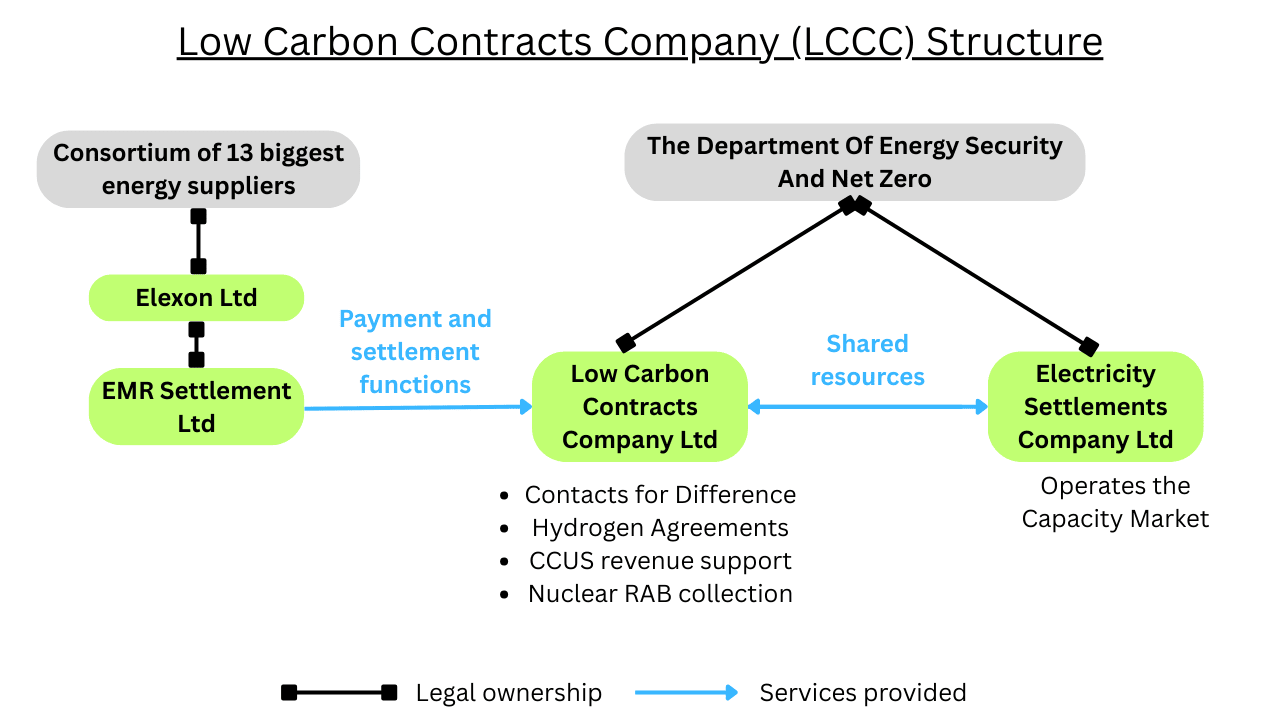
The diagram below illustrates the legal and operational structure of the Low Carbon Contracts Company.
Source: Prepared using the latest Companies House filings.
The Low Carbon Contracts Company is a private limited company incorporated in 2013 under the Companies Act 2006. It is wholly owned by the Secretary of State for Energy Security and Net Zero.
The LCCC operates on a not-for-profit basis and seeks to recover its costs through levies on electricity suppliers and government funding for other schemes. It is structured to break even over the financial year.
The LCCC is led by an independent Board of Directors focused on delivering its strategic objectives.
The relationship between the Low Carbon Contracts Company and the Capacity Market
The LCCC does not administer the Capacity Market. Instead, this is operated by the LCCC’s sister company, the Electricity Settlements Company (ESC). Both the LCCC and the Electricity Settlements Company are wholly owned by the Secretary of State for Energy Security and Net Zero.
The Capacity Market is a mechanism designed to ensure sufficient electricity generation capacity is connected to the national grid to meet peak demand in future years.
The Electricity Settlements Company is responsible for the financial settlement of the Capacity Market, including making capacity payments to capacity providers and managing payment flows associated with the scheme.
Confusion can arise because the LCCC and the Electricity Settlements Company share the same senior management team, staff, office locations and website.
 Back to blog
- Share: