 Our use of cookies
Understanding the British retail energy market
The retail energy market is a key part of Britain’s energy industry, where licensed suppliers compete to deliver electricity and gas to homes and businesses.
Over the past three decades, this market has transformed from state monopolies into an open, competitive market. Along the way, it has faced major challenges, including energy price shocks, supplier collapses, tighter regulation and the urgent push to decarbonise.
This guide explains the retail energy market. Here are the key parts of our guide:
- What is the retail energy market?
- How the retail energy market works
- Retail energy market structure and regulations
- How tariffs are priced in the retail energy market
What is the retail energy market?
The retail energy market is the competitive, consumer-facing part of the energy industry, where licensed suppliers sell mains electricity and gas to households and businesses.
In the retail market, licensed suppliers purchase electricity and gas on the wholesale market, pay to distribute it through the grid, and then sell it to individual consumers through energy tariffs.
The retail energy market is open to competition, meaning households and businesses can choose any licensed supplier for their electricity and gas supply.
Suppliers actively compete for customers, aiming to build loyalty and grow their market share. This competition encourages better customer service and lower prices.
Liberalisation of the energy market
In the 1990s, the British energy industry went through a period of privatisation and liberalisation, which meant:
- Privatisation – transferring key parts of government-owned energy infrastructure to private companies.
- Liberalisation – opening up the market to competition by removing monopolies and allowing new companies to enter and compete.
In the late 1980s and early 1990s, monopoly electricity and gas companies were privatised, with their shares sold on the London Stock Exchange.
Initially, these private companies continued to be the sole energy suppliers to all properties using their infrastructure. Over time, the retail market was gradually liberalised between 1990 and 1998, with large business energy customers first gaining a choice of suppliers. The market then opened up to smaller businesses and, finally, domestic customers.
The former monopolies were sold, merged and rebranded over time, becoming the large energy supplier brands still competing today, such as EDF, E.ON, Scottish Power, SSE and British Gas.
Difference between the wholesale and retail markets
The retail and wholesale energy markets serve different economic functions and operate at either end of the British energy system:
- Wholesale energy market – a competitive market where generators, importers, traders and suppliers buy and sell electricity and gas on the grid.
- Retail energy market – a competitive market where licensed energy suppliers are contracted to provide electricity and gas services to end users.
How the retail energy market works
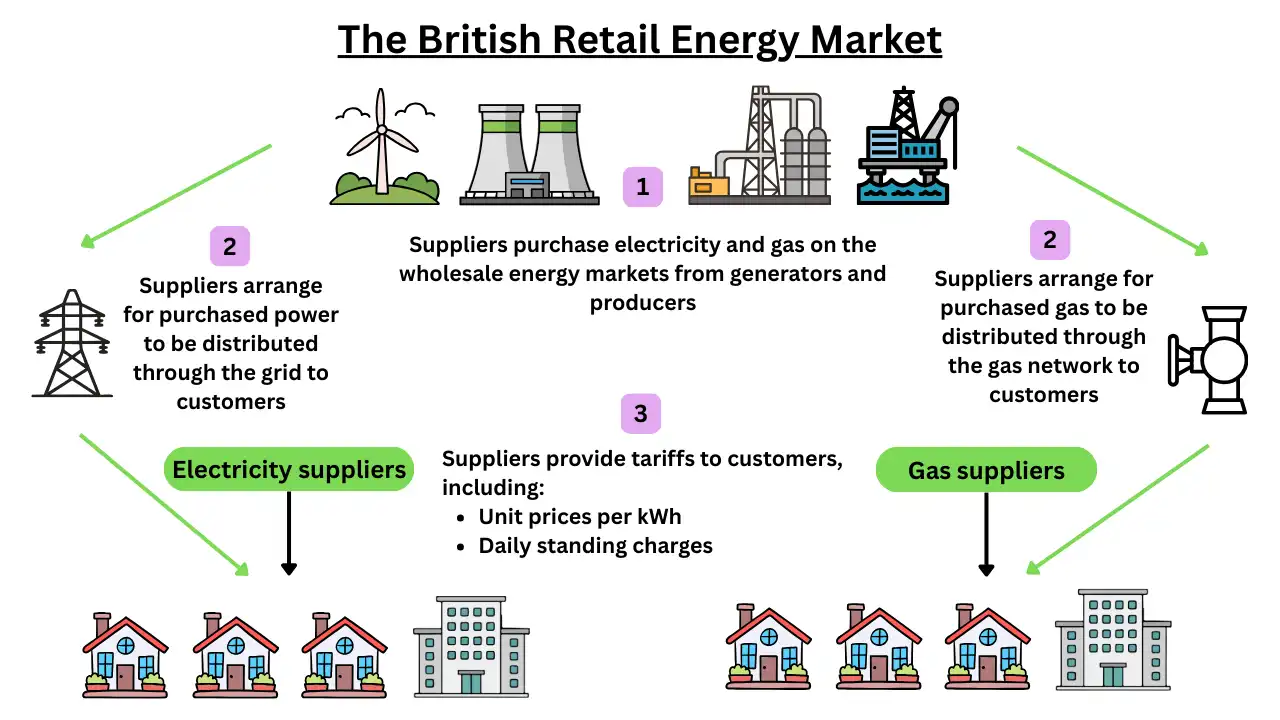
Below, we explain how the retail energy market fits within the wider industry and outline the three key activities carried out by licensed energy suppliers operating in this market.
1. Purchasing electricity and gas on the wholesale market
Retail energy suppliers must continually purchase electricity and gas to match the consumption of their customers.
Licensed energy suppliers make purchases in the following two markets:
Wholesale electricity purchases
Electricity purchases are made on the wholesale electricity market from companies that own the following generation assets:
- UK wind farms
- Gas power stations
- Nuclear power stations
- Other small-scale renewables and biomass sources.
Suppliers use a combination of long-term Power Purchase Agreements and short-term purchases made directly on commodity exchanges.
Wholesale gas purchases
Gas purchases are made on the wholesale gas market from the following producers and importers of natural gas:
- Domestic gas production in the North Sea and Irish Sea
- LNG imports
- Imports via the Langeled pipeline and other undersea routes.
2. Arranging distribution of electricity and gas
Licensed energy suppliers pay to deliver energy to their customers using electricity and gas infrastructure. The following section explains how this works for electricity and gas distribution.
Electricity distribution
Licensed suppliers must use the high-voltage national grid and regional distribution networks to deliver a mains electricity supply to customers.
To distribute power through the grid, licensed electricity suppliers must pay:
- TNUoS charges to the national grid owner
- BSUoS charges to the national grid operator, NESO
- DUoS charges to the relevant regional Distribution Network Operator
Gas distribution
Licensed suppliers use the National Transmission System and the regional Gas Distribution Network when delivering a mains gas supply to customers.
Suppliers pay a combination of unit charges per kWh and standing charges for using these gas distribution networks.
3. Providing an electricity and gas supply to consumers
A retail licence from Ofgem allows energy suppliers to offer electricity and gas tariffs to domestic and business customers using a mains supply.
Providing supply tariffs to customers involves the following activities:
Metering
Domestic and business energy suppliers measure how much electricity and gas their customers consume using the following devices:
- Smart electricity meters
- Traditional single-rate and Economy 7/10 meters
- Half-hourly electricity meters
- Smart gas meters
- Analogue imperial and metric gas meters
Billing
Licensed suppliers agree on tariff rates with customers, which define:
- Domestic and business electricity prices per kWh
- Domestic and business electricity standing charges
- Domestic and business gas prices per kWh
- Domestic and business gas standing charges
These agreed tariffs, together with energy meter readings, are used to calculate customers’ regular bills.
For more information about this process, visit our guides to business electricity bills and business gas bills.
Customer service
Energy suppliers must maintain a customer service function to manage billing queries and other customer enquiries.
Ofgem requires suppliers to have processes and procedures in place to handle domestic and business energy complaints.
Retail energy market structure and regulations
This section explains the role of the market regulator and the key rules and arrangements governing the retail energy market.
The role of Ofgem
Ofgem is the independent regulator for the energy industry in Britain. Ofgem licenses domestic and business electricity and gas suppliers and monitors them to ensure they comply with licence conditions and other regulatory requirements.
Key regulations from Ofgem include:
- Supplier licence conditions – suppliers must meet specific standards for customer service, billing accuracy, financial resilience and environmental reporting.
- Default energy price cap – a prescribed maximum charge on standard variable tariffs for domestic customers.
- Financial resilience rules – Ofgem requires suppliers to maintain adequate capital and robust risk management practices.
Ofgem offers four types of licences for the retail energy market:
- Domestic electricity supplier
- Business electricity supplier
- Domestic gas supplier
- Business gas supplier
An individual supplier can hold more than one of these licence types. Ofgem publishes lists of current retail electricity licences and gas licences on its website.
Retail Market Indicators (RMI)
The Retail Market Indicators (RMI) are a set of metrics published by Ofgem to monitor how the retail energy market is functioning.
The RMI metrics cover the following broad areas:
- Prices and margins – reviewing default tariff prices versus competitive deals to understand how the competitive market is functioning.
- Competition and switching – reviewing the market shares of the largest suppliers and rates of domestic and business energy switches.
- Consumer engagement – the proportion of customers on default tariffs and the use of price comparison sites.
- Customer experience – complaints data and service quality metrics.
Ofgem publishes the RMI metrics in its monthly retail market indicators report.
Market arrangement and industry codes
Retail energy suppliers must comply with a series of codes and frameworks that set out the technical, commercial and procedural rules governing the market.
Here are the key industry codes governing the retail electricity and gas markets:
| Code | Supply type | Purpose |
|---|---|---|
| Balancing and Settlement Code (BSC) | Electricity | Governs wholesale electricity settlement, imbalance pricing and system balancing (administered by Elexon). |
| Retail Energy Code (REC) | Electricity & Gas | Governs retail market processes, including customer switching, meter registration, data flows and consumer protections across both fuels. |
| Smart Energy Code (SEC) | Electricity & Gas | Provides the legal and operational framework for smart metering infrastructure, including data access and communications via the Data Communications Company (DCC). |
| Distribution Connection and Use of System Agreement | Electricity | Sets out the rules for suppliers’ and users’ connection to, and use of, electricity distribution networks. |
| Grid Code | Electricity | Specifies the technical and operational requirements for parties interacting with the electricity transmission system. |
| Uniform Network Code (UNC) | Gas | Governs access to, and operation of, the gas transmission and distribution networks, including allocation, balancing and capacity arrangements. |
| Supply Point Administration Agreement (SPAA) | Gas | Covers gas retail processes such as supply point registration, switching, meter reading and customer transfers between suppliers. |
These codes are legally binding and may only be changed through formal governance processes involving industry stakeholders and Ofgem.
Market differences for businesses and households
Despite the grid infrastructure being identical for businesses and households, they are treated differently under industry rules and regulations.
Energy suppliers are licensed separately for domestic and non-domestic customers, with the following key differences:
- Price cap – The energy price cap limits electricity and gas rates on domestic variable tariffs. Business energy prices are not restricted by regulation.
- Cooling-off period – Domestic tariffs are protected by a 14-day cooling-off period. Business energy contracts do not typically include a cooling-off period.
How tariffs are priced in the retail energy market
Tariffs offered in the retail energy market are designed to cover all the costs associated with providing an electricity or gas supply, plus a margin for the supplier’s profit.
As explained above, the largest costs incorporated into customer tariffs are wholesale commodity purchases and distribution costs.
This section explains the other key factors suppliers take into account when designing tariff rates:
Risk management and hedging
Suppliers typically offer multi-year fixed tariffs to new customers, which have a set unit price per kWh of electricity or gas supplied.
By entering into these customer contracts, suppliers are exposed to price risk, with tariffs becoming unprofitable if underlying wholesale prices rise.
To manage this price risk, suppliers employ hedging strategies that include:
- Forward purchasing – Purchasing electricity and gas in advance, with a defined future delivery date based on their expected future customer base.
- Trading – Using wholesale markets to adjust contracted forward purchases as customer numbers and risk profiles change.
Environmental levies and taxes
Licensed energy suppliers are responsible for collecting a range of environmental levies and taxes from consumers of gas and electricity. These include:
- Climate change levy
- Contracts for difference levy
- Renewable Obligation
- VAT on business energy rates/domestic energy rates
- Green gas levy
The cost of these levies is incorporated into the tariff rates offered to customers.
Supplier margins
Licensed energy suppliers are typically privately owned companies that seek to make a profit by earning a margin on top of their underlying costs.
When incorporating a margin into tariffs, suppliers must balance the profitability of individual tariffs against the risk that customers will switch to alternative suppliers offering cheaper rates.
Across the domestic and business retail markets, the most unfavourable rates are out-of-contract and deemed rates, which apply to customers who do not have an active fixed tariff with a supplier.
In both the domestic and business retail markets, customers who regularly compare the market to find the cheapest tariffs benefit from the lowest rates.
At Business Energy Deals, we help non-domestic users navigate the retail market and find competitive prices. Use our business electricity comparison and business gas comparison services to find the best deals for your business.
Recent developments in the retail energy market
Below, we summarise four key developments in the retail energy market that have occurred since 2020.
Energy price crisis 2021/22
During the energy price crisis, wholesale energy costs soared due to a post-COVID surge in demand and constrained European gas supplies, exacerbated by the conflict in Ukraine.
The price rises significantly increased costs for retail energy suppliers. Many suppliers found they could not fulfil the fixed contracts agreed with their customers and became unprofitable when charging variable tariffs constrained by Ofgem’s price cap.
As a result of these financial difficulties, 30 energy suppliers collapsed, including major firms such as Bulb, impacting more than four million customers.
In response to the crisis, Ofgem’s regulations were amended to:
- Introduce capital adequacy rules – Suppliers are required to demonstrate stronger financial resilience.
- Energy price cap updates – The energy price cap now changes every three months (previously every six months) to be more responsive to wholesale price changes.
- Market entry reforms – New suppliers face much stronger scrutiny before becoming licensed.
Renewable energy products
Public and corporate interest in tackling climate change has increased considerably in recent years.
Suppliers now compete to offer renewable domestic and green business energy tariffs.
Green tariffs are verified using Renewable Energy Guarantees of Origin (REGO) certificates, which provide proof that an energy supplier has purchased electricity generated from renewable sources.
Energy suppliers are also diversifying by offering additional green services, such as installing domestic and commercial solar panels and providing EV charging solutions.
Smart meter rollout
In 2011, the UK government mandated a transition in the retail energy market to a universal network of smart meters for homes and businesses.
Smart meters automatically transmit meter readings to suppliers, avoiding the need for manual readings and providing the industry with better consumption data.
Once the smart meter rollout is complete, the industry plans to implement Market-wide Half-hourly Settlement (MHHS) reform, under which all meters will automatically transmit readings every thirty minutes.
Having more granular data on electricity consumption is expected to improve demand forecasting for suppliers and generators, and help enhance the flexibility of the energy grid by allowing suppliers to offer innovative new time-of-use tariffs.
Market share developments
Over the past five years, there have been two key developments that have affected retail energy market share.
The first is increased market concentration. The number of licensed domestic energy suppliers halved following the energy crisis in 2022 and has not recovered since. The six largest energy suppliers now control over 90% of the market.
The second trend is the rise of Octopus Energy. Founded in 2015, Octopus has expanded rapidly over the past decade to become the UK’s largest energy supplier. Its growth has been driven by a reputation for strong customer service and a series of strategic acquisitions.
Challenges faced by the retail energy market
The retail energy market in Britain faces a range of emerging challenges that are affecting suppliers, consumers and regulators. Here, we summarise the three biggest challenges currently facing the market.
Affordability and fuel poverty
Current electricity prices are approximately double pre-crisis levels, placing many consumers under serious financial strain.
The retail market is under pressure to keep consumer prices low while continuing efforts to fully decarbonise the national grid.
Market interventions, such as the energy price cap, help to control prices for consumers but carry the risk of further energy suppliers going out of business.
Regulatory complexity and barriers to entry
Suppliers face an increasingly complex regulatory environment, which can be particularly challenging for smaller firms.
New financial resilience regulations have also significantly raised barriers to entry for new suppliers.
Fewer new entrants to the retail energy market are a concern, as this reduces competition, innovation and consumer choice.
Digital divide and smart meter rollout
The universal rollout of smart meters is increasing consumer choice but also adding complexity for many customers.
Millions of households remain reluctant to accept or use smart meters due to privacy concerns and misinformation about potential health risks.
In addition, the rise of flexible energy services and in-home devices risks leaving behind those without access to, or willingness to use, digital tools.
 Back to blog
- Share: