 Our use of cookies
Smart business electricity and gas meters: How they work, types and eligibility criteria
Smart meters are now standard for many British businesses. According to the latest government statistics, 61% of non-domestic customers use electricity and gas meters that automatically send readings.
If your business hasn’t taken advantage of a free smart meter upgrade yet, this guide explains how they work, the types available, and their benefits. Here’s what we cover:
- What are business energy smart meters?
- What does a smart meter look like?
- Types of smart meters for business
- Smart meter eligibility for businesses
- Benefits of smart meters for businesses
What are business energy smart meters?
Smart business energy meters are devices that measure electricity or gas consumption at non-domestic properties and meet the following Smart Metering Equipment Technical Specifications (SMETS):
1. Automatic digital measurement of consumption
A smart meter automatically takes digital readings of electricity or gas consumption. It uses electronic measurement sensors and a microprocessor to record meter readings.
This contrasts with older meter types, which only display consumption through analogue dials and require manual meter readings.
2. Automatic remote transmission of readings
Smart meters automatically transmit encrypted meter reading data over the smart metering network, which is operated by the Data Communications Company (DCC).
This central network:
- Securely carries data between meters, suppliers and network operators
- Uses standardised protocols rather than supplier-specific systems
- Ensures consistent functionality nationwide
3. Interoperability when switching suppliers
A smart meter can automatically transmit meter readings to any licensed energy supplier.
It will continue to transmit meter readings before and after switching business energy suppliers, making it easier to take advantage of the best deals.
What does a smart meter look like?
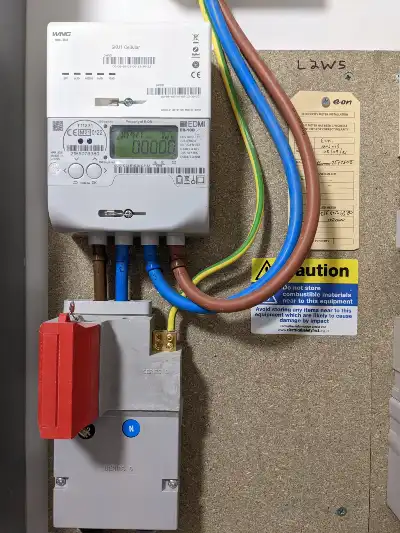
Smart meters at small business properties typically look identical to those used in homes.
They are boxes with digital displays that measure electricity or gas consumption. Here’s an example of a smart business electricity meter:
The easiest way to check whether your meter is smart and is sending automatic meter readings is to use the Smart Meter Checker on the Citizens Advice website.
Types of smart meters for business
Here are the types of smart meters used to measure the supply of electricity and gas to commercial properties in Britain.
Types of smart business electricity meters
The table below shows the most common types of electricity meters used in commercial properties in the UK.
Officially, only SMETS2 electricity meters are classed as smart meters. However, other meter types, such as half-hourly electricity meters, have similar functionality to smart meters:
| Meter type | Typical users | How consumption is measured | How readings are collected | Uses smart metering network (DCC)? | Officially classed as a smart meter? |
|---|---|---|---|---|---|
| Traditional non-smart electricity meter | Small businesses, older premises | Digital or mechanical cumulative counter | Manual meter readings | No | No – no communication capability |
| Half-hourly (HH) electricity meter | Energy-intensive businesses | Digital half-hourly intervals | Automatic (private DAs/DCs) | No | No – uses non-standard, supplier-specific communications |
| Advanced electricity meter | Medium to large businesses | Digital half-hourly intervals | Automatic (supplier systems) | No | No – uses non-standard, supplier-specific communications |
| SMETS1 electricity meter | Early smart meter adopters | Digital, half-hourly capable | Automatic via smart system | Only when upgraded | Yes – early smart meter standard but requires upgrade |
| SMETS2 electricity meter | Small and medium-sized businesses | Digital half-hourly intervals | Automatic via national system | Yes | Yes – meets all SMETS standards |
Types of smart business gas meters
The table below shows the most common types of gas meters used in commercial properties in the UK.
Officially, only SMETS2 gas meters are classed as smart meters. However, advanced gas meters can also provide automatic meter readings to certain suppliers:
| Meter type | Typical users | How consumption is measured | How readings are collected | Uses smart metering network (DCC)? | Officially classed as a smart meter? |
|---|---|---|---|---|---|
| Traditional non-smart gas meter | Small businesses, older premises | Mechanical volume measurement (cubic metres) | Manual meter readings | No | No – no communications capability |
| Advanced gas meter | Medium to large gas users | Mechanical volume measurement converted to digital data | Automatic (supplier-specific systems) | No | No – not SMETS-compliant or DCC-connected |
| SMETS1 gas meter | Early smart meter adopters | Mechanical volume measurement digitised internally | Automatic via smart system | Only when upgraded | Yes – early smart meter standard but requires upgrade |
| SMETS2 gas meter | Small and medium-sized businesses | Mechanical volume measurement digitised internally | Automatic via national system | Yes | Yes – meets all SMETS requirements |
Smart meter eligibility for businesses
In Britain, most small and medium-sized businesses are eligible to request a free smart meter upgrade, provided they meet the criteria of the government’s non-domestic smart meter rollout.
Eligibility for smart business electricity meters
The smart meter rollout for business electricity connections applies to any property that does not already have a half-hourly meter. Specifically, this applies to MPANs starting with 03 or 04:
- 03: Electricity supplied to non-electricity-intensive commercial properties.
- 04: Non-electricity-intensive commercial properties with a dual- or multi-rate meter installed.
💡 Other non-domestic MPANs that start with 05–08 or 00 are large business electricity users that typically already have meters capable of sending automatic meter readings.
Eligibility for smart business gas meters
The smart gas meter rollout applies to commercial properties that use less than 293,000 kWh of gas each year.
Commercial properties that consume more than this are likely to already have an advanced business gas meter that communicates automatically with business gas suppliers.
How to request a smart business energy meter installation
The process for requesting a smart business energy meter installation depends on how you arranged your current business energy contract:
- Using a broker: Ask the business energy broker who arranged your current tariff to contact the supplier and make a smart meter request on your behalf.
- Direct with a supplier: Use Energy GB’s Smart Meter Request search to find the correct form on your supplier’s website.
A typical smart meter installation takes around two hours and may briefly disrupt your gas or electricity supply. For more information about the process, visit our guides to:
Data privacy and your smart business energy meter
Smart business energy meters that automatically record and transmit energy usage data, raises data privacy considerations for some businesses.
These concerns have been addressed through the design and implementation of smart meters, which transmit encrypted data that can only be accessed by the following parties:
Your electricity supplier
The data sent by your smart business energy meter is shared with your electricity supplier, which uses it to calculate your business electricity bills in line with your agreed tariff.
To purchase the energy used by their customers on the wholesale electricity market, the supplier shares consumption data with the market operator Elexon.
Your gas supplier
In the case of a smart business gas meter, the data is shared with your gas supplier, which uses it to calculate business gas bills in line with your agreed tariff.
Gas suppliers send consumption data to the wholesale gas market operator Xoserve, which uses it to reconcile the consumption of individual MPRNs against gas purchases made by individual suppliers.
Network operators
The operators of the regional electricity and gas distribution networks in Britain receive anonymised and aggregated smart meter data to help them operate their networks.
Individual distribution network operators do not receive site-specific consumption data and cannot use this data for commercial purposes.
Authorised third parties
Businesses can provide consent for third parties to receive their smart meter data. Typical examples include:
- Energy Management Systems
- Business energy monitoring software
- Brokers or consultants
- Demand flexibility service providers
Benefits of smart meters for businesses
This section outlines the six key benefits for businesses that choose to upgrade to a smart meter.
Automatic meter readings
Smart meters automatically communicate meter readings to your electricity and gas supplier using mobile and radio communications. This saves you the hassle of locating your meters and manually submitting readings.
From 2027, smart meters will be used to support half-hourly electricity settlement for all business customers. Find out more in our guide to the Market-wide Half-Hourly Settlement for businesses.
Avoid estimated bills
Business energy tariffs always include a unit business electricity price per kWh or a business gas price per kWh. With automatic meter readings, your supplier can monitor your energy use and accurately calculate your bills.
Accurate bill calculation helps your business avoid receiving inflated estimated bills when meter readings have not been provided.
Time-of-use tariffs
Upgrading to a smart meter gives your business access to a broader range of electricity tariff options. Suppliers such as Octopus Business Energy offer smart multi-rate business energy tariffs that allow businesses to benefit from cheaper off-peak electricity.
This is especially valuable for businesses that can shift consumption to off-peak periods, such as those with EV charging.
Find a smart energy tariff for your business today using our business electricity comparison service.
Better visibility of energy use
Smart meters provide detailed business energy consumption data at intervals as frequent as every half hour.
Energy suppliers must enable their customers to access this consumption data in a usable format, free of charge. The best business energy suppliers offer free energy monitoring software on their websites.
Improved visibility of energy consumption allows businesses to identify opportunities to improve business energy efficiency.
Smart Export Guarantee tariffs
Having a smart meter installed is a technical requirement for businesses using a Smart Export Guarantee (SEG) tariff.
The SEG scheme allows properties with commercial solar panels to export and sell excess electricity they generate back to the grid.
Demand flexibility incentives
Grid operators in Britain are beginning to offer demand-side incentives for businesses to adjust their consumption to help balance supply and demand on the national grid.
Under the demand flexibility service, businesses with smart meters can receive payments to reduce consumption during periods of peak grid stress.
Smart business energy meter display terms
Smart meters cycle through different registers on their digital displays. Each register shows a specific type of electricity flow or total, usually measured in kilowatt-hours (kWh).
Here is a table explaining the most common terms and acronyms used on a smart business energy meter display:
| Display label | What it stands for | Explanation | When it is used |
|---|---|---|---|
| IMP kWh | Import kilowatt-hours | Total electricity drawn from the grid | Always (main consumption figure) |
| EXP kWh | Export kilowatt-hours | Electricity sent back to the grid | Only if you generate power (e.g. solar PV) |
| IMP R1 / Rate 1 | Import register 1 | Electricity imported during Rate 1 | Multi-rate or time-of-use tariffs |
| IMP R2 / Rate 2 | Import register 2 | Electricity imported during Rate 2 (often off-peak) | Economy or smart tariffs |
| IMP R3 / Rate 3 | Import register 3 | Electricity imported during a third rate | Complex commercial tariffs |
| EXP R1 / EXP R2 | Export rate registers | Exported electricity by tariff period | SEG or export tariffs |
| kW | Kilowatts | Instantaneous power demand (not total usage) | Some meters only |
| VA / kVA | Volt-amperes | Apparent power being drawn | Larger or three-phase sites |
| PF | Power factor | Efficiency of the electrical load | Larger commercial installations |
| L1 / L2 / L3 | Line phases | Consumption per phase | Three-phase power supplies |
| TOU | Time of use | Meter is using time-based pricing | Smart tariffs |
| NET kWh | Net energy | Imported electricity minus exported electricity | Some export-enabled meters |
| TOTAL kWh | Total consumption | Cumulative imported electricity | Summary screen |
Smart business energy meters communication hubs
A smart meter communication hub is a small device installed alongside a smart electricity meter. Its role is to securely transmit meter data from the property to the Data Communications Company’s national smart metering network.
Depending on your location, the communication hub will typically use a cellular network or long-range radio technology. Your supplier will make this decision as part of the installation process.
If these standard wireless options are unreliable due to poor signal quality, suppliers may install a WNC smart meter that uses a hard-wired external antenna or dedicated on-site communications equipment.
 Back to blog
- Share: