 Our use of cookies
Gas power stations in the UK
Despite significant progress over the last decade to decarbonise the national grid, the UK’s energy system is still heavily reliant on gas power stations.
This guide uses the Government’s July 2025 natural gas statistics to analyse the current role of gas power stations in the UK. Here’s what we cover:
- How many gas power stations are in the UK?
- Where are the UK’s gas power stations?
- Types of gas power station in the UK
- Who owns the UK’s gas power stations?
- The future of gas power in the UK
How many gas power stations are in the UK?
The latest government data shows that there are 48 active major gas power stations in the UK.
Major gas power stations are those where the primary purpose is generating electricity for the national grid. This excludes smaller industrial facilities that produce power mainly for on-site use.
The combined capacity of the UK’s major gas power stations is 30.7 GW, larger than that of any other single energy source on the grid.
💡View the live contribution of gas power stations on our National Grid Energy Mix Live dashboard.
Where are the UK’s gas power stations?
The map below shows the locations of major gas power stations in the UK, according to the latest government-published data.
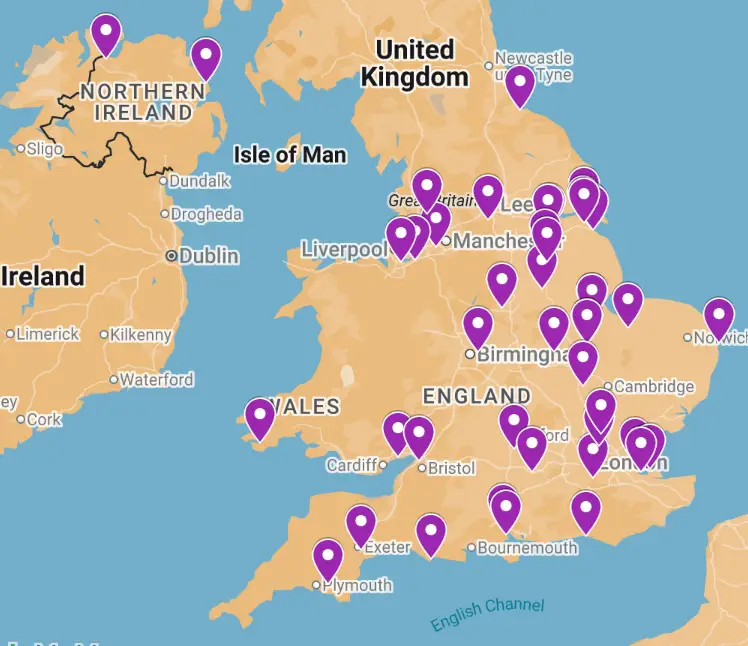
Gas power stations in the UK are clustered in industrial regions such as Yorkshire and the Midlands, as well as high-demand areas like London.
Scotland is not shown on the map because it has only a single major gas power station, Peterhead, which is located near Aberdeen.
The table below shows the distribution of gas power stations by capacity and region.
| Region | Number of Power Stations | Installed Capacity (MW) |
|---|---|---|
| East Midlands | 10 | 6,936 |
| East of England | 5 | 2,510 |
| London | 2 | 458 |
| North East | 2 | 170 |
| North West | 4 | 1,794 |
| Northern Ireland | 2 | 1,029 |
| Scotland | 1 | 1,180 |
| South East | 9 | 6,748 |
| South West | 4 | 2,239 |
| Wales | 2 | 3,049 |
| West Midlands | 1 | 100 |
| Yorkshire and the Humber | 6 | 4,497 |
| Total | 48 | 30,710 |
Types of gas power station in the UK
There are three types of gas power station used in the UK. Below, we describe the role of each, the number of active stations, and their capacity.
Combined Cycle Gas Turbine
- Active power stations: 28
- Capacity: 24.8 GW
A Combined Cycle Gas Turbine (CCGT) power station is a highly efficient type of gas plant that generates electricity using two linked thermodynamic cycles.
Gas is burned in a turbine to produce electricity and very hot exhaust gases. Instead of being released as waste heat, those gases pass through a heat recovery steam generator, which produces steam to drive a second turbine for extra power.
This design makes CCGT stations efficient and adaptable. They can run steadily when required and also ramp output up or down to support periods of higher demand.
Combined-Cycle Gas Turbine – Combined Heat and Power
- Active power stations: 5
- Capacity: 4.1 GW
This type of CCGT power station also captures steam or hot water from the generation process, supplying it either to a district heating network or to a nearby industrial process.
Find out more in our full guide to Combined Heat and Power for businesses.
Single-cycle gas power station
- Active power stations: 15
- Capacity: 1.8 GW
This is the most basic form of gas-fired electricity generation, in which natural gas is combusted in a turbine to drive an electrical generator. The hot exhaust gases are then released to the atmosphere without being used for further power production or heat recovery.
Single-cycle gas power stations are quick to start up and are typically used for peak-only or reserve power generation.
Who owns the UK’s gas power stations?
The UK energy industry is privatised. This means that any organisation is eligible to build, own, and operate power stations that feed power onto the grid.
Here is a list of the top ten corporate owners of gas power stations in the UK:
| Company (HQ) | Description | Number of Stations | Capacity Owned (MW) |
|---|---|---|---|
| RWE Npower (Germany) | German energy giant, focused on electricity | 9 | 7,160 |
| SSE Group (UK) | Part of the same group that owns SSE Business Energy. | 6 | 3,610 |
| Vitol (Switzerland) | Global energy and commodities trader, also owns energy assets | 5 | 3,252 |
| Uniper UK (Germany) | German-based power generation company | 4 | 2,970 |
| EPUKi (Czech Republic) | Czech energy infrastructure company | 3 | 2,886 |
| Intergen (Canada/UK) | International power producer | 4 | 2,860 |
| ESB (Ireland) | Ireland's leading energy provider | 3 | 1,704 |
| UK Transition Limited (UK) | UK-based energy transition company | 1 | 1,332 |
| Energy Capital Partners (USA) | US private equity firm focused on energy | 1 | 1,200 |
| Marchwood Power (UK) | UK power station operator | 1 | 898 |
What is the largest gas power station in the UK?
According to the latest government figures, the Pembroke gas power station in Wales is the largest in the UK.
The power station is owned by RWE Generation UK, and when operating at its full capacity of 2.2 GW, it can produce enough electricity to power around 3.5 million homes. The plant was built in 2012 on the site of a former oil-fired station.
How is gas power distributed?
In the past, gas power stations played the role of providing continuous baseload power to the grid.
As part of the transition to a clean-energy grid, this role is now provided exclusively by UK nuclear power stations. Gas power stations instead provide the following distinct roles for the grid:
Flexible generation
Most UK combined-cycle gas turbine stations operate as flexible mid-merit plants.
They run most of the time, but not continuously, ramping up and down to balance variable wind and solar output. They used to act as baseload, but this has changed as renewables have grown.
Peaking plants
Single-cycle gas power stations provide short-notice, highly flexible peaking power during demand spikes or when renewables dip. They have low efficiency but extremely fast start times.
Older, smaller units run only occasionally to provide reserve voltage control and black-start capability. They may be contracted through the Capacity Market to guarantee availability even if they rarely generate.
Connection with the grid
Most large gas power stations are connected to the UK’s high-voltage transmission network (the national grid).
From there, electricity is distributed to consumers through local grids managed by Distribution Network Operators.
Some medium-sized and smaller gas power stations are connected directly to a low-voltage distribution network, efficiently meeting local demand.
How do gas power stations affect the price of electricity?
In the UK energy market, the continued reliance on gas power stations to provide power generation means there is a strong correlation between the price of gas and the price of electricity for consumers.
In this section, we explain how the marginal-cost system causes business gas rates and business electricity prices to track each other.
💡At Business Energy Deals, we specialise in helping SMEs lower their energy costs. Compare business electricity prices today to find out how much you can save.
Electricity is expensive because gas is expensive
In the “marginal-cost” system used by the UK wholesale electricity market, the most expensive generator sets the half-hourly price per kWh of electricity for all generators.
So even on days when UK wind farms are generating the bulk of the grid’s power at almost no cost, the price that business energy suppliers must pay for electricity is set by the cost of the natural gas burnt to generate it.
If gas is expensive and electricity is generated at 7 pence per kWh, all the electricity bought during that period from the spot market will be priced at 7 pence per kWh.
When did gas power become the “marginal producer”?
Throughout the 1990s and 2000s, coal-fired power stations were often the highest-cost generators, especially as environmental regulations tightened and carbon pricing was introduced.
However, by the early 2010s, natural gas began to play a larger role in setting prices as coal use declined, coal plants were phased out, and cheap renewables were incorporated into the grid.
In 2021, the price of natural gas spiked due to low natural gas storage levels, a chronic lack of infrastructure investment, and rising geopolitical tensions. These pressures were exacerbated by Russia’s invasion of Ukraine in 2022, culminating in a nationwide energy crisis.
Since then, the British fleet of gas-fired power stations has relied on expensive liquified natural gas and imports through Norway’s Langeled pipeline to replace cheap gas formerly sourced from Russia.
The future of gas power in the UK
The current UK government aims to phase out unabated natural gas power by 2030, but this will depend on the UK’s ability to build a reliable and flexible energy grid based on nuclear baseload generation and energy-storage facilities.
In practice, phasing out unabated natural gas power by 2030 means that the UK intends to stop using gas-fired power stations that emit CO₂ into the atmosphere without any form of carbon capture or low-carbon fuel substitution.
Gas power plants will still be involved in back-up power generation, but using:
- Carbon Capture, Utilisation and Storage (CCUS)
- Green hydrogen sources
 Back to blog
- Share: