 Our use of cookies
Business electricity bills: A visual guide
Business electricity bills are very different from the simple home energy bills you might be used to.
They include a range of additional charges and taxes that can leave business owners feeling confused.
This guide provides a clear overview of how business electricity bills work, explains how each element is calculated, and provides an annotated real-world example of a bill.
Here are the key sections of our guide:
- What is a business electricity bill
- How business electricity bills are generated
- Business electricity bill breakdown
- Business electricity bills for half-hourly meters
- Common errors on business electricity bills
What is a business electricity bill
A business electricity bill is an invoice issued by a licensed electricity supplier for electricity supplied to a non-domestic property.
In Great Britain, electricity supply points are identified by a Meter Point Administration Number (MPAN). Business electricity bills apply to MPANs with profile classes 00 or 03-08 (classes 01 and 02 relate to domestic supplies).
A business electricity bill uses meter readings and agreed tariff rates to calculate the amount payable by a business customer. It is typically issued on a regular monthly billing cycle.
How business electricity bills are generated
Business electricity bills are generated using meter reading data that shows how much electricity was consumed (in kWh) during a billing period, typically one month.
Electricity bills are calculated based on either actual or estimated meter readings. Here, we explain how both work:
Actual meter readings
Most commercial properties in Great Britain are fitted with either smart or half-hourly business electricity meters, which automatically record and transmit electricity consumption data.
For businesses with these devices, electricity bills are generated using actual meter readings covering the start and end of the billing period.
Estimated meter readings
Older meter types that do not automatically transmit electricity meter readings remain common in commercial properties across Great Britain.
Without actual meter reading data, business energy suppliers will use the following estimation method:
- Opening meter reading – Taken from the closing meter reading on the previous bill.
- Closing meter reading – Based on the expected annual consumption defined in your contract, or estimated using recent manually submitted meter readings.
Backdating of bills
Backdating is a billing process in which a business energy supplier corrects the estimates used for meter readings on previous bills.
When you manually submit a meter reading, your supplier obtains a precise measurement of how much electricity your business has consumed. They then use this information to recalculate previous consumption estimates. Backdating can result in either an additional charge or a refund.
Unexpected charges arising from the backdating process are a frequent source of business energy supplier complaints. We recommend regularly submitting meter readings or upgrading to a smart business energy meter to reduce the risk of backdating adjustments on your business electricity bills.
Business electricity bill breakdown
The section below provides a visual guide to the key components of a small business electricity bill. We have annotated specific sections of a real electricity bill to explain what they mean and how they work.
Summary and amount due
The first page of a business electricity bill typically provides the following summary:
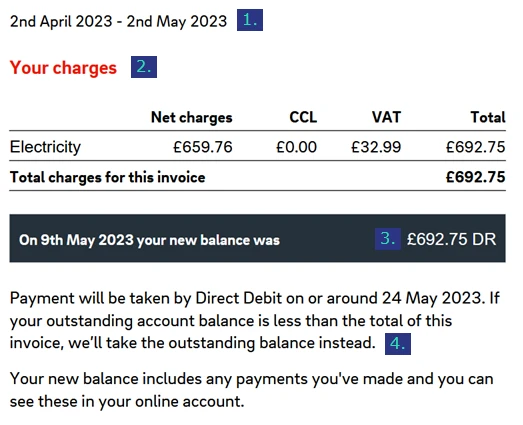
- [1] – Billing period – The date range over which the electricity charges are calculated.
- [2] – Total electricity charges – The electricity costs incurred during the billing period. A detailed breakdown is provided later in the bill.
- [3] – Balance due – The total amount payable, calculated as the electricity charges plus any unpaid balances from previous billing periods.
- [4] – Payment information – Instructions on how to pay the bill, or the date on which payment will be automatically collected by Direct Debit.
Your tariff information
The next part of the bill displays information about your current business electricity tariff. Ofgem requires this information to be shown for all microbusiness electricity customers.
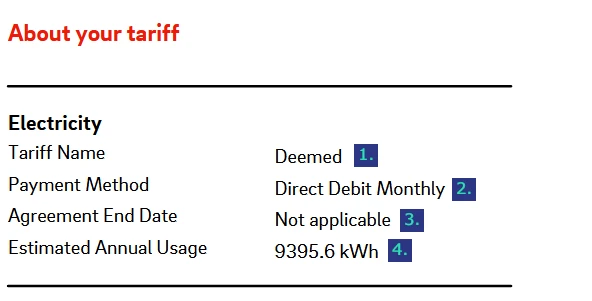
- [1] – Tariff name – The type of tariff being used, usually stated as “deemed”, “variable”, “fixed” or “pass-through”.
- [2] – Payment method – The agreed method of payment for your tariff.
- [3] – Agreement end date – The date on which fixed tariff rates will no longer apply.
- [4] – Estimated annual consumption – The annual consumption figure your supplier will use to estimate your bill if meter readings have not been received.
Your business electricity charges details
The final section of a business electricity bill provides a detailed calculation of your electricity charges.
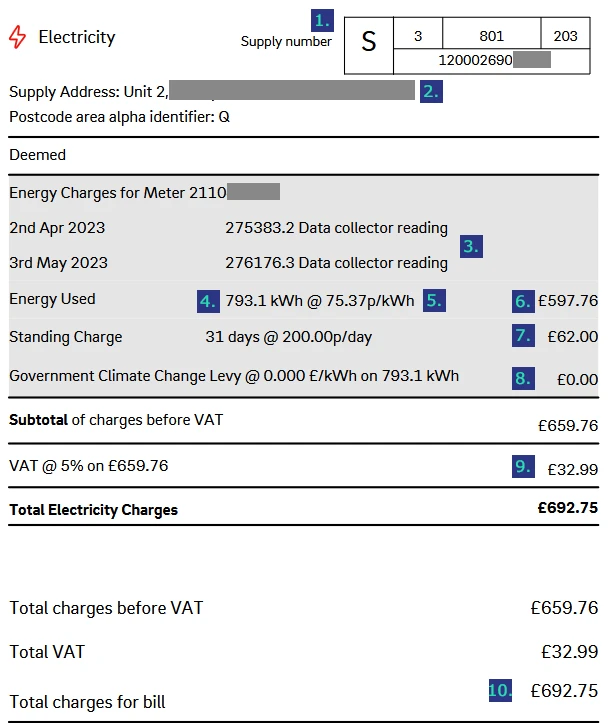
- [1] – The supply number – The supply number (MPAN) is the unique identifier associated with your electricity supply point.
- [2] – Supply address – The address and meter serial number associated with your business electricity supply.
- [3] – Meter readings – The electricity meter readings at the start and end of the billing period.
- [4] – Electricity consumption – The electricity used during the billing period, calculated as the difference between the opening and closing meter readings.
- [5] – Unit rate – The business electricity price per kWh set out in your tariff.
- [6] – Unit charge – The electricity consumption multiplied by the unit rate.
- [7] – Standing charge – The business electricity standing charge set out in your tariff, multiplied by the number of days in the billing period.
- [8] – Climate Change Levy (CCL) – The Climate Change Levy rate multiplied by the electricity consumption during the billing period.
- [9] – VAT – VAT on business energy bills is applied to the relevant charges on the bill at a rate of either 5% or 20%.
- [10] – Total electricity charges – The total charges incurred during the billing period.
💡 At Business Energy Deals, we are experts in helping companies compare business electricity prices to secure the lowest possible charges on their energy bills.
Business electricity bills for half-hourly meters
Energy-intensive commercial properties in Great Britain are typically fitted with half-hourly electricity meters. Bills issued for the supply of electricity to these properties usually include the following additional elements:
Capacity related elements
A capacity charge provides for the availability of a defined Maximum Import Capacity (MIC), measured in kVA, for a business electricity connection. Capacity charges typically appear on the bill as a fixed daily rate.
Capacity charges are paid to the local Distribution Network Operator. For more information, visit our guide to capacity charges.
Pass-through tariff elements
Business electricity tariffs for properties with half-hourly meters are often structured to include the pass-through of network costs and environmental levies.
On these business electricity bills, there will typically be separate line items in the charges section for the following elements:
- DUoS charges – Charges for using the local electricity distribution network.
- TNUoS charges – Charges for using the high-voltage transmission network operated by the National Grid.
- BSUoS charges – Charges associated with balancing services provided by the system operator, NESO.
- Supplier Obligation – Electricity suppliers pay a CfD levy for each MWh of electricity supplied to fund low-carbon generation support schemes.
- Renewable Obligation Certificates – Suppliers are required to present Renewable Obligation Certificates (ROCs) to demonstrate compliance with the Renewable Obligation for each MWh of eligible electricity supplied.
- Meter Operator (MOP) charges – An additional line item that may appear on business electricity bills for properties with half-hourly meters, covering metering services.
- EII support levy – A charge suppliers are required to pay to support payments under the Network Charging Compensation Scheme, a key component of the British Industry Supercharger policy.
Common errors on business electricity bills
This section explains the most common errors found on business electricity bills and how to resolve them with your supplier.
Supply address inconsistencies
Business electricity bills typically display the supply address, meter serial number and MPAN to identify the property being supplied. Inconsistencies in this information can arise in multi-occupancy buildings or recently subdivided sites.
If you notice any inconsistencies in the supply address details, we recommend contacting your supplier’s customer service team to explain the issue and request a correction.
Overlapping billing periods or duplicate invoices
A business customer may receive two business electricity bills covering electricity used during the same billing period.
This error can occur following switching business energy suppliers, a contract renewal, or a billing system migration.
In this case, send copies of the overlapping bills to your supplier and request a full account statement and reconciliation.
Account name or legal entity mismatch
A business electricity bill will state the name of the company or individual (in the case of a sole trader) who is responsible for paying the bill.
A bill may be issued to the wrong person in the following circumstances:
- A change in business structure or company name registered at Companies House.
- A change in tenancy where a new occupier has started using the premises.
In these cases, we recommend providing your supplier with evidence of the change, for example, a lease agreement confirming the change in tenancy.
 Back to blog
- Share: