 Our use of cookies
Battery storage facilities in the UK: statistics on current and planned developments
The number of grid-scale battery storage facilities on the national grid is growing rapidly, with several projects planned at a scale comparable to large conventional power stations.
Once seen as niche infrastructure, battery storage has become essential to the operation of a clean energy grid, stepping in to balance supply and demand as renewable generation expands.
This guide uses the latest statistics to explain the growing role of battery storage facilities on the UK grid. Here is what we cover:
- The scale of battery storage facilities in the UK
- Where battery storage facilities are located in the UK
- Major operational and planned battery storage projects
- The role of battery storage in grid balancing
- How battery storage facilities connect to the electricity grid
The scale of battery storage facilities in the UK
Since 2020, battery storage capacity on the national grid has grown fivefold, and there is an exceptionally large pipeline of projects in planning and development.
The rush to develop new battery storage is a key part of the UK Government’s Clean Power 2030 target, which aims to increase battery storage capacity to between 23 and 27 GW.
The latest data from the Government’s Renewable Energy Planning Database (October 2025) shows the following status of battery storage facilities that are in operation, under construction, or making their way through the planning process:
| Status | Facilities | Capacity (MW) |
|---|---|---|
| Operational | 136 | 3,269 |
| Under construction | 110 | 6,204 |
| Planning permission granted | 1,015 | 56,382 |
| Planning application submitted | 596 | 52,711 |
💡Although planning data shows over 1,000 battery storage facilities with planning permission, it is likely that a large majority of these will never be built due to delays in obtaining a grid connection.
Where battery storage facilities are located in the UK
The following table shows the distribution of the UK’s operational battery storage facilities.
| Region | Facilities | Capacity (MW) |
|---|---|---|
| Scotland | 20 | 508 |
| Eastern | 16 | 473 |
| North West | 14 | 442 |
| South East | 14 | 442 |
| South West | 22 | 437 |
| Yorkshire and Humber | 11 | 346 |
| West Midlands | 13 | 244 |
| East Midlands | 10 | 116 |
| London | 4 | 99 |
| North East | 6 | 89 |
| Wales | 5 | 64 |
| Northern Ireland | 1 | 10 |
| Total | 136 | 3,269 |
Battery storage facilities tend to be built near major demand centres, often at the sites of former power stations that already have high-capacity connections to the electricity grid.
Scotland also has a high concentration of battery storage facilities to help the grid absorb large quantities of intermittent power generated by Scotland’s wind farms.
The map below shows the distribution of battery storage facilities throughout the UK:
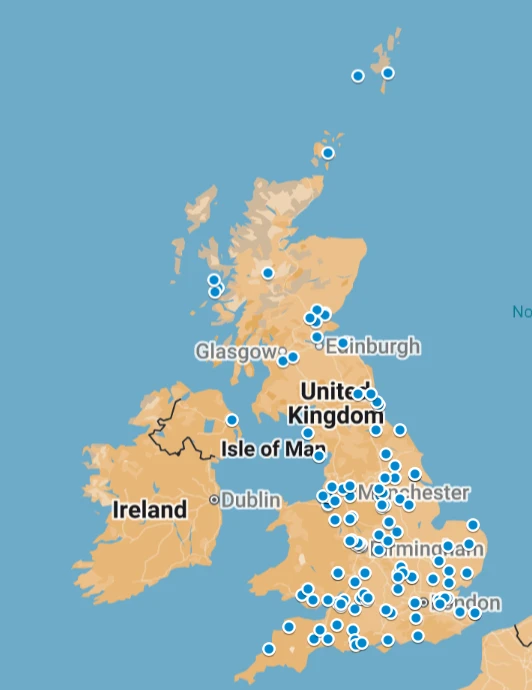
Data source: UK Renewable Energy Planning Database
Co-located vs standalone battery storage
Standalone batteries are independent assets that are directly connected to the grid. In contrast, co-located batteries share a single grid connection with an energy generation asset, typically a solar or wind farm.
The table below shows the breakdown of co-located and standalone operational battery storage facilities:
| Type of facility | Facilities | Capacity (MW) |
|---|---|---|
| Co-located with fossil fuel plant | 7 | 292 |
| Co-located with renewables | 56 | 582 |
| Standalone storage | 73 | 2,395 |
| Total | 136 | 3,269 |
There are two key reasons why developers may choose to co-locate battery storage:
- Shifting renewable output to high-value periods: Solar generation tends to peak at midday, when electricity prices are low. On-site batteries allow solar farm operators to store power and discharge it to the grid in the evening, when prices are higher.
- Maximising the utility of an existing connection: Obtaining a new high-capacity business electricity connection to the grid is expensive and slow. Co-locating allows a battery storage facility to access the grid more quickly than applying for a new connection.
Why battery storage facilities are essential for decarbonisation
Under the UK Government’s Clean Power 2030 plan, electricity generation from offshore wind farms will triple, while generation from onshore wind farms will double.
The deployment of a vast number of grid-scale battery facilities is essential to support this effort to decarbonise the national grid.
On very windy days, wind farms can generate more electricity than the national grid is able to transmit to demand centres. When this occurs, some turbines have to be switched off, a practice known as wind curtailment, to prevent excessive power flows from overwhelming the network.
Battery storage facilities ease this situation by providing short-term storage for excess renewable energy that can be used later when generation is less plentiful, or demand rises.
Battery storage facilities maximise the utilisation of renewable energy and reduce the need for expensive grid upgrades to absorb wind power.
What is the difference between battery storage and energy storage facilities?
Energy storage facilities is a broad term for infrastructure that stores electricity on the grid for later use.
In the UK, this includes battery storage facilities as well as:
- Pumped hydro storage: Five operational sites with a combined capacity of 2,833 MW.
- Compressed air energy storage: A limited, emerging technology.
- Liquid air energy storage: A limited, emerging technology.
- Green hydrogen storage: Prototype projects currently being explored.
Battery storage facilities specifically refer to infrastructure that stores energy electrochemically, typically using lithium-ion battery technology.
Major operational and planned battery storage projects
Using the Renewable Energy Planning Database, we have summarised the largest operational and planned battery storage facilities in the UK.
Biggest operational battery storage facility
- Name: Thurrock Flexible Generation Plant
- Capacity: 300 MW
- Status: Operational from August 2025
- Location: Tilbury, Essex
- Developer: Stratera Energy
The Thurrock lithium-ion battery system is the largest-capacity battery storage facility currently operating on the National Grid.
In addition to the battery storage capacity, the site also hosts 600 MW of flexible generation capacity provided by a gas power plant.
The facility is strategically located near London to help balance electricity demand in the UK’s capital city.
Biggest planned battery storage facility
- Name: Thorpe Marsh Green Energy Hub
- Planned capacity: 1,450 MW
- Status: Under development, expected to be operational in Q4 2027
- Location: Doncaster, South Yorkshire
- Developer: Fidra Energy
Thorpe Marsh is the largest planned battery storage project, being developed on land adjacent to a former coal-fired power station.
The site will cover 55 acres and will host batteries capable of storing up to 2.9 GWh of electricity, roughly equivalent to the annual electricity consumption of around 1,000 UK homes.
Other planned giga-scale battery storage projects
According to the Renewable Energy Planning Database, Thorpe Marsh is just one of several planned facilities that will deliver more than 1,000 MW of battery storage capacity to the grid.
Here is a summary of these facilities:
| Developer | Project / site name | Location | Planned capacity (MW) | Notes |
|---|---|---|---|---|
| Sandbrook Capital BES Limited | West Leake Lane Battery Storage | Nottinghamshire | 1,200 | Large standalone BESS in the East Midlands |
| Wainstones Energy Limited | Carrington Battery Storage | Greater Manchester | 1,040 | Part of the wider Carrington energy hub |
| Novus Renewable Services | Fairfields Energy Storage System | Derbyshire | 1,025 | Giga-scale BESS with limited public detail |
| Innova Renewables | The Balk, Almholme Energy Storage System | South Yorkshire | 1,025 | Adjacent to the Thorpe Marsh energy cluster |
| Alcemi Storage Development Limited | Coalburn II Energy Storage Facility | South Lanarkshire | 1,000 | Expansion of the Coalburn battery cluster |
| Latos Cardiff Limited | Rover Way Energy Park & Data Centre | Cardiff | 1,000 | Mixed-use energy park proposal |
| Teesworks Ltd / NatPower UK | Teesworks Battery Storage Project | Teesside | 1,000 | Located within a major industrial redevelopment zone |
| TagEnergy Development UK Limited | Drakelow Battery Energy Storage System | Derbyshire | 1,000 | Former coal-fired power station site |
| Mowbray Energy Park Limited | Mowbray Battery Energy Storage Station | North East England | 1,000 | Part of a proposed energy park |
| NatPower | Old Rides Farm Battery Energy Storage System | Kent | 1,000 | Coastal grid connection area |
| Navenby Energy Limited | Hill Rise Battery Energy Storage | Lincolnshire | 1,000 | Close to major east–west transmission corridors |
| NatPower UK | Swinford Energy Park | Leicestershire | 1,000 | Large grid-connected energy park proposal |
How battery storage facilities connect to the electricity grid
Battery storage facilities connect to the wider electricity grid at either:
- The national transmission network (275 kV or 400 kV)
- A regional distribution network (33 kV or 132 kV)
Most large battery storage facilities connect at or near substations, where voltage is transformed, and power flows are controlled.
Through their connection to the grid, energy storage facilities can both import and export electricity as the battery charges and discharges.
Queues for new grid connections
To connect a battery storage facility to the grid, a developer must obtain consent from either National Grid for a transmission connection or a Distribution Network Operator for a lower-voltage connection.
Connections for battery storage facilities typically require the grid operator to reinforce the network to support the facility’s high-capacity imports and exports.
Once new connection applications are accepted, projects are assigned a connection date on a first-come, first-served basis, so new projects join at the back of the queue of reinforcement work that the network operator has agreed to complete.
Battery storage developers are competing with wind turbines, solar farms, and data centres, which also require high-capacity connections. As a result, typical connection queue times range from five to ten years. The grid connection process is the single largest bottleneck to the future construction of battery storage facilities.
The length of the queue has led some developers to secure large future connection capacities to provide optionality for their businesses, even though these capacities may not ultimately be used when projects reach the front of the queue.
💡Connections reform in the energy industry is designed to clear this backlog by prioritising ready-to-go projects that contribute to the security of the energy system.
The role of battery storage in grid balancing
The national grid is designed to deliver alternating current (AC) power to all users at a frequency of 50.0 ± 0.2 Hz. Keeping the frequency within this tight range is necessary to protect the electrical equipment on which the grid relies.
To maintain this frequency, the grid operator, NESO, ensures real-time balance between power supply and demand.
The Government’s clean energy targets have made maintaining this balance increasingly difficult, as intermittent renewables have replaced the controllable output of gas and coal-fired power stations.
Battery storage facilities have become crucial in NESO’s efforts to maintain system balance because of the following three aspects of their technology:
Speed
Battery storage technology can respond in milliseconds to the requirements of the grid, both by absorbing and injecting power.
Battery storage facilities are much faster to respond than alternative balancing technologies:
- Gas power plants: Minutes
- Pumped hydro storage: Tens of seconds
- Demand-side response: Seconds to minutes
Bi-directional control
Battery storage facilities can:
- Inject power when supply is short; and
- Absorb power when supply exceeds demand.
This control allows a battery storage facility to assist NESO in both increasing and reducing the availability of power.
💡View our National Grid Live dashboard to see the current contribution of batteries on the grid.
Precision
The technology used in lithium-ion batteries allows their power injection and absorption to be precisely controlled.
In NESO’s frequency response services, these adjustments are made automatically, with the battery responding almost instantaneously to grid conditions.
How battery storage facilities make money
Battery storage facilities do not generate or sell electricity in the traditional way that a power station does. Instead, their owners earn revenue by providing flexibility services to the grid or by responding to price signals in the electricity market.
A battery storage operator can earn revenue through the following schemes and strategies:
Frequency response service
Frequency response services are schemes under which NESO pays participants to make second-by-second injections or absorptions of power to maintain a stable grid frequency.
Under frequency response arrangements, batteries are set up to provide automatic and precise frequency control to the grid operator. NESO pays participating battery storage facilities a £/MW/hour fee for providing this service.
Balancing Market payments
The Balancing Mechanism is another NESO scheme under which participants can earn revenue by making larger adjustments to manage hour-by-hour imbalances caused by changes in weather or demand.
Under the scheme, a battery storage operator can:
- Discharge when the system is short of power
- Charge when the system has excess generation.
Under this scheme, battery storage facilities earn revenue per MWh of electricity charged or discharged at NESO’s request.
Wholesale market trading
Battery storage operators can buy and sell electricity on the wholesale electricity market and earn revenue by:
- Charging when prices are low (or negative)
- Discharging when prices are high
Since the electricity market is predictable, with pricing responding to weather conditions and daily demand patterns, it is easy for battery facilities to earn money through this strategy.
Revenue stacking of battery storage facilities
Typically, a battery storage facility will seek to earn revenue through a combination of different schemes throughout the day, depending on which options generate the highest returns at any given time.
This strategy is known as revenue stacking. Here is an example of how it might operate over the course of a day:
| Time of day | Primary activity | What the battery is doing physically | Why this activity is chosen |
|---|---|---|---|
| Overnight | Wholesale market trading | Charging at low or negative prices | Electricity is cheapest; the battery prepares energy for later use |
| Morning | Frequency response | Holding state of charge with small, rapid charge/discharge | Provides fast, automatic response to stabilise the grid |
| Late morning | Balancing Mechanism | Discharging at NESO’s instruction | The system requires additional power due to a generation shortfall |
| Early afternoon | Frequency response | Holding state of charge with small, rapid charge/discharge | Provides fast, automatic response to the grid |
| Mid afternoon | Wholesale market trading | Charging in anticipation of evening peak demand | Positions the battery for the evening peak |
| Evening peak | Wholesale market trading | Discharging a large proportion of stored energy | Prices are high; the battery sells energy into peak demand |
Investment trends in battery storage facilities
Developing grid-scale battery storage is a capital-intensive undertaking that requires significant upfront investment in a battery system, which typically has an economic life of 10-15 years.
A recent poll by Modo Energy found an average cost of £580,000 per MW of capacity for battery storage facilities in Great Britain.
At this cost level, a typical 200 MW battery storage facility being developed on the grid requires more than £100 million in upfront investment.
No UK government subsidies
Despite being crucial for decarbonisation and requiring substantial capital investment, there are no direct government subsidies to encourage private investment in battery storage facilities.
This contrasts with renewable energy generation facilities, which are supported by the Contracts for Difference scheme, and nuclear power stations, which are supported by the RAB nuclear model.
The policy approach of the UK Government and Ofgem is to favour a market-led system for providing flexibility services on the electricity grid.
Rather than subsidising batteries directly, the system is designed so that battery storage facilities:
- Earn revenue by providing valuable services
- Compete with other flexibility options
- They are rewarded when and where they reduce system costs
The overall aim of a competitive energy storage market is to lower long-term domestic and business electricity prices.
Who is investing in battery storage facilities?
In the absence of government support, private investors in battery storage facilities are taking on considerable financial risk.
As a result, battery storage facilities are typically being developed by large institutions that can raise and deploy the significant capital required for construction. The following section explains the two main types of investors funding battery storage facilities in the UK.
Dedicated battery investment funds
A majority of planned grid-scale battery storage facilities are being developed by dedicated battery investment funds.
Prominent examples include:
- Gresham House Energy Storage: A publicly traded fund on the London Stock Exchange with a market capitalisation of over £400 million.
- The Equitix-led Eelpower battery storage consortium: £500 million co-investment by UK and Australian sovereign wealth funds.
Energy suppliers
The following domestic and business energy suppliers are actively investing in and operating battery storage facilities on the electricity grid:
The market impact of rising battery storage capacity
The number and overall capacity of grid-scale battery storage facilities in the UK are expected to rise significantly over the coming years.
This growth will be accompanied by increased deployment of small-scale domestic and commercial solar batteries, many of which will also participate in providing demand flexibility services to the grid.
As private investment continues to flow into battery storage, competition within the balancing and frequency response markets operated by NESO is expected to intensify. Greater competition should reduce the prices paid for these services, lowering returns for battery operators while also reducing system balancing costs.
Over time, this is expected to feed through into lower Balancing Services Use of System (BSUoS) charges, helping to reduce overall electricity system costs for consumers while maintaining grid stability in a renewables-led power system.
 Back to blog
- Share: