
Business gas standing charges
Compare and save up to 45% on business gas standing charges
Just enter your business postcode…
 Our use of cookies
 This website uses cookies to ensure you get the best experience on our website, to read more about the cookies we use, please read our cookies policy here.
Necessary cookies enable core functionality such as security, network management, and accessibility. You may disable these by changing your browser settings, but this may affect how the website functions.
Compare and save up to 45% on business gas standing charges
Just enter your business postcode…
Start saving now
A business gas standing charge is a fixed daily fee applied to your gas tariff, which you pay regardless of how much gas your business uses. It is charged simply for having an active gas connection at your premises.

The standing charge covers the cost of keeping your property connected to the British gas distribution network as well as metering and administrative costs from your supplier.

Even if your property is vacant or your gas usage is very low, a daily standing charge still applies. The network and metering equipment must remain in place and ready to supply gas at any time.

The standing charge is billed independently from the unit rate you pay for gas consumption. Reducing gas consumption will lower your overall gas bill, but will not affect the standing charge.
A business gas standing charge is made up of several fixed cost components linked to supplying gas to your premises. These costs apply regardless of usage and are charged separately from your unit rate.

Local Distribution Zone capacity charges cover the cost of using regional gas networks operated by Cadent, Northern Gas Networks, Wales and West Utilities, and SGN. These charges are based on your site’s peak daily gas demand rather than average consumption and apply to most businesses, including small business energy customers.

NTS charges relate to the national high-pressure gas network operated by National Gas. This network transports gas from production sources and LNG import terminals to regional distribution networks. Charges are capacity-based and scale with the peak demand linked to your gas MPRN.

Import capacity costs reflect the need to ensure enough gas can enter the national system to meet demand at peak times. These fixed costs support system resilience and form part of the wider capacity charging structure recovered through standing charges.

Standing charges include the cost of providing, maintaining and inspecting a gas meter at your premises. This covers meter installation, safety checks, and manual meter readings where required, as well as secure data communication for measuring business energy consumption.

Suppliers include a margin within the standing charge to cover billing, customer service, contract administration and regulatory compliance. This margin varies by tariff and is typically much higher on out-of-contract rates.

The Green Gas Levy is an environmental levy that the government applies as a fixed daily charge to every gas connection in Britain. The levy pays for the Green Gas Support Scheme.
On a business gas bill, the standing charge is shown separately from your gas usage and usually appears in two places.
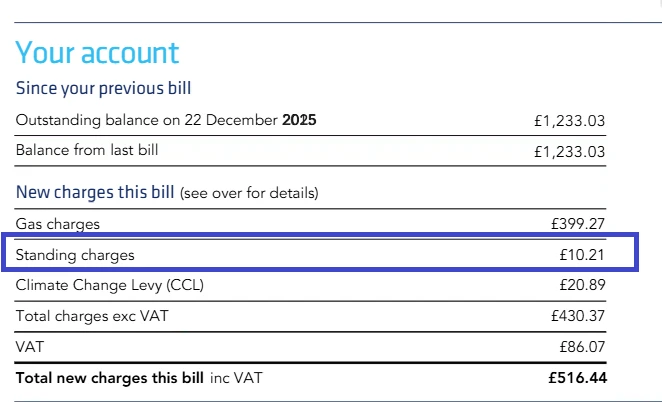
On the first page of your bill, the standing charge is typically listed in the summary section under new charges for the billing period. It appears as its own line item alongside your gas usage charge, showing the total standing charge amount for that bill.
This gives you a quick view of how much you have been charged before VAT is added.
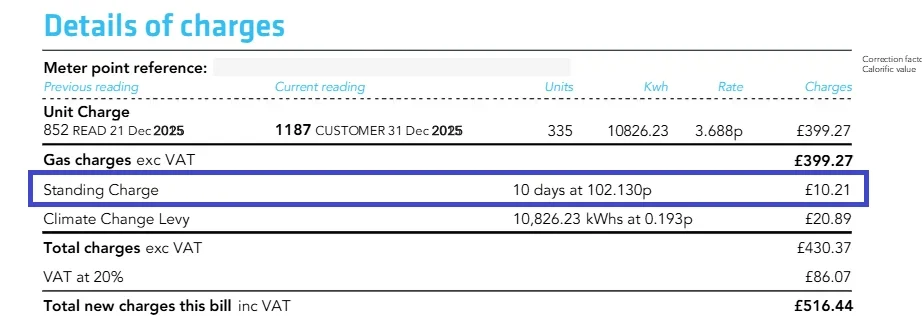
On the detailed charges page, the standing charge is shown again with a full calculation. Here, it is usually displayed as a daily rate in pence per day, multiplied by the number of days in the billing period.
This makes it clear how the total standing charge has been calculated and confirms that it is applied independently of gas consumption charges.
Together, these two sections show both the total cost of the standing charge and how it has been calculated.
The table below shows the average business gas standing charges for different types of gas connections.
| Commercial property type | Standing Charge | Annual Cost | Explanation |
|---|---|---|---|
| Domestic | 33 - 35p/day | £120 to £130 | Determined by Ofgem's quarterly price cap. |
| Small commercial property (U6 Gas Meter, 15,000 kWh pa.) | 35 - 70p/day | £130 to £250 | Similar distribution costs to domestic properties, but business gas suppliers have greater freedom over profit margins. |
| Medium commercial property (U16 Gas Meter, 50,000 kWh pa.) | £0.9 to £2.1/day | £330 to £770 | Distribution costs scale with connection capacity. |
| Large commercial property (U25 Gas Meter, 100,000 kWh pa.) | £1.7 to £4.0/day | £620 to £1,460 | Distribution costs scale with connection capacity. |
Source: Published 2025/26 LDZ and NTS standing charges.
For an index of these gas meter sizes, refer to our guide to business gas meter sizes.
Each business type has a large range because business gas standing charges also depend on location, tariff type, and the additional margin added by suppliers.
💡 Large industrial gas users will have much higher business gas standing charges. For example, a factory with an annual consumption of 20,000,000 kWh will pay LDZ charges of approximately £50,000 per year.
Several factors influence how much your business pays in gas standing charges. These are linked to your site, your connection to the network and the type of business energy contract you are on, rather than how much gas you use.

Your standing charge is partly determined by where your premises are located. Different gas network operators serve different regions, and each applies its own capacity and distribution charges, which are passed through to businesses in their area.

The type of gas meter installed at your premises affects your standing charge. Larger or more complex meters typically carry higher fixed costs for maintenance, safety checks and data communication.

Standing charges are influenced by your site’s peak daily gas demand rather than average usage. The gas network must be able to meet your highest potential demand, so businesses with higher capacity requirements generally pay higher standing charges.

Different suppliers structure standing charges differently across their tariffs. Some business gas contracts apply lower unit rates alongside higher standing charges, while others do the opposite, depending on how costs are recovered.

The length and type of your contract can also affect standing charges. Longer fixed-term contracts take into account expected annual rises in gas network costs, so may have a higher daily standing charge.
The type of tariff you choose for your business gas supply can have a noticeable impact on the standing charge you pay.
While underlying network and metering costs remain broadly the same, suppliers adjust standing charges based on how risk and costs are recovered across different tariff types.
On longer fixed-term contracts, suppliers factor in expected future increases in gas distribution and operating costs. This often results in a higher standing charge fixed for the duration of the agreement.
Out-of-contract and rollover tariffs usually carry significantly higher standing charges. Suppliers typically apply a larger margin to these tariffs, making them one of the most expensive ways to pay for business gas on a daily basis.
Standing charges can vary widely between tariffs, so reviewing available business gas comparison options can help identify contracts with lower fixed daily costs rather than focusing on unit rates alone.
Our experts answer the most common questions regarding business gas standing charges.
Business gas standing charges reflect fixed costs that do not change with usage. These include gas network capacity charges, metering costs and supplier operating costs.
In recent years, increases in network charges and higher supplier risk costs have pushed standing charges up, particularly on variable and out-of-contract tariffs.
Zero standing charge business gas tariffs are now very rare. Where they do exist, the fixed costs are usually recovered through higher business gas prices per kWh instead.
For most businesses, removing the standing charge does not reduce overall costs and can result in higher bills if gas usage increases.
Yes. As long as your property has an active business gas connection, the standing charge will continue to apply. This is because network capacity and metering remain in place, even if the property is temporarily unoccupied or using no gas.
The only way to stop the standing charge completely is to have the gas supply formally disconnected. This involves removing or capping the meter and ending the connection, which can involve one-off costs and may require a new connection if gas is needed again in the future.
Standing charges vary based on factors such as location, gas network operator, business gas meter type and peak daily demand. Even businesses with the same supplier can have different standing charges if their sites have different capacity requirements or network costs.
In most cases, business gas standing charges cannot be reduced. These charges are linked to network access, metering and fixed supplier costs, which apply for as long as your property remains connected to the gas network.
The most common opportunity to lower standing charges is when a business is out of contract. Out of contract and rollover tariffs often include inflated standing charges, so switching to a new fixed business gas tariff can reduce what you pay each day.
For some larger businesses, reviewing agreed capacity levels may also help, although this is unlikely to apply to most small and medium-sized sites.
Over the longer term, some businesses can eliminate gas standing charges entirely by disconnecting from the gas network. Switching from gas boilers to electric heating or heat pump systems can allow the gas meter to be removed and the supply formally disconnected.