 Our use of cookies
Sub-metering for businesses: Measure and optimise electricity usage
Effective energy management increasingly depends on real-time, granular and accurate electricity usage data. With rising energy costs and greater regulatory focus on carbon reporting, many organisations are choosing sub-metering to measure and control their electricity consumption.
This guide provides a clear, comprehensive overview of sub-metering for commercial buildings.
Here’s what we cover:
- How sub-metering works
- Types of sub-metering for businesses
- Benefits of sub-metering for businesses
- The process of getting sub-meters installed
- Sub-metering providers for businesses
What is a sub-meter?
A sub-meter is a device that measures the electricity consumed by a specific part of a building, such as a tenant space, department or individual piece of equipment.
It measures and records detailed electricity usage for that particular area, providing businesses with granular data on energy consumption.
The difference between a meter and a sub-meter
Main supply meters are used by licensed energy suppliers and installed at the point of connection between a property and the electricity distribution grid to measure the power consumption of an entire property.
In contrast, sub-meters are installed downstream of the mains meter to measure power consumption on specific electrical circuits within a building.
Main supply meters are much larger (typically 20–30 cm), enclosed in a robust casing, and designed to handle high-capacity supply cables and to be tamper-proof.
Sub-meters are typically much smaller and use a current transformer device that wraps around an electrical cable to indirectly measure power consumption using the magnetic field produced by the current in the wire.
How sub-metering works
This section explains the steps involved in enabling sub-metering in a commercial building, enabling it to provide real-time, granular insights into power consumption across different parts of the building.
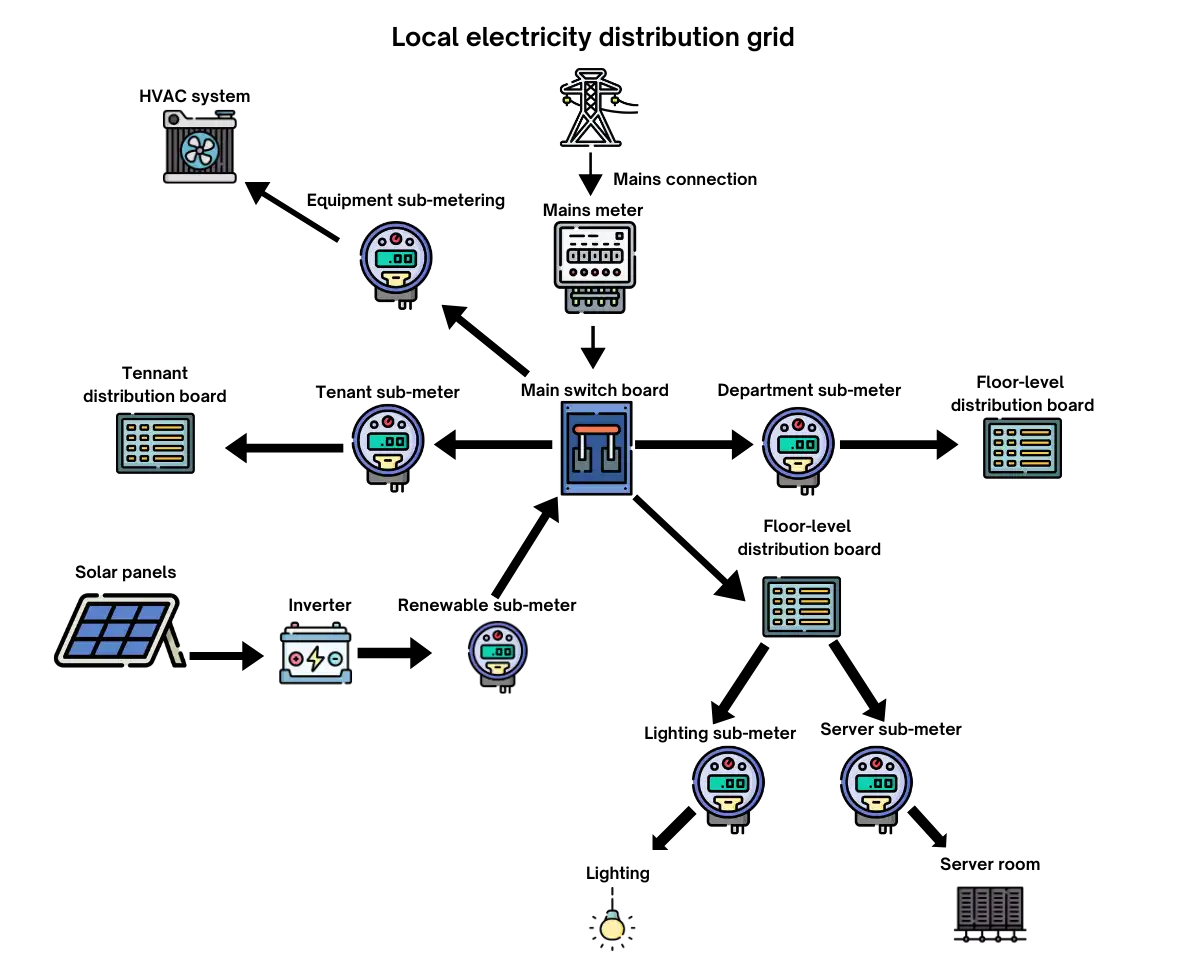
The main meter measures the consumption of the entire property
All commercial properties with a connection to the grid have a main business electricity meter fitted at the building’s point of connection to the local electricity network.
The mains meter is typically either a half-hourly energy meter or a smart business energy meter and records the total electricity consumption of the entire site.
The readings from the main meter are unaffected by the installation of sub-meters in the same building.
Sub-meters are installed downstream
Sub-meters sit downstream of the main meter to measure the energy consumption of specific parts of the building, such as individual departments, sub-let floors or specific equipment.
There are a few different sub-meter technologies typically used in commercial properties. Still, most sub-meters are clipped onto existing cables to measure the voltage and current in individual parts of the building’s electrical distribution network.
A sub-meter device is designed to calculate power consumption using its voltage and current readings. Power is then monitored over time to provide an energy consumption figure in kWh.
Data transmission
Energy consumption data from sub-meters is collected at regular intervals, typically every 1–30 minutes.
The data from the sub-meters is automatically transmitted by one of the following:
- Dedicated low-voltage communication wiring connecting multiple sub-meters.
- Connection to the local area network via an Ethernet cable.
- Wireless communication by connecting to the building’s Wi-Fi network.
- Wireless communication using a SIM to connect to a cellular network.
Data collection
Sub-meter data is typically collected centrally and used by one of the following systems:
- Energy Management System (EMS) – A cloud-based energy management platform that can optimise the use of electricity in a commercial building.
- Energy monitoring software – Cloud-based software that provides data visualisation and reporting based on automatic readings from meters and sub-meters.
- Building Management System (BMS) – A system used to control heating, ventilation and air conditioning.
Types of sub-metering for businesses
This section explains the five most common types of sub-metering in commercial properties, based on what energy consumption is being measured.
Tenant sub-metering
Large commercial properties, such as offices, typically have a single business electricity connection, one MPAN and one main business electricity meter to measure consumption for the entire property.
Tenant sub-metering is used in multi-let commercial buildings to fairly allocate the business electricity prices of the entire building to all the companies using power.
The landlord or managing agent of the property will use sub-metering to bill tenants for electricity and gas accurately.
For tenants, sub-metering is installed at the point where the tenant’s electricity supply branches off the landlord’s main electricity distribution system, and before the tenant’s distribution board.
Departmental sub-metering
Departmental sub-metering is used to allocate consumption between different business units or cost centres.
It allows a business to measure and optimise the energy consumption of individual functions separately, for example, manufacturing, warehousing and office space.
Departmental sub-metering typically occurs at floor-level distribution boards or specific circuit groups feeding departmental loads.
Equipment sub-metering
Equipment sub-metering is used to isolate electricity consumption for a specific piece of energy-intensive equipment, for example:
- Air-conditioning systems
- Server rooms
- EV chargers
Equipment-level sub-metering occurs directly on the circuits feeding individual pieces of equipment.
Measure and verification metering
Measurement and verification metering refers to the temporary installation of sub-meters to measure the performance of a particular system or piece of equipment before and after a step taken to improve business energy efficiency. For example:
- LED lighting upgrades
- Building management system upgrades
- Heat pump installations
The installation of these sub-meters is typically used when an Energy Service Company implements energy efficiency solutions with guaranteed savings.
Measurement and verification commonly use a clamp-on power analyser or a temporary multi-circuit meter.
Renewable sub-metering
Where commercial properties have on-site commercial solar panels, a sub-meter is typically installed between the solar inverter and the building’s distribution board.
Sub-metering from solar panels enables reporting on on-site renewable generation and helps businesses understand and optimise self-consumption versus grid exports under the Smart Export Guarantee scheme.
Benefits of sub-metering for businesses
Sub-metering provides businesses with granular, real-time insight into how electricity is used within their buildings.
Here are the key benefits for businesses that install a sub-metering system on their property.
Cost control
In all business energy contracts there is a unit cost for each kWh of electricity consumed in a commercial building.
A sub-metering system helps businesses reduce their consumption of electricity and their business electricity bills, by:
- Identifying energy wastage – Real-time data from sub-meters helps to identify baseload spikes in power consumption, equipment left running and inefficient processes.
- Benchmarking – Granular data from sub-meters allows direct comparison of energy efficiency between floors, departments or machines. Benchmarking highlights older, inefficient equipment that may be wasting power.
- Accountability – Individual teams become more accountable when they have data on their own energy performance. This encourages simple behavioural changes, such as turning off IT equipment at night.
💡At Business Energy Deals, we’ve helped thousands of businesses reduce their energy costs with our business electricity comparison service.
Accurate tenant billing
Tenant sub-meters enable the accurate and transparent recharging of energy costs to tenants renting individual parts of a property.
MID-approved sub-meters are required for billing tenants for energy consumption and provide guaranteed accuracy that helps avoid billing disputes.
Compliance and reporting
Sub-metering systems in commercial properties provide high-quality data for the following mandatory schemes for large business energy users:
Having high-resolution energy consumption data makes reporting more accurate and more defensible during an audit process.
Additionally, sub-metering data supports cost-centre-level reporting and budgeting of energy costs.
Data-driven energy optimisation
The real-time data provided by sub-metering systems allows businesses to optimise their power consumption in the following ways:
- Peak demand monitoring – Identifying which equipment contributes most to maximum demand periods, enabling changes in timing that can eliminate excess demand charges.
- Demand flexibility – Enabling a business to shift the timing of power consumption for particular activities to take advantage of the demand flexibility service.
- Solar battery optimisation – Providing sufficient data for an EMS to strategically charge and discharge a commercial solar battery to minimise peak electricity rates.
Which businesses need sub-metering?
Sub-metering of electricity in commercial properties is considered essential for the following types of businesses:
- Multi-let commercial buildings – Sub-metering is necessary to accurately divide electricity costs between occupying businesses in large office spaces and retail parks.
- Properties with energy-intensive equipment – Energy-intensive manufacturing businesses use sub-metering to manage consumption and drive efficiency improvements.
- Large commercial buildings – New non-domestic buildings in the UK with a floor area of over 1,000 m² must have sub-metering covering at least 90% of consumption.
- Businesses with on-site generation – Sub-metering is essential for buildings with commercial solar installations to track and optimise generation and self-consumption.
In practice, all but the smallest commercial properties are likely to benefit from a sub-metering system.
What meters can be used for sub-metering?
The technology used in sub-metering varies depending on what is being measured, the level of accuracy required and the practicalities of installation.
Here are the main categories of meters used in sub-metering:
CT-operated sub-meters
CT-operated sub-meters are the most common type of sub-meter and take measurements using a current transformer (CT) clipped around each live conductor. The CT device monitors the magnetic field of a live cable to detect the strength of the electrical current passing through it.
The meter also takes a simple voltage connection from the same circuit. By combining the current and voltage measurements, it calculates the power and energy used over time.
These meters are compact devices that mount neatly onto a DIN rail, the standard metal rail found inside most electrical distribution boards.
Multi-circuit sub-meters
Multi-circuit sub-meters are a type of CT-operated sub-meter that can take separate measurements of numerous electrical circuits simultaneously.
These meters are cost-effective for complex circuits used in data centres or refrigeration banks. A multi-circuit sub-meter sends a consolidated data stream to an energy management system.
Whole-current sub-meters
Whole-current sub-meters are directly connected so that all electrical current flows through the meter.
They are a cheaper solution that directly measures the current passing through them.
They are less commonly used because they are bulky devices and can only handle electrical circuits of up to 100 A.
Rogowski Coil sub-meters
Rogowski coil–based sub-meters are a different type of CT-operated metering, designed for situations where traditional CTs do not fit or where very large or awkward cables need to be monitored.
The meter works by wrapping a flexible ring around a cable. It measures the rate of change of current in the cable and uses this to calculate electrical power.
The process of getting sub-meters installed
The following section provides a step-by-step process for new sub-meter installations at UK commercial properties.
1. Surveying the electrical system
The installation process usually starts with an engineer visiting your commercial property to conduct a business energy audit that:
- Locates main intake and distribution boards.
- Identifies outgoing ways that feed tenants, equipment or departments.
- Maps the building’s electrical hierarchy.
- Checks physical space in distribution boards.
- Assesses cable sizes and sub-meter requirements.
From the initial survey, the audit will recommend the scope of the sub-metering, including the number of meters required and what each will measure.
2. Prepare a detailed metering plan
The electrical engineer will prepare a detailed metering plan that includes:
- The location and types of sub-meters to be installed.
- How the meters will communicate.
- Which EMS/BMS will be used to receive sub-meter data.
- Any panel modifications required for the new meters.
3. Installation by a qualified engineer
Sub-meter installation must be carried out by an approved contractor because it involves working inside live distribution boards.
Meter installation requires isolating each distribution board, so it is normally done outside working hours to minimise business interruption.
Once installed, the meters are checked to ensure that the voltage and current readings from the sub-meters are accurate.
4. Configure data collection and integration
Depending on the connection method, the automatic data communication for the meters is set up and tested.
Initial meter readings are sent to the chosen software, and the process is checked to ensure that all sub-meters are automatically communicating their readings.
Sub-metering providers for businesses
In the UK, sub-metering installation for commercial properties is offered by some of the top energy suppliers and is often provided as part of a wider package for businesses looking to integrate a new energy or building management system.
Below we have summarised the different providers offering sub-metering to UK businesses:
Business energy suppliers
The best business energy suppliers in the UK offer energy monitoring software and sub-metering solutions to their customers:
- E.ON business energy – E.ON offers sub-meter installation and access to its energy management service, Optimum.
- EDF business energy – EDF has a dedicated Industrial and Commercial Metering & Solutions team that delivers sub-metering services.
At Business Energy Deals, our experts can help you switch business energy suppliers to one of these top providers that offer sub-metering solutions to their customers.
Energy Management System providers
Energy Management System (EMS) providers primarily sell subscriptions to a software platform, but will typically install sub-meters as part of a full solution.
Top EMS providers in the UK include:
- EcoStruxure – The EMS offered by Schneider Electric.
- SIMATIC – The energy management solution offered by Siemens.
- Honeywell Forge – An IoT platform for optimising operations in industrial properties.
Find out more in our full guide to Energy Management Systems for businesses.
Building Management System providers
A Building Management System (BMS) acts as a control system that automates the management of heating, cooling and ventilation systems.
The decision engine of modern BMS systems relies on data from sub-meters, so installing sub-meters is typically part of the BMS installation process.
Costs of sub-metering for businesses
The cost of a sub-metering installation in a commercial property depends on a number of factors, particularly:
- Number of meters – The cost of a sub-metering system increases with the number of individual meters installed.
- Electrical capacity – The hardware cost of a sub-meter rises depending on the capacity of the circuit it is measuring.
- Installation complexity – The accessibility of distribution boards affects the number of labour hours required to install the sub-meters.
- MID-approval – MID-approved sub-meters required for tenant billing are more expensive.
We recommend obtaining a bespoke quotation for a sub-metering installation for your business based on a site visit.
Common sub-metering issues for businesses
Here are the three most common technical and operational problems businesses face with the sub-metering of electricity.
Poor installation
An incorrectly installed sub-meter produces inaccurate business energy consumption data. Common issues include installing the sub-meter on the wrong cable.
We recommend choosing a reputable installer who checks that the meters are working correctly and have been properly configured.
Data connectivity issues
Sub-metering systems rely on automatic data transfer from each meter to a central system.
Business wireless LAN connectivity issues or IP address conflicts can block the automatic transfer of data from sub-meters.
Analogue or obsolete meters
Some older buildings may still have analogue sub-meters that do not automatically send meter readings but instead have mechanical kWh counters.
Analogue meters provide no usable digital data and therefore offer limited value beyond allowing tenant billing with manual energy meter readings.
Regulations for tenant sub-metering for businesses
If a landlord of a commercial property recharges tenants for their energy consumption based on actual meter readings, then the meter used must be MID-approved.
MID stands for the Measuring Instruments Directive, an EU law (retained in the UK) that sets accuracy, quality and compliance requirements for meters used for billing.
MID-approval for a sub-meter means that:
- It has been independently tested
- It meets strict accuracy requirements
- It is tamper-resistant
- It is traceable to the manufacturer
- It displays the required markings (e.g., the “M” mark and year)
Alternatives to sub-metering for businesses
Below, we have summarised the viable alternatives to sub-metering systems in commercial properties:
- BMS insights – Some BMS systems estimate energy usage based on the status of air-conditioning and heating systems. This is a simple solution but not as accurate as sub-metering.
- Smart plugs – It is possible to install plug-level monitoring for small appliances. This is useful for encouraging behavioural changes in small offices, but not suitable for full building visibility.
- Bill apportionment – Landlords can choose to split electricity bills using proxies such as floor area, desk count or headcount. This is easier to administer but less accurate.
 Back to blog
- Share: