 Our use of cookies
Commercial solar panels: types, dimensions and configurations
Commercial solar panels are large-scale solar energy systems designed for businesses, factories, warehouses, offices, and other commercial buildings.
They capture sunlight and convert it into electricity, enabling businesses to reduce energy bills and lower carbon emissions.
This guide explains the key technical and design choices available to businesses, including commercial solar panel types, dimensions, configurations, expected power output, and regulations.
How commercial solar panels work
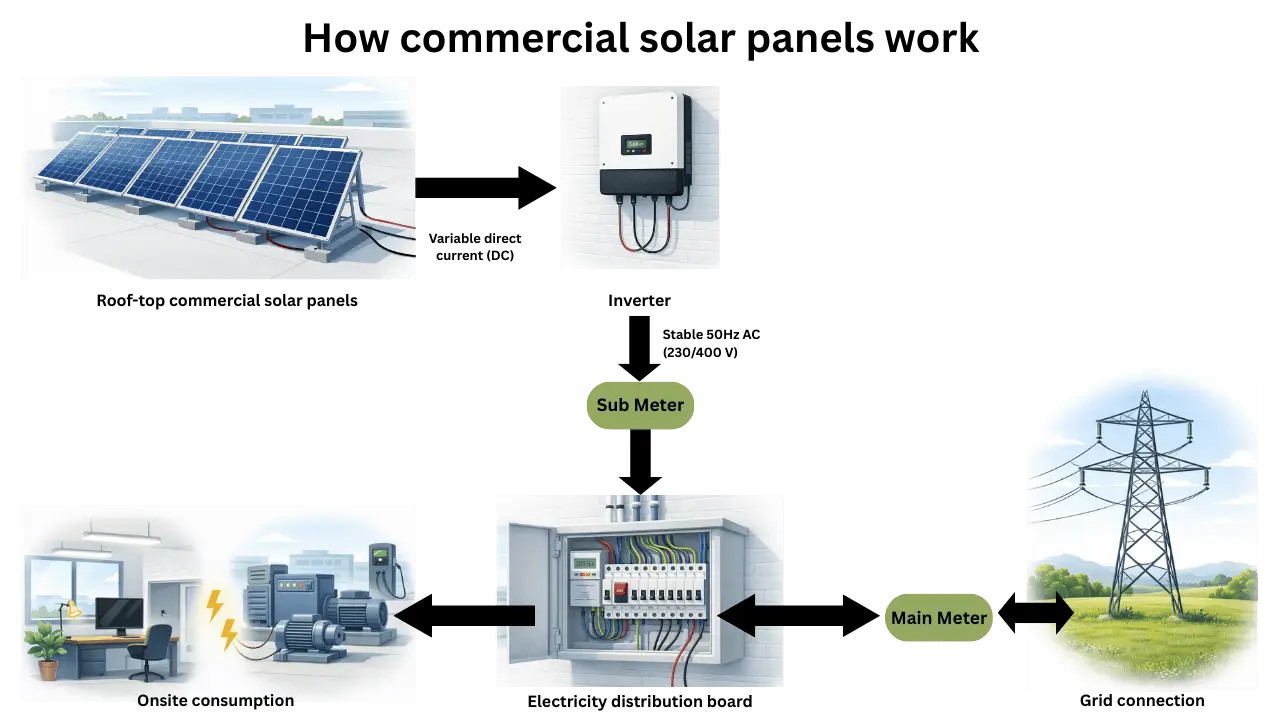
This section explains the component-by-component process by which a commercial solar system generates renewable power, providing an alternative to grid electricity.
1. Solar panel array
Commercial solar panels are typically installed on rooftops or on unused land. A racking system is used to hold the panels in place and tilt them in a south-facing direction to maximise exposure to sunlight.
Solar absorption
Solar panels are made from semiconductor materials that convert light energy into an electrical current.
The panels generate direct current DC electricity, with power output varying in real time based on sunlight levels and weather conditions.
Panels connected in strings
The individual panels in a solar array are connected in strings using DC cabling, which combines the power output of the individual panels.
Larger solar arrays have multiple strings that are connected together in a combiner box.
2. Inverter converts the power into alternating current
The collective DC power output from the strings of solar panels is fed into an inverter.
Most devices in a commercial building use alternating current (AC) power. The inverter converts the DC output from the solar panels into AC electricity that can be supplied to an electrical distribution board.
The solar inverter ensures the AC electricity produced has the correct voltage, frequency, and phase configuration to be used safely on site, typically either:
Single-phase electricity distribution:
- Nominal voltage: 230 V AC
- Frequency: 50 Hz
- Phase: Single live conductor + neutral
- Typical applications: Small offices, retail units, workshops, schools, small warehouses
Three-phase electricity distribution:
- Line-to-line voltage: 400 V AC
- Line-to-neutral voltage: 230 V AC
- Frequency: 50 Hz
- Phases: Three live conductors (L1, L2, L3) + neutral
- Typical applications: Factories, large warehouses, data centres, supermarkets.
3. Electricity distribution
Once converted into AC, solar power flows into the building’s electrical distribution system.
By default, solar electricity is used on-site to meet the real-time power demand of devices such as lighting, IT equipment, and machinery.
The next section explains what happens when there is a shortfall or surplus of solar power:
Shortfall of solar power
If the real-time solar output is lower than the site’s electricity demand, the difference is imported from the grid as normal.
The electricity distribution system seamlessly blends solar and grid power.
Surplus of solar power
When solar generation exceeds the building’s real-time demand, the excess can go one of three ways:
- Charge a commercial solar battery – If a battery is installed on site with available capacity, surplus electricity is used to charge it and store solar energy.
- Export to the grid – Excess electricity can be exported back to the grid using a Smart Export Guarantee tariff or a corporate PPA.
- Export limitation – If the local grid operator imposes export capacity restrictions on a commercial site, an export limitation device automatically reduces inverter output to limit grid exports.
Monitoring and control devices
Commercial solar systems typically use a combination of measurement, monitoring, and control devices to maximise the utilisation of solar power.
Electricity meters
Business electricity meters measure the flow of power through different parts of a building’s electricity distribution system.
The following meter types are typically used in buildings with commercial solar panels:
- Main meter – A half-hourly meter or smart meter used to measure the import and export of power from the grid
- Sub-meter – A CT clamp used to measure the power output of the commercial solar panels.
Monitoring software
A cloud-based solar monitoring system receives automatic meter readings, as well as status signals from the inverter and solar batteries.
Using this data, the monitoring system helps verify that the panels are performing as expected and provides alerts for any system faults.
Control system
Sites that use a combination of commercial solar panels and batteries typically use an Energy Management System to control the flow of power between:
- On-site business energy consumption
- Grid export
- Battery charge/discharge
The Energy Management System is configured to use solar power strategically, depending on peak and off-peak periods in a multi-rate business electricity tariff.
Commercial solar panel types
This section explains the different types of commercial solar panels available for new solar installations in the UK.
Monocrystalline solar panels
Monocrystalline solar panels are the most efficient type currently available on the market, with a lifespan of up to 40 years.
The majority of new commercial solar installations in the UK use high-efficiency monocrystalline solar panels.
Polycrystalline solar panels
Polycrystalline panels offer a more affordable alternative and are viable for businesses where space is not a constraint.
These panels are approximately 30% less efficient than monocrystalline panels but are around 20% cheaper per panel.
Bifacial solar panels
Bifacial solar panels are typically monocrystalline photovoltaic panels that generate electricity from both the front and rear sides of the panel.
Unlike standard (monofacial) solar panels, which only capture direct sunlight on the front surface, bifacial panels also capture reflected and scattered light that reaches the rear of the panel from surrounding surfaces.
This additional rear-side generation increases the total energy output of the system without increasing its footprint.
Thin film solar panels
Thin-film solar panels are a low-efficiency but versatile alternative for businesses and can be the best option in several niche cases.
They perform better in conditions with sub-optimal sunlight exposure, so can be installed in a wider variety of configurations, such as vertical walls.
They are also significantly lighter than monocrystalline panels, so can be used on roof spaces where structural capacity is an issue.
Commercial solar panel sizes and dimensions
Standard monofacial and bifacial monocrystalline solar panels used by most UK businesses have the following standardised sizes and dimensions:
- Surface area – 2.0 m²
- Dimensions – 2.0 × 1.0 metres
- Thickness – 30 to 40 mm
- Weight – 20 to 30 kg
The number of solar panels installed on a commercial building is often determined by the amount of roof space available.
Each standard panel requires approximately 2 square metres of space, which is equivalent to around 21.5 square feet.
Commercial solar panel power output
The power rating of a commercial solar panel indicates how much electrical power a panel can produce under standard test conditions.
The table below shows the power ratings of panels typically used by businesses, and their expected power output based on weather conditions and average solar irradiance in the UK.
| Panel type | Typical power rating (Wp) | Average daily output (UK) | Average annual output (UK) | Common use |
|---|---|---|---|---|
| Polycrystalline | 300 – 350 W | 0.7 – 1.0 kWh/day | 270 – 380 kWh/year | Older commercial and domestic systems |
| Monocrystalline | 400 – 450 W | 1.0 – 1.3 kWh/day | 360 – 500 kWh/year | Most UK commercial rooftops |
| Monocrystalline bifacial | 450 – 600 W | 1.3 – 1.7 kWh/day | 480 – 650 kWh/year | Flat roofs, carports, ground-mounted |
In an optimum commercial solar setup, the panels produce approximately the same amount of power as is consumed on site. This is because prices received under the Smart Export Guarantee are significantly lower than import unit prices per kWh, meaning it is generally not cost-effective to generate large amounts of excess electricity.
Here is an approximate calculation for determining the optimal number of standard commercial solar panels:
Using this calculation, a micro business electricity customer consuming 15,000 kWh per year would benefit most from installing 30 commercial solar panels.
Commercial solar panel configurations
Commercial solar panels require a large, sunlight-exposed area for mounting the array.
Here are the three most popular configurations used by businesses in the UK:
Rooftop solar panels
Rooftop solar panels are ideal for warehouses, factories, and schools, which typically have large flat roof surfaces.
On a flat roof, panels are usually mounted at an optimal tilt angle of 10 to 15 degrees to maximise exposure to sunlight.
Businesses with a south-facing sloped roof can mount panels flush with the roof surface.
Ground-mounted solar panels
Businesses with unused open land often choose ground-mounted solar panels.
Solar maintenance is generally easier for ground-mounted solar panels than for roof-mounted systems, but they occupy space that could otherwise be utilised for other purposes.
These systems typically require the preparation of concrete foundations, making installation more expensive.
Solar canopies over carparks
Solar canopies allow car parks to be used as locations for solar panels, while also providing covered parking for employees and customers.
This is a common option for corporate offices and universities with large car parks.
Commercial solar panel rules and regulations
This section summarises the key planning, building, and grid connection regulations associated with commercial solar systems.
Planning permission for roof-mounted commercial solar panels
Most roof-mounted commercial solar panel installations fall under permitted development rules, meaning installations are allowed without the need for planning permission.
The table below explains the permitted development rules for England, Scotland, and Wales:
| Topic | England | Scotland | Wales |
|---|---|---|---|
| Primary legislation | Town and Country Planning (General Permitted Development) (England) Order 2015 – Part 14 | Town and Country Planning (General Permitted Development) (Scotland) Order 1992 (as amended) | Town and Country Planning (General Permitted Development) Order 1995 (as amended) |
| Height restriction | Panels must not protrude more than 200 mm from the roof plane | Panels must not exceed the highest part of the roof (excluding chimneys) | Panels must not protrude more than 200 mm from the roof plane |
| Flat roof rules | Panels must not be higher than the highest part of the roof | Panels must not exceed the highest part of the roof | Panels must not exceed the highest part of the roof |
| Visual impact requirement | Must minimise the effect on the building’s appearance and local amenity | Must minimise visual impact and be sensitively sited | Must minimise the impact on appearance and amenity |
| Listed buildings | Permitted development does not apply. Listed building consent required | Permitted development does not apply. Listed building consent required | Permitted development does not apply. Listed building consent required |
| Conservation areas / protected sites | Permitted development may apply, but stricter scrutiny applies | Permitted development may apply, but additional controls often apply | Permitted development may apply, but restrictions are tighter |
For businesses planning a solar installation, we recommend obtaining a Lawful Development Certificate from the local planning authority. This confirms that the installation qualifies as permitted development, provided it is commenced prior to installation.
Planning permission for ground-mounted commercial solar panels
Most commercial ground-mounted solar installations require planning permission, as they affect land use and have a greater visual impact.
Only very small installations (four standard panels in England) can avoid the need for planning permission.
Local planning authorities assess applications based on land use, visual impact, and environmental considerations.
Following a successful application, ground-mounted systems are typically approved as temporary developments, lasting between 25 and 40 years.
Building regulations for commercial solar panels
Commercial solar installations must comply with UK building and safety standards.
Key considerations include:
- Structural load assessments to ensure the roof can support the additional weight
- Wind uplift calculations, particularly for flat-roof systems
- Fire safety compliance, including safe isolation and access routes
- Electrical safety standards, such as BS 7671 (IET Wiring Regulations)
Grid connection rules
Any solar panels installed at a commercial property with a business electricity connection to the grid must either notify or obtain permission from the local Distribution Network Operator (DNO).
The type of approval required from the DNO depends on the size of the system:
G98 – Small solar systems
Small systems are only required to notify the DNO post-installation where:
- Single-phase grid supply – Less than 3.68 kW (approximately 9 standard panels)
- Three-phase grid supply – Less than 11 kW (approximately 27 standard panels)
The notification process for small systems is called a G98 micro generation application.
G99 – Other solar systems
All other commercial solar systems require a G99 application and specific approval from the local DNO before installation.
Following a review of the electrical schematics and equipment, the DNO issues one of the following outcomes:
- Unconditional approval
- Approval subject to installing an export limitation device
- Approval subject to network reinforcement
If network reinforcement is required, the DNO will provide a cost quotation and timescale for the work required to connect the commercial solar system.
Why businesses invest in commercial solar panels
Commercial solar panels are long-term investments that can generate electricity for over 40 years, degrading at a rate of around 0.5% per year.
An upfront investment in commercial solar panel costs (and associated VAT on commercial solar) can pay for itself through long-term energy cost reductions.
This section summarises the key reasons why businesses invest in commercial solar panels.
💡 Use our commercial solar panel ROI calculator to estimate the payback period for an installation at your property.
Reduce business electricity unit charges
All business energy contracts include a unit charge for each kWh of electricity consumed, and business electricity prices per kWh typically make up the largest portion of commercial energy bills.
In contrast, power generated from solar panels requires only sunlight, providing a cost-free alternative to mains electricity.
When combined with a battery system, solar power can be strategically stored to eliminate electricity consumption from the grid during peak rate periods.
Reduce business electricity standing charges
The output from commercial solar panels enables businesses to reduce their reliance on the grid connection.
Business electricity standing charges scale with the capacity of a site’s connection to the local grid and can be expensive for large commercial properties. Businesses with a large solar panel installation and a solar battery system can request a reduction in their Maximum Import Capacity from their Distribution Network Operator.
Find out how to reduce your Maximum Import Capacity in our guide to maximum demand charges.
Reduce peak rate energy costs
Commercial solar panels can also provide an additional revenue stream for businesses.
When solar panels generate more power than is required on site, the Smart Export Guarantee scheme allows businesses to export excess electricity to the grid, selling it back to a business energy supplier.
For larger solar systems, businesses can export power to the grid by selling solar energy with a PPA.
Find the best import and export electricity tariffs with our business electricity comparison service.
Reduced carbon emissions
The electricity generated by commercial solar panels relies on a renewable energy source, the sun, making it a low-carbon energy source.
In contrast, the national grid relies in part on gas power stations to generate electricity, producing carbon emissions. As a result, commercial solar panels help reduce the carbon footprint of business operations.
Larger businesses must include their carbon emissions in their public Streamlined Energy and Carbon Reporting, so investing in solar panels can enhance their green credentials.
Generating REGOs
Commercial properties with solar panels can generate Renewable Energy Guarantees of Origin (REGOs) for each MWh of electricity they produce.
REGOs registered with Ofgem can be sold to energy suppliers that need to validate their green business energy tariffs. Find out how in our guide to generating and selling REGOs.
Differences between commercial and residential solar panels
The technology used in commercial and residential solar panels is similar. However, the main differences in setup arise due to the larger scale of commercial solar systems.
The table below summarises the key differences between typical commercial and residential solar panels:
| Factor | Residential Solar | Commercial Solar |
|---|---|---|
| Size per Panel | 1.6m x 1m | 2m x 1m |
| Capacity per Panel | 300W – 400W | 400W – 600W |
| Number of Panels | 10 – 20 panels | 50 – 1,000+ panels |
| Total System Capacity | 3 – 8 kW | 30 kW – 1 MW+ |
| Efficiency | 18 – 22% | 19 – 23% (slightly more efficient) |
| Panel Type | Mostly monocrystalline | Monocrystalline & polycrystalline |
| Mounting Options | Roof-mounted | Roof-mounted or ground-mounted |
| Mounting Surface | Sloped roofs | Flat roofs or ground-mounted |
| Installation Complexity | Simple, 1 – 2 days | Complex, may take weeks |
| Structural Considerations | Roof strength checked | Requires load assessments |
| Voltage Output | 230V single-phase | 230V single-phase or 400V three-phase |
| Battery Storage | Optional, small (5 – 20 kWh) | Optional, larger storage systems (50 – 500+ kWh) |
| Cost Range | £5,000 – £15,000 | £30,000 – £500,000+ |
| Financial Incentives | SEG payments available | SEG, corporation tax deduction |
 Back to blog
- Share: