 Our use of cookies
Change of tenancy process for business energy
Moving into new commercial premises, or moving out of your current ones, means applying for a change of tenancy (CoT) for your business energy supply.
It is a straightforward process when handled properly, but missed steps can leave you paying for energy you didn’t use, stuck on expensive deemed rates, or chasing final bills months after you’ve moved on.
We cover:
- What is a change of tenancy?
- Why it matters
- The incoming change of tenancy process
- The outgoing change of tenancy process
- FAQs
What is a change of tenancy in business energy?
A change of tenancy (CoT) is the process of transferring responsibility for a business energy supply from one occupier of premises to another. When a business moves out, and a new one moves in, the energy account at that address needs updating to reflect who is now legally responsible for paying for the gas and electricity used.
The key point to understand is that energy contracts are tied to the property, not to the business. Your tariff doesn’t move with you when you relocate, and you can’t update an existing contract to cover a new address.
The change of tenancy process allows the outgoing business to end its tariff on the date it moves out. Once the CoT has been processed, the incoming occupier can either enter into a new tariff with the existing supplier or arrange to switch to a different one.
You may also see this process referred to as a change of occupier (CoO). Ofgem uses both terms, and suppliers tend to use them interchangeably. They mean the same thing in practice.
Why a change of tenancy matters for business energy
Skipping or mishandling a change of tenancy is one of the most common causes of business energy billing problems. Getting it right protects both the outgoing and incoming parties from costs and disputes that can drag on for months.
The table below sets out what a properly handled CoT achieves, and what tends to go wrong when it isn’t.
| What a CoT does | What happens if it's missed |
|---|---|
| Prevents billing disputes by creating a clean break between accounts, with a confirmed date and meter reading to close one account and open another | Final bills land months after a move, often with disputed usage that's hard to evidence after the fact |
| Stops the outgoing business being charged for energy it hasn't used at the premises | The supplier keeps billing the previous occupier until notified, and recovering those costs involves chasing the landlord or the new occupier |
| Helps the incoming business avoid sitting on expensive deemed rates, which can be 50% to 80% higher than negotiated contract rates | The new occupier stays on deemed rates indefinitely, as suppliers won't set up a contract until the previous account is closed |
| Avoids confusion over who is responsible for the supply at the premises | Any attempt to switch suppliers is rejected outright until the CoT has been processed, locking the business into paying expensive deemed rates. |
The incoming change of tenancy process
Taking on new premises requires setting up your business as the responsible party for the energy supply with the existing supplier. The process is the same regardless of whether you intend to stay with that supplier or switch to a new one afterwards.
1. Identify the current supplier
If you don’t already know who supplies the premises, contact your local gas distribution network for gas, or use the Energy Networks Association’s online lookup for electricity. These will tell you who the current supplier is, so you know who to notify.
The gas lookup will also provide the MPRN, which is the unique identifier for your gas meter.
For electricity, the supplier can provide your MPAN once you contact them. Keep both numbers on file as they’ll be needed for the CoT notification and any future contract setup.
2. Notify the current supplier as soon as possible
Contact the current supplier on or before your move-in date. Most suppliers have a dedicated change of tenancy form or email address for this. The notification, sometimes called a CoT letter, should include:
- Your business name and registered address
- The supply address you’re moving into
- Your move-in date
- Opening meter readings, if available (see step 4)
- A contact name, phone number, and email
3. Submit evidence of occupation
Suppliers typically require proof that you are the new occupier of the premises.
Acceptable evidence usually includes a signed lease or tenancy agreement, a completion statement if you’ve purchased the premises, or a letter from the landlord confirming the tenancy start date.
Some suppliers will accept business rate correspondence as supporting evidence.
4. Take opening meter readings on the move-in date
Read the business gas meter and business electricity meter on the day you take occupation, photograph them with a clear date stamp, and submit the readings with your CoT notification.
Accurate opening readings are what protect you from being billed for energy used by the previous occupier.
Read our guide to submitting energy meter readings for more information about this process.
5. Notify both suppliers if you intend to switch
If you want to switch to a new business energy supplier, the CoT with the existing supplier still has to be processed first. You can run the two in parallel by notifying your chosen new supplier of your intended business energy switch, but the new contract won’t go live until the CoT process is complete.
Once the supplier has your notification and evidence, they will review and either accept it, reject it, or come back with questions, typically within 10 working days. Until the CoT is accepted and a contract is in place, you’ll be billed at deemed rates from your move-in date.
Using a broker for an incoming change of tenancy
If you’re working with a business energy broker, much of the above is handled for you. A broker will typically identify the existing supplier on your behalf, complete and submit the CoT notification, gather and forward the required evidence, and chase the supplier through to acceptance.
You will still need to submit meter readings on your move-in date and supply documents like your lease or completion statement, but the supplier liaison is taken off your plate. Brokers will also usually arrange a new business energy contract to start the moment the CoT is processed, so you minimise the time spent on a deemed energy contract.
Our energy experts can handle the full process for you, from CoT notification through to securing competitive rates on the new premises, with business electricity comparison and business gas comparison options to suit any size of operation.
What happens when you move into a new business premises?
When you take over a premises, the energy supply doesn’t pause for the handover. From the moment you have the keys, any energy used is being recorded against the meter, and you’ll be billed for it from your move-in date onwards. There’s no grace period.
Even if you don’t use any energy, business electricity standing charges and business gas standing charges still apply daily from the day you take over, so the meter is effectively costing you something from day one, regardless of usage.
Until your CoT is processed, the supplier on the meter will charge you at deemed rates. These are the supplier’s default tariff for any business using energy at a premises without a contract, and they are usually significantly more expensive than a negotiated deal.
The clock starts on day one, so the faster you notify the supplier and get a contract agreed, the less you spend at premium rates.
A quick checklist to have ready before move-in day:
- A copy of your signed lease, completion statement, or landlord letter confirming the start date
- A camera or phone ready for dated meter photos
- Your business name, registered address, and a contact email and phone number
- The supplier’s CoT form or email address, if known in advance
Knowing what’s coming means you can move through the formal CoT process quickly and confidently, which is what the next section walks through.
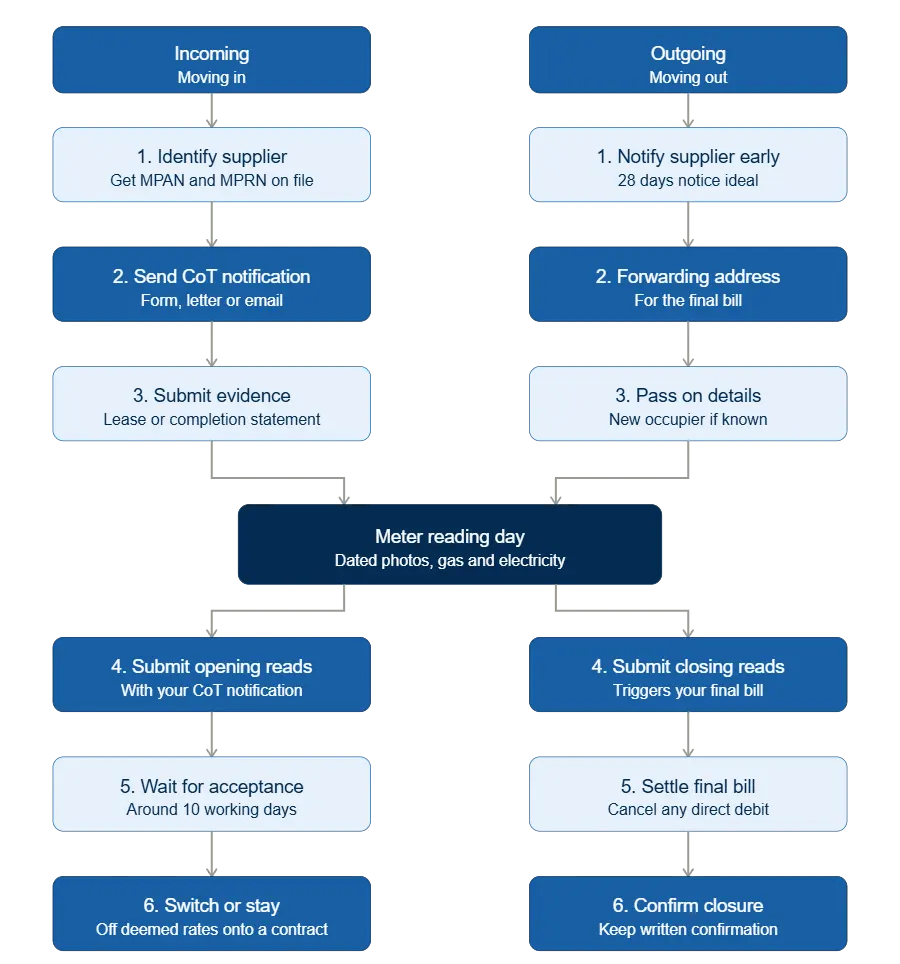
The outgoing change of tenancy process
Closing your account properly when you leave a premises is what protects you from being billed for energy used by the next occupier. The process mirrors the incoming one, but the focus is on ending your responsibility cleanly rather than starting fresh.
1. Notify your supplier in advance
Contact your current supplier as soon as you have a confirmed move-out date, ideally at least 28 days before.
Most suppliers require this notice period in their terms and conditions, and giving them less can complicate matters. Use the supplier’s CoT or change of occupier process, which is usually a dedicated form or email address.
2. Provide a forwarding address for the final bill
Suppliers will send your final bill and any related correspondence to a forwarding address. This can be your new business premises, your registered office, or your accountant. Without one, the bill can end up at the old premises and create issues months down the line.
3. Take closing meter readings on your move-out date
Read both gas and electricity meters on the day you hand back the keys. Photograph them with a clear date stamp and submit the readings to your supplier as soon as possible. These are the readings used to calculate your final bill.
4. Pass on the incoming occupier’s details if you have them
If you know who’s taking over the premises, we recommend sharing their business name and contact details with your commercial electricity or business gas supplier.
This isn’t always available, especially with landlord-managed premises, but it speeds up the supplier’s own records and reduces the risk of any overlap on your account.
5. Settle the final bill
Once the supplier has processed your closing readings, they’ll issue a final business electricity bill and business gas bill covering usage up to your move-out date. Pay this promptly and keep written confirmation that the account is closed.
If you’re working with a broker, they’ll typically handle the supplier notification, submit your closing readings on your behalf, and chase the final bill through to settlement. You’ll still need to take and supply the closing readings yourself.
What happens when you move out of your old premises?
Your responsibility for the energy supply ends when the supplier has accepted your move-out date, your closing meter readings, and any evidence they require. Until that point, the account remains in the name of your business regardless of whether you’ve physically left the premises.
One of the practical benefits of a properly processed CoT is that it ends your contract at the old premises without triggering any exit fees, even if you’re partway through a fixed term. Energy contracts are tied to the meter, so vacating the premises and completing the CoT is treated as a natural end to your tariff rather than an early termination.
How long this acceptance takes is entirely supplier-dependent. Some confirm within a few working days of receiving your final readings, others can take several weeks to issue the final bill, particularly if there’s any query over the readings or the move-out date.
A few things tend to happen during this window that are worth knowing:
- Any direct debit will keep running unless you cancel it once the final bill is settled
- If the new occupier doesn’t go through their own CoT, the supplier may try to keep the account open in your name, which is why your evidence and forwarding address matter
- Final bills can arrive weeks or even months after you’ve left, so we recommend retaining your closing reading photos and CoT correspondence.
Following up regularly and keeping a written record of every contact is what gets the account formally closed. Don’t assume silence from the supplier means it’s done. The point of finality is the written confirmation, not your move-out date.
Change of tenancy disputes and delays
Even with everything submitted correctly, change of tenancy applications don’t always run smoothly. Knowing what to do when something goes wrong and when to escalate makes the difference between a problem resolved in days and one that drags on for months.
When the supplier asks for more evidence
The most common cause of CoT delays is the supplier coming back with a request for further evidence. This usually means the lease wasn’t signed, the landlord’s letter wasn’t dated, or the business rates correspondence is still in the previous occupier’s name.
Respond quickly with whatever the supplier is asking for, send it through the same channel as the original application, and ask for written confirmation that the file is now complete.
When the supplier misses its review window
Suppliers typically aim to review CoT applications within 10 working days, though this is industry convention rather than a regulated deadline. If you’ve heard nothing within that window, follow up in writing, reference your original submission date, and ask for a specific completion timeline.
Keep every reply. If the supplier continues to delay without a clear reason, you have grounds to raise a formal complaint.
When the previous occupier hasn’t closed their account
Incoming occupiers occasionally find that a CoT can’t be processed because the outgoing party hasn’t notified the supplier they’ve left. The supplier should still be able to open your account using your evidence and meter readings, but in some cases they’ll insist on closing the previous account first.
If that happens, ask the supplier to escalate internally, provide as much evidence of your occupation as possible, and request that you not be left on deemed rates beyond a reasonable timeframe while their internal process catches up.
When a final bill arrives late
For outgoing tenants, late final bills are a known pressure point. Ofgem’s back-billing rules limit suppliers to charging for energy used in the previous 12 months only, provided the supplier was at fault for not billing sooner. It’s worth flagging that this protection applies to domestic customers and micro business energy customers specifically, not to larger businesses.
If a final bill lands more than a year after your move-out date and you submitted closing readings on time, you can challenge any portion that falls outside the 12-month window.
When meter readings are disputed
Suppliers sometimes question opening or closing readings, particularly if they sit well outside historic usage at the premises. This is where dated meter photos prove their worth.
Submit them with the original notification, keep the originals, and if a reading is challenged, provide the photo evidence and ask the supplier to either accept the reading or arrange for a meter inspection at their cost.
Raising a formal complaint
If a CoT issue isn’t resolved through normal contact, raise a formal business energy complaint with the supplier in writing. Suppliers have eight weeks to resolve a complaint or issue a deadlock letter, which confirms they cannot resolve the issue further. If you receive a deadlock letter, you can escalate immediately rather than waiting the full eight weeks.
After eight weeks, or once you have a deadlock letter, you can take the complaint to the Energy Ombudsman, which handles disputes between businesses and energy suppliers free of charge. The Ombudsman’s decision is binding on the supplier but not on you, so accepting it is your choice.
Change of tenancy – FAQs
Below, we answer the most commonly asked questions about change of tenancies.
Can you transfer your current energy deal to your new premises?
No. Energy contracts are tied to the meter at a specific premises, not to your business. When you move, your existing contract ends at the old address and a new one needs to be set up at the new address. You can stay with the same supplier if you want to, but it will be a separate contract on different terms.
What is the process for CoT if it’s a new build premises?
A brand new premises that has never had an energy supply isn’t a CoT at all, it’s a new business electricity connection or new business gas connection.
You’ll need to contact the local distribution network operator to arrange the physical connection and meter installation, which can take weeks or months depending on the work required.
Once the connection is live, you’ll then go through the supplier setup process to agree a contract.
Can I be billed for energy used before I officially took over the premises?
No, provided you have evidence of your move-in date and your opening meter readings. The opening reading is the dividing line. Anything used before that point is the previous occupier’s liability, and dated meter photos are what protect you if there’s any dispute.
If a supplier tries to bill you for usage before your move-in date, we recommend sending them your photographic evidence of meter readings and the move-in date confirmed in your CoT submission.
Can a change of tenancy be backdated if it wasn’t reported on time?
Yes, suppliers will usually backdate the CoT to your actual move-in or move-out date if you have evidence to support it. The lease, completion statement, or landlord letter will typically be enough.
Without evidence, the supplier may use the date the CoT was reported instead, which can mean being billed for periods you weren’t responsible for. The longer the delay, the harder backdating becomes, so report the CoT as soon as you can.
Can a landlord manage the change of tenancy on behalf of a business tenant?
A landlord can submit the CoT notification on a tenant’s behalf, but the contract for the energy supply still sits with the business occupying the premises. Landlords don’t normally take on the energy account themselves unless the premises is genuinely vacant or the lease is structured with electricity and gas included in the rent.
Where a landlord does handle the notification, the tenant should still hold copies of the meter readings, evidence submitted, and any supplier correspondence.
What happens if multiple businesses operate from the same premises?
If the premises have a single meter, only one business can hold the energy contract for that supply. The businesses involved need to agree between themselves who holds the account and how the costs are split, with that arrangement managed privately rather than through the supplier.
If the premises have separate meters for each unit, each business goes through its own CoT independently for its own meter. Check the meter setup early on, as assumptions about shared or separate supplies can cause billing problems later.
 Back to blog
- Share: