 Our use of cookies
Business energy brokers: A practical guide for businesses
Choosing the right energy contract can be challenging for businesses, especially with constantly changing prices and supplier offers.
Business energy brokers act as intermediaries between companies and energy suppliers, helping organisations find suitable electricity and gas deals.
In this guide, we explain how business energy brokers work, what they offer, and when using one may be worthwhile.
What is a business energy broker?
A business energy broker, also known as a third-party intermediary (TPI), is a private company that helps businesses source, compare, and arrange business energy contracts with licensed business energy suppliers.
Rather than supplying energy themselves, brokers focus on supporting the procurement stage.
Business energy brokers sit between companies and suppliers during the purchasing and renewal process. They act as advisors and facilitators, helping businesses navigate a complex market and understand available options.
In practice, brokers support businesses by:
- Reviewing contracts and consumption data
- Comparing business energy prices across suppliers
- Managing negotiations and renewals
- Helping to arrange the switch to your new supplier
What a business energy broker does not do
A common misunderstanding is how much control brokers have over commercial electricity and business gas prices.
While they can help you access competitive offers, they do not set underlying wholesale electricity or wholesale gas prices or network charges. The wider energy market and regulatory system determine these.
Business energy brokers are also not responsible for:
- Physical business electricity meter installations or upgrades
- Billing customers and taking payment
- Fault repairs and outages
- Supplier credit checks and approvals
These responsibilities sit with licensed energy suppliers and network operators.
As a result, the main value of business energy brokers lies in market insight, contract comparison, and negotiation support, rather than day-to-day account management.
What services do commercial energy brokers offer?
While most business energy brokers follow a similar process when arranging contracts, the services they provide can vary depending on the size of the brokerage and the needs of their clients.
The sections below summarise the core and additional services typically offered by business energy brokers.
Core services offered by most energy brokers
The majority of business energy brokers provide the following core services:
- Contract sourcing and comparison: Brokers review available tariffs from multiple suppliers and identify suitable options based on your usage, contract length preferences, and budget.
- Negotiation with suppliers: Many brokers negotiate pricing and commercial terms on behalf of businesses, particularly for large business energy users or multi-location organisations.
- Contract management and renewals: Brokers monitor contract end dates and contact businesses ahead of renewal to help them avoid expensive out-of-contract rates.
- Switching suppliers: Brokers handle the paperwork involved in moving between suppliers, helping to reduce delays and administrative errors.
- Usage and billing reviews: Some commercial energy brokers review business electricity bills, business gas bills and consumption data to identify unusual charges, errors, or inefficient usage patterns.
Additional and specialist services
Alongside standard contract support, some business energy brokers offer more specialised services. These may include:
- Business energy audits and efficiency assessments
- Support with multi-site business energy management
- Advice on fixed, flexible, and pass-through contracts
- Carbon reporting and environmental data support
- Assistance with metering upgrades or smart meters
These services are more common among energy consultants who specialise in working with energy-intensive businesses.
Should I use a business energy broker or go directly to business energy suppliers?
When arranging a business energy contract, companies usually have two options: work with a business energy broker or deal directly with energy suppliers. Both approaches can work, depending on your size, resources, and experience with energy procurement.
The table below compares the two routes to help you decide which is more suitable for your business.
| Area | Using a business energy broker | Going direct to a supplier |
|---|---|---|
| Price comparison | Broker compares multiple suppliers at once | Your business must contact each supplier separately |
| Admin and organisation | Broker manages most of the process | Your business manages the process |
| Market knowledge | Access to specialist whole market insight | Limited to information from one supplier |
| Access to tariffs | Wider range of commercial offers | Restricted to that supplier’s products |
| Contract negotiation | Often supported by the broker | Handled directly by your business |
| Switching process | Coordinated by the broker | Coordinated by your business |
| Paperwork and setup | Broker supports contract and switching admin | Your business handles supplier paperwork |
| Ongoing account service | Supplier handles billing and faults, broker may support renewals | Supplier handles billing and service |
| Renewal support | Often includes reminders and market comparison refreshes | Will provide you with one renewal offer |
| Fee structure | Commission or service fee may apply | No broker commission, although a supplier rates may not be competitive |
For very small businesses with simple requirements and stable usage, going direct can be a practical option. It allows you to work with one supplier from the outset and manage the relationship yourself.
However, many businesses choose to use commercial energy brokers for faster comparisons, clearer guidance, and structured support during renewals and contract changes.
How business energy brokers make money
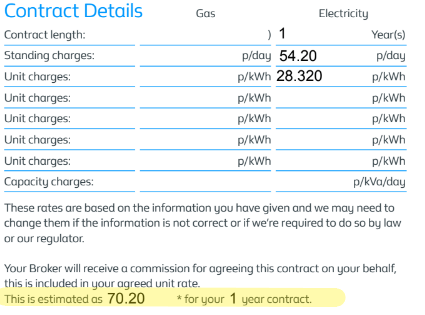
Most business energy brokers are paid through commissions built into the electricity or gas rates in your contract. Instead of charging businesses a separate fee, the broker’s payment is usually included within the unit price per kWh of your contract and will be paid by your supplier.
Since October 2024, Ofgem has required all non-domestic energy contracts to clearly display broker fees within the contract’s principal terms. This rule was introduced to improve transparency and help businesses understand exactly how much they are paying.
For example, a contract may include wording such as:
“Broker fees: X.XXp per kWh is included in the total energy cost.”
The example below shows how broker commission may be displayed in a business energy contract.
How do business energy brokers work?
Most business energy brokers follow a structured procurement process, starting from your initial enquiry through to your new contract going live.
Below are the typical steps:
1. Contact a broker
The process usually begins when you contact a broker to discuss your current contract, renewal date, and general requirements. At this stage, you may explain whether you are looking for lower costs, budget certainty, flexibility, or longer fixed contracts.
The broker should also outline their service model, how they are paid, and what level of support they provide.
2. Provide key information
The broker will ask for key details so suppliers can produce accurate quotes. This typically includes your business address, current supplier, contract end date, and recent bills. For electricity and gas, they may also request your MPAN and MPRN.
Recent bills also help brokers understand your business energy consumption, as well as how much you currently pay in business electricity standing charges and business gas standing charges.
Providing complete and accurate information at this stage helps avoid delays later in the process.
3. Sign a Letter of Authority (LOA)
Brokers typically request a Letter of Authority (LOA) to approach suppliers and manage parts of the procurement process on your behalf.
An LOA allows the broker to:
- Request quotes from suppliers
- Access usage information
- Manage the switching process
The LOA does not commit you to a new contract. It simply gives the broker permission to act on your behalf.
A properly drafted LOA should also make clear:
- Which sites are covered
- What the broker is authorised to do
- How long does the authorisation lasts
- How can it be cancelled
4. The broker requests quotes
Once authorised, the broker contacts relevant licensed suppliers and requests tailored pricing based on your usage and contract preferences.
This may include specific contract terms and payment options, depending on your business needs.
5. Review your quotes
The broker presents suitable offers and explains how the contracts differ. This should cover unit rates, standing charges, contract length, key conditions, and any pass-through charges.
A good broker will clearly explain:
- How prices are structured
- What commission has been added
- Renewal and termination terms
6. Select a deal and switch
After you choose a contract, the broker works with your new supplier to arrange your switch. Once confirmed, your broker will confirm the start date of your new tariff.
For more information on this part of the process, visit our guide to switching business energy suppliers.
7. Supply goes live
When the contract goes live, the supplier becomes responsible for billing, metering, and customer service.
Depending on the broker’s service model, they may continue to provide renewal support and contract reviews, but they do not manage day-to-day queries you may have with your supplier.
Are business energy brokers regulated in the UK?
For many UK businesses, regulation is a key trust issue when working with energy brokers. Common concerns include unclear commission, aggressive sales practices, limited complaint routes, and confusion over responsibility between brokers and suppliers.
At present, business energy brokers are not directly regulated. However, the UK government and Ofgem are planning direct licensing and regulation of TPIs in the energy industry.
The current regulatory position
There is currently no formal licensing system for business energy brokers. However, suppliers must follow specific rules when working with brokers, particularly for small and microbusiness customers.
These requirements include:
- Brokers must operate under a signed Letter of Authority before acting on a customer’s behalf.
- Small business customers must have access to Alternative Dispute Resolution through an approved ADR scheme.
- Broker commission must be disclosed within the contract documentation.
- Suppliers must take responsibility for ensuring broker activity meets regulatory standards.
What the planned regulatory framework is expected to change
In its 2025 response to the TPI consultation, the Government confirmed its intention to introduce direct regulation of energy intermediaries.
While implementation timelines have not yet been finalised, the proposed framework is expected to introduce:
- Mandatory registration for brokers and TPIs with Ofgem
- Clear conduct standards covering transparency and sales practices
- Formal compliance monitoring and enforcement powers
- Stronger business energy complaints handling and access to redress
The aim is to create consistent minimum standards across the sector, rather than relying on voluntary schemes or supplier oversight alone.
What this means for businesses
Until direct regulation is introduced, businesses remain responsible for carrying out their own checks when choosing a broker. This includes reviewing commission disclosures, understanding contract terms, and confirming how complaints are handled.
Over time, the introduction of statutory oversight should improve consistency, accountability, and confidence in the broker market. However, these changes are likely to take several years to fully implement.
In the meantime, transparency, documentation, and clear communication remain the most reliable indicators of broker quality.
How to check if a business energy broker is trustworthy
Because business energy brokers are involved in arranging long-term contracts, choosing a reliable and transparent intermediary is important. While many brokers operate professionally, standards vary across the market, which makes it worth checking a few key signals before committing.
1. Check how clearly fees and commissions are explained
A trustworthy broker should be open about how they are paid and explain this clearly from the outset. While broker commission must now be included within contract documentation, good brokers will also explain it verbally and show you exactly where it appears in the paperwork.
You should feel confident about how fees affect your unit rates and overall costs before agreeing to anything, rather than having to search through contract terms later.
2. Review the contract paperwork carefully
Reputable brokers provide full written quotes, principal terms, and supplier contracts before you agree to anything. This gives you time to review pricing, contract length, and conditions without pressure.
3. Look for a clear complaints process
Reliable brokers have a formal procedure for handling complaints and explain how issues can be escalated if needed. Many established brokers are linked to recognised dispute resolution schemes, which gives businesses additional protection.
4. Check how many suppliers they work with
Brokers with access to a wide range of electricity and gas suppliers are more likely to offer balanced recommendations. A very limited supplier panel can sometimes indicate restricted choice.
5. Read reviews from other businesses
Customer feedback can provide useful insight into how a broker operates in practice. Reviews often highlight whether pricing is transparent, communication is clear, and support continues after a contract is signed.
6. Ask about ongoing support
Some brokers focus mainly on securing an initial deal, while others offer renewal reminders, energy usage reviews, and contract monitoring. Ongoing support can be valuable, particularly for businesses with multiple sites or complex contracts.
Taking time to check these areas can help you identify business energy brokers who prioritise transparency, accountability, and long-term relationships over short-term sales.
Common problems businesses face with energy brokers
While many business energy brokers provide professional and transparent service, some businesses report problems when expectations are unclear or when standards are not met.
Understanding the most common issues can help you avoid difficulties and make more informed decisions.
Hidden commission and unclear pricing structures
One of the most common complaints involves broker fees being built into unit rates without a clear explanation. Some businesses only realise how much commission is included after reviewing detailed contract terms. Although disclosure rules have improved transparency, it is still important to check how pricing is structured.
Long-term contracts with higher than expected costs
Some businesses agree to multi-year contracts without fully understanding how broker uplift affects costs over time. A small increase per kWh can add up to thousands of pounds across a three to five-year term. If this is not clearly explained at the outset, companies may later find themselves stuck in overpriced agreements with limited exit options.
Limited support after the contract is signed
A frequent issue is poor after-sales service. Some brokers focus mainly on securing the initial deal and offer little help with billing disputes or contract changes. This can leave businesses feeling unsupported once the contract is active.
Confusion over broker and supplier responsibilities
Many businesses are unclear about where the broker’s role ends and the supplier’s role begins. Brokers arrange contracts, while suppliers manage billing, meters, and faults. When this is not clearly explained, problems can be passed between parties, causing delays.
Difficulty exiting unsuitable contracts
Business energy contracts are legally binding and often expensive to exit early. Some businesses only become aware of termination fees or restrictive terms after signing, limiting their flexibility if circumstances change.
Pressure selling and restricted choice
Some businesses report being encouraged to make quick decisions without enough time to review alternatives. This may happen when a broker works with a limited supplier panel or prioritises certain deals, reducing the range of options presented.
How to choose the right business energy broker
At Business Energy Deals, we only work with trusted, highly rated brokers through our business electricity comparison and business gas comparison services, helping businesses access competitive, transparent offers from reliable providers.
Before committing, it is worth asking a potential broker a few direct questions:
How are you paid?
Ask whether commission is built into unit rates, charged as a separate fee, or structured in another way. Understanding this upfront makes it easier to assess overall value.
Which suppliers do you work with?
Some brokers have broad supplier panels, while others work with only a small number of providers, or with providers that offer them preferential commission or payment terms. A broader panel usually means more choice, but a smaller panel is not necessarily a problem if pricing and service are competitive.
Do you offer support after the contract is signed?
Clarify whether the broker provides renewal reminders, billing support, and contract reviews, or whether their involvement ends once the deal is agreed.
How do you compare and present deals?
Ask how quotes are selected and ranked. This helps you understand whether recommendations are based on value, suitability, or commercial arrangements.
What contract lengths do you usually recommend?
Understanding whether a broker favours short, medium, or long-term contracts can help you assess whether their approach aligns with your budgeting and risk preferences.
Business energy brokers | FAQs
Below are answers to some of the most common questions businesses ask about energy brokers.
What is the difference between a business energy broker and an energy consultant?
Business energy brokers and energy consultants both support companies with energy management, but their roles are different.
A business energy broker:
- Acts as an intermediary between businesses and suppliers
- Focuses on sourcing and securing energy contracts
- Is usually paid through commission
- Works with multiple suppliers to compare deals
An energy consultant:
- Provides strategic and efficiency-focused advice
- Supports long-term energy planning
- Typically directly charges a fee for services
- May advise on compliance and reporting
Should I choose a business energy broker or an energy consultant?
A business energy broker is usually the best option if you want help comparing suppliers, securing competitive rates, and managing the switching process.
An energy consultant is more suited to larger organisations that need wider support, such as reducing consumption, improving business energy efficiency, and developing long-term energy strategies.
If your main priority is arranging or renewing an energy contract, a broker is normally the more practical choice.
How much does a business energy broker charge?
There is no standard fee structure across the industry. In most cases, businesses do not pay brokers directly.
Instead, broker commission is usually included as an uplift within the unit business electricity price per kWh and paid by the supplier. This means you will not receive a separate invoice, but the cost is built into your contract.
Commission levels can vary between brokers, which is why transparency around pricing and contract terms is important.
How many energy brokers are there in the UK?
According to the most recent Energy Ombudsman Broker Register data, there are around 2,017 active business energy brokers operating in the UK.
This number changes over time as new brokers enter the market and others exit. Because standards and service levels can vary, it is important to assess individual brokers rather than relying on market size alone.
Checking whether a broker is registered with a recognised complaints or redress scheme can help confirm their credibility.
 Back to blog
- Share: