 Our use of cookies
Maximum demand: Capacity and excess capacity charges
Commercial properties with half-hourly meters pay capacity charges based on the highest level of demand they place on the local electricity network.
This guide explains Maximum Demand and Maximum Import Capacity for business properties, and how these are used to calculate capacity and excess capacity charges on electricity bills.
You can explore the key parts of the guide using the links below:
- Maximum Demand – The highest amount of electricity consumed by your business in any 30-minute interval, as recorded by a half-hourly meter.
- Maximum Import Capacity – The highest demand your business can draw from your electricity connection, as agreed with the local grid operator.
- Capacity Charges – A monthly fixed charge to guarantee the availability of your Maximum Import Capacity.
- Excess Demand Charge – An additional penalty charge applied if your Maximum Demand exceeds your agreed Maximum Import Capacity.
What is maximum demand?
Maximum demand in business energy contracts refers to the highest recorded power consumption, measured in kVA, in any 30-minute period during an entire billing month.
The sections below explain how kVA power consumption is measured and calculated.
kVA power consumption in 30-minute period
Power consumption in kVA is a measure of the total power drawn from a grid connection, and is the combination of:
- Active power consumption – This is the useful power consumed by your business, as measured in kWh.
- Reactive power consumption – The non-working component of electrical power, measured in kVAr.
A half-hourly electricity meter measures both components and automatically sends readings of total power consumption in kVA every 30 minutes.
💡 Reactive power typically accounts for less than 5% of overall power demand for most commercial properties with a reasonably efficient electrical system.
Maximum demand calculation
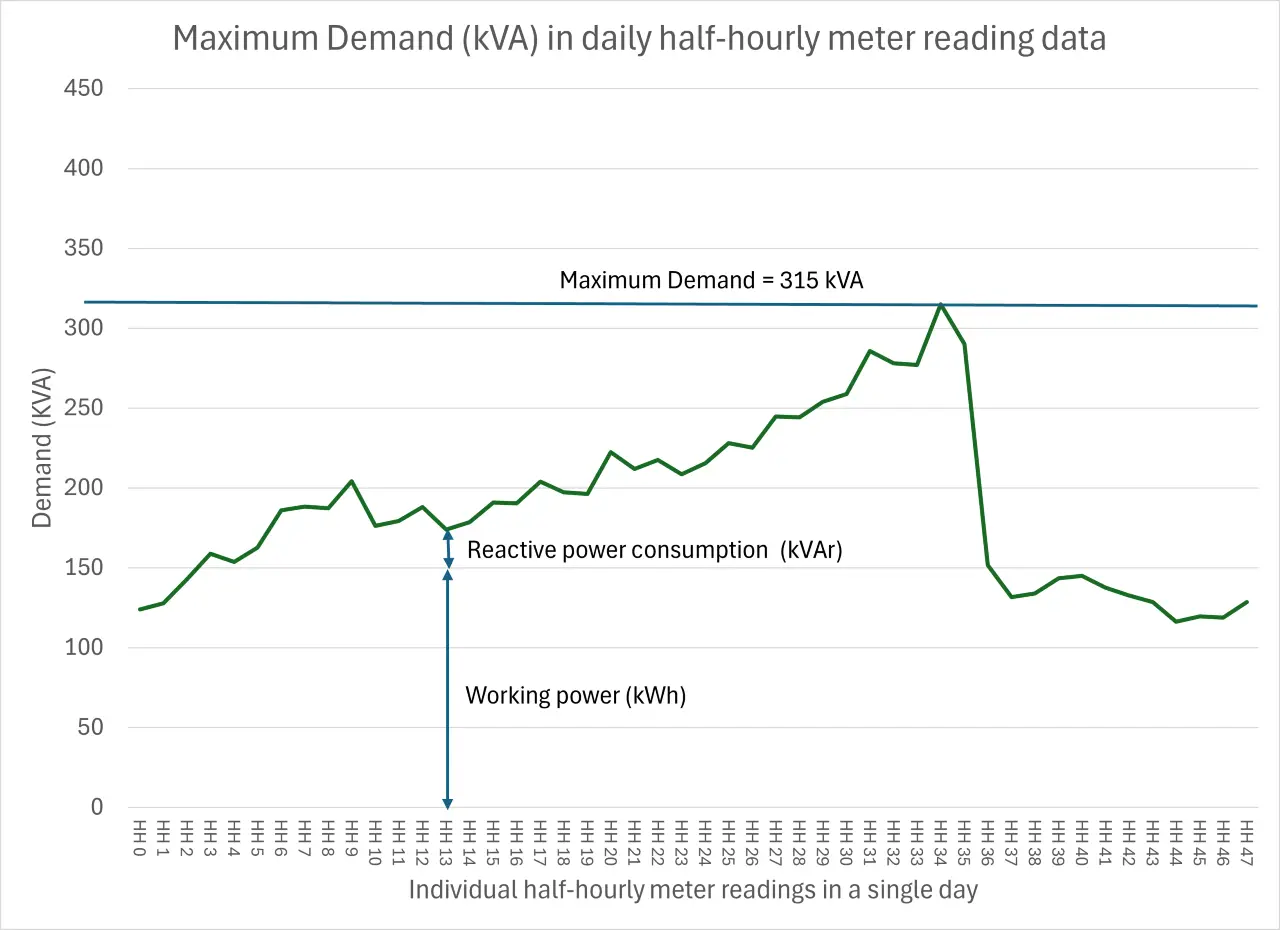
To calculate maximum demand, your business energy supplier looks at the power consumption, in kVA, of each 30-minute interval recorded during an entire billing month.
The maximum demand is the single highest recorded 30-minute kVA demand for that month.
The graph below shows how Maximum Demand is calculated during a single day of half-hourly meter readings.
Maximum Import Capacity
Maximum Import Capacity (measured in kVA) is the upper limit on how much power your business is allowed to draw from the grid, as agreed with your local distribution network operator.
A grid operator uses Maximum Import Capacity to manage local power demand by dividing the available network capacity between nearby properties.
A network operator will always guarantee that there is enough network bandwidth for your business to draw power up to the Maximum Import Capacity.
Capacity charges are applied monthly in proportion to your agreed Maximum Import Capacity.
If your actual Maximum Demand exceeds your agreed Maximum Import Capacity, then your business will need to pay excess capacity charges.
How to find your Maximum Import Capacity
The Maximum Import Capacity of your connection can typically be found on a recent business electricity bill for your property. It is always expressed in kVA, e.g. 69 kVA, 200 kVA, etc.
Other names for Maximum Import Capacity include Available Supply Capacity (ASC) and Maximum Power Requirement (MPR).
Alternatively, you can contact the customer services department of your energy supplier, meter operator, or regional distribution network operator.
How to change Maximum Import Capacity
When you set up a new business electricity connection, you agree on a Maximum Import Capacity with your distribution network operator.
The initial Maximum Import Capacity of your connection can be changed by contacting your distribution network operator, as follows:
Decrease in Maximum Import Capacity
A decrease in Maximum Import Capacity is usually free and will reduce your monthly capacity charges. The released capacity will be made available to other connections on the network.
Local grid operators cannot guarantee the availability of additional or relinquished capacity, so it’s crucial not to release capacity your business may need in the future.
Increase in Maximum Import Capacity
An increase in Maximum Import Capacity requires an application and will increase your monthly capacity charges.
An increase requires there to be sufficient available bandwidth in your local area and may require your business to pay for network reinforcement upgrades.
Application to change Maximum Import Capacity
To change the Maximum Import Capacity of your connection, you will need to provide the following details:
- Company information
- Site address
- MPAN
- Existing capacity (kVA)
- Proposed capacity (kVA)
- Letter of Authority (if your business energy broker is doing this on your behalf)
💡 Maximum Import Capacity can only be changed once every 12 months.
How to choose a Maximum Import Capacity
When changing the Maximum Import Capacity of your business electricity connection, it is vital to consider both current and future power requirements.
Current demand requirements can be assessed by reviewing your half-hourly meter data for Maximum Demand recorded over the past year.
The Maximum Import Capacity should also take into account long-term expected power requirements. You should set the Maximum Import Capacity so that your electricity demand is never expected to exceed it.
Capacity charges
Capacity charges are levied by your distribution network operator to guarantee the Maximum Import Capacity of commercial properties with a half-hourly meter.
Capacity charges typically range between 120p and 330p/kVA of available capacity each month, depending on your region.
Capacity charges are one element of Distribution Use of System (DUoS) charges, which are applied for using regional low-voltage electricity grids.
How capacity charges work
Capacity charges are levied by local distribution network operators and paid by your business electricity supplier, who will pass these on through your monthly bills.
Your Maximum Import Capacity and the distribution fees from your local distribution network operator determine the capacity charges you pay.
Capacity charges per kVA of available capacity are regulated directly by Ofgem and are updated annually.
💡 Compare business electricity prices today to find out how much you can save on your capacity charges.
Calculating capacity charges
Capacity charges are usually shown separately on business electricity prices for commercial properties with half-hourly meters.
Here’s an example of how the capacity charge is calculated on your business electricity bill:
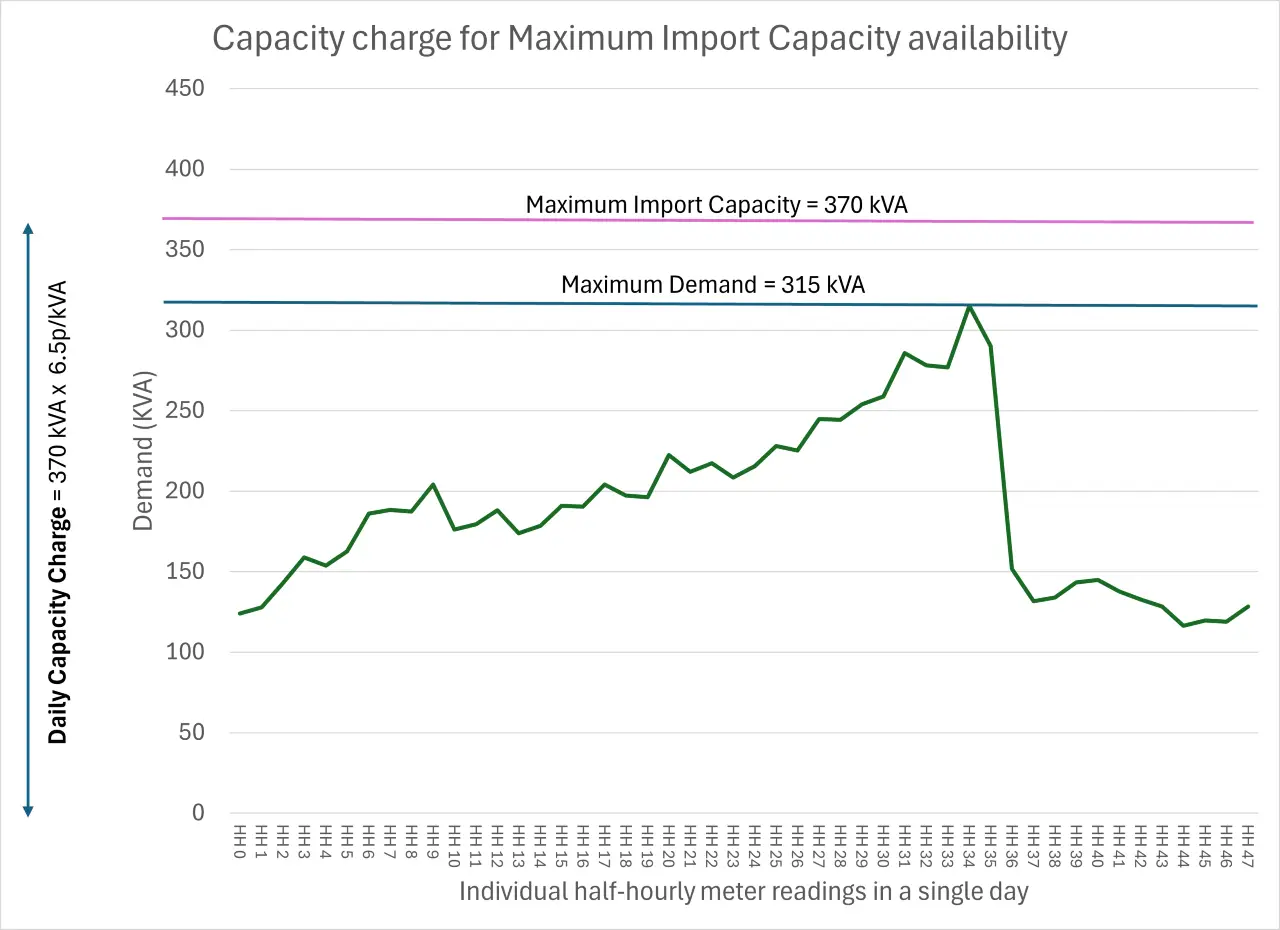
- Maximum Import Capacity: 370 kVA (as agreed with your DNO)
- Capacity charge: 6.5p/kVA/day (as determined annually by Ofgem)
- Monthly capacity charge: £721
The monthly capacity charge is the Maximum Import Capacity multiplied by the unit capacity charge and the number of days in the month.
The graph below shows how a capacity charge is calculated using agreed Maximum Import Capacity.
Excess capacity charges
Excess capacity charges occur in any month when your Maximum Demand exceeds your Maximum Import Capacity.
The excess capacity charge is applied to each kVA of additional demand used and is levied for the entire month in which the Maximum Import Capacity is breached.
Calculating excess capacity charges
An excess capacity charge is calculated as follows:
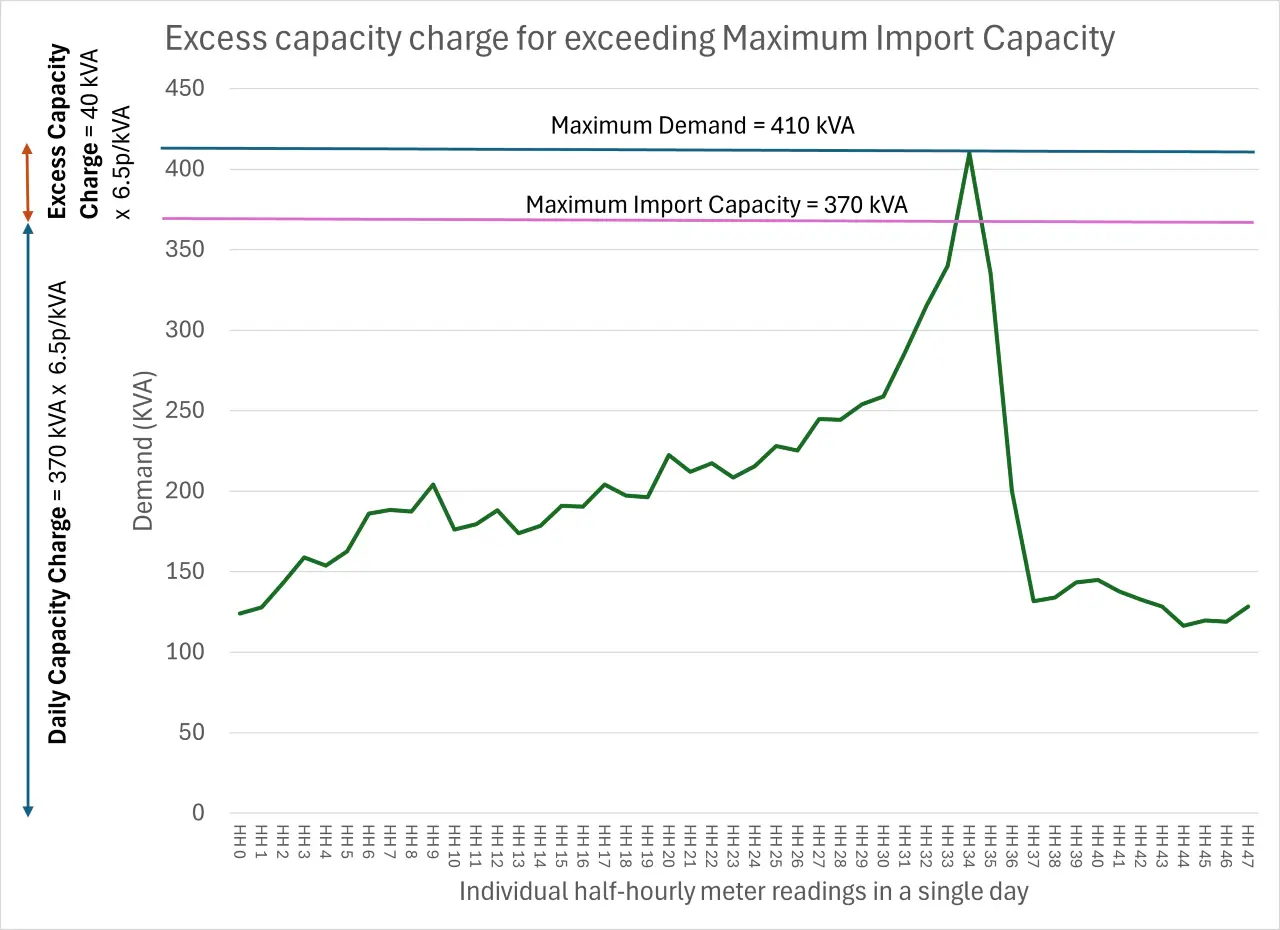
- Maximum Demand: 410 kVA
- Maximum Import Capacity: 370 kVA
- Excess capacity: 40 kVA
- Excess capacity unit charge: 6.5p (pence/kVA/day)
- Excess capacity for the month: £78
The graph below shows how excess capacity is calculated based on Maximum Import Capacity and a Maximum Demand measurement for a single day of half-hourly meter data.
How to avoid excess capacity charges
There are three ways to avoid excess capacity charges:
- Increase your Maximum Import Capacity – See above for the process of applying for additional Maximum Import Capacity from your local grid operator.
- Reduce your Maximum Demand – Improve business energy efficiency to use less energy, or use load management to shift the timing of electricity consumption and reduce Maximum Demand.
- Energy Management System – Use an Energy Management System to control the charge and discharge of commercial solar batteries to optimise peak demand.
 Back to blog
- Share: